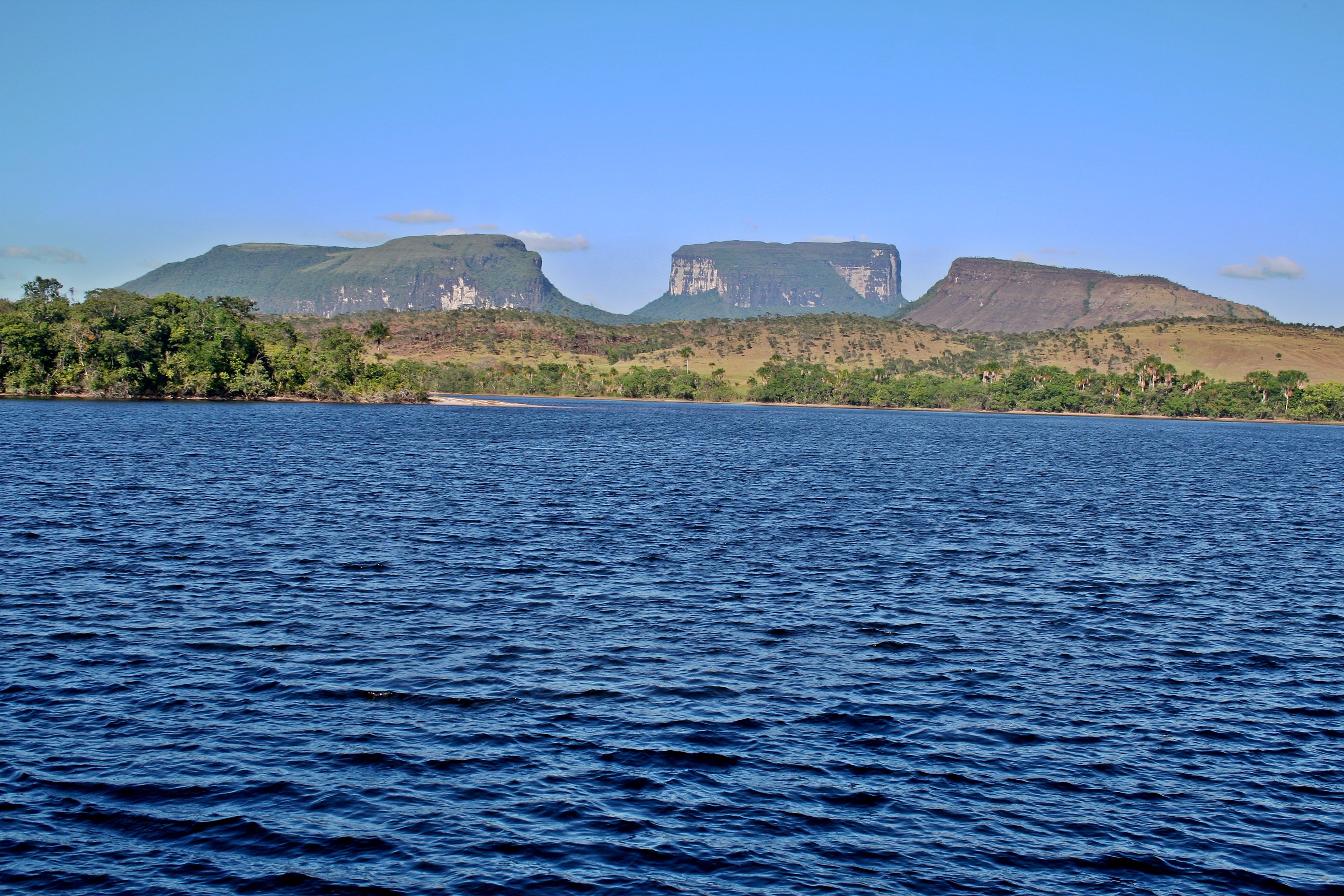
Canaima National Park is a 30,000-square-kilometre stretch of tepui country in the far south of Bolívar state — bigger than Belgium, and one of the largest national parks in the world. It exists primarily to protect the western half of the Guayana highlands: vast tracts of savanna and rainforest broken by the dark, flat-topped sandstone plateaus that gave Conan Doyle his Lost World. About 65 percent of the park's surface is tepui rock, and the cliffs harbour some of the oldest exposed geology on Earth — close to two billion years.
The park splits practically into two halves. The eastern sector overlaps the Gran Sabana, the road-accessible plateau between Ciudad Guayana and the Brazilian border. The western sector — what most travellers mean when they say "Canaima" — is reached only by air, from Ciudad Bolívar or Puerto Ordaz. The small Pemón village of Canaima sits beside the Canaima Lagoon, a tea-coloured lake fed by a row of seven waterfalls (Salto Hacha, Salto Wadaima, Salto Golondrina and others) pouring over a low cliff at one end. From here the boat-and-trek route to Angel Falls starts.
Angel Falls — Salto Ángel, called Kerepakupai Vená by the Pemón — drops 979 metres off the face of Auyán-tepui, the largest of the tepuis. It is the highest uninterrupted waterfall in the world, three times the height of the Eiffel Tower. The standard visit is a small plane to Canaima airport, an overnight in a basic camp by the lagoon, then a six- to eight-hour motorised canoe up the Río Carrao and Río Churún to a base camp at the foot of Auyán-tepui, followed by a steep one-hour walk up to the Mirador Laime. The falls are only reliably full in the wet season (June to November); by February the dry-season trickle is dramatic but thinner.
This is wilderness travel. There is no road in, no fuel station, no mobile signal once you leave Canaima village. Pemón guides run almost every excursion, and operating costs run on US dollars in cash. The Pemón themselves have lived around the tepuis for centuries and consider Auyán-tepui — "Devil's Mountain" — sacred. The park was inscribed as a UNESCO World Heritage Site in 1994 for both its geology and its endemic species, many evolved in isolation on the summit plateaus and found nowhere else on Earth.