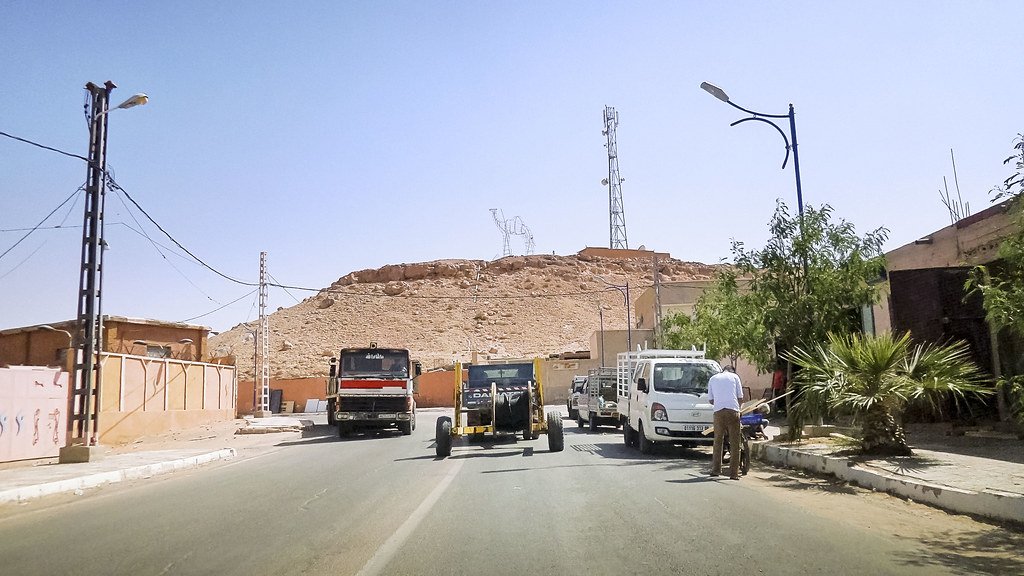
Tindouf
©
Tindouf

Tindouf

Remote western Algerian Sahara town beside Sahrawi camps and the fragmentary remains of an old ksar

Tindouf used to be a small town in the westernmost part of Algeria. Since the outbreak of the conflict in the Western Sahara, it has seen many people from the WS flocking to the city. Most of them live in camps that have the same names as the cities they left behind: Smara, el Ayoune, Dakhla.

Tindouf is rarely visited by tourists. In principle it is on one of the routes crossing the Sahara, since it should be possible to cross from here to Zouerate in Mauritania but I have not heard of anyone doing this. Even when the borders are open, the route itself is hard enough. What's left in town is a fragmentary old ksar buried under the modern grid; the one event worth timing a visit around is the annual Mouggar de Tindouf cultural festival. The surrounding Hammada du Draa is one of the bleakest and most spectacular Saharan landscapes.

Guide

Getting There

The realistic route into Tindouf is by air. Commandant Ferradj Airport, just north of the town, has scheduled Air Algérie flights to and from Algiers and occasional connections to Oran; the flights run several times a week and are heavily booked by government, military, and aid traffic. Reserve well in advance.

Overland travel to Tindouf is possible but slow and bureaucratically complex. The paved road from Bechar runs about 750 kilometres through the open desert; long-distance buses run a few times a week and the journey takes roughly fifteen hours. Foreigners on overland routes need a permis de voyage from the wilaya, arranged in advance through a registered agency. The land border with Morocco west of Tindouf has been closed for decades and is not open to civilians; the border with Mauritania to the south can in principle be crossed (the old route through Zouerate) but is rarely used and politically sensitive. Plan for a flight unless you have very specific reasons not to.

Guide

Things to Do

Tindouf is not a place tourists come to look at things. Almost everyone who passes through is on official business — diplomatic, journalistic, humanitarian, military — and the town's interest is largely sociological rather than scenic. That said, the small original old town survives in fragments behind the modern grid of administrative buildings, and the surrounding Sahrawi refugee camps are one of the longest-running displaced populations in the world and are accessible (with permission) to outside visitors.

The annual Mouggar de Tindouf is the one event for which the town fills up. It is a Saharan cultural festival drawing musicians, poets, dancers, and herders from across the western Sahara, and is the closest thing the place has to a tourist season. Beyond that, the appeal is the desert itself — the Hammada du Draa stone plateau that stretches west toward the Mauritanian border is one of the bleakest and most spectacular landscapes in the Sahara.

A reality check: Tindouf has been politically and militarily sensitive for fifty years. Foreigners must be registered with the authorities on arrival, photography of government buildings is restricted, and travel beyond the wilaya boundary requires explicit permission. Plan accordingly.

Guide

When to Go

Tindouf is brutally hot for much of the year. Visit in the cool half — November through March — when daytime temperatures sit between 18 and 28°C, the nights are cold but tolerable, and the air over the hammada is at its clearest. The Mouggar de Tindouf typically falls within this window and is the practical anchor for a visit.

April and October are transition months and still manageable. May to September is the long Saharan summer: daytime temperatures of 40 to 50°C, occasional sandstorms, and a noticeable slowing of all activity. Aid workers and journalists who must be in the camps year-round arrange their movement around dawn and dusk; outside visitors should simply avoid the summer entirely.