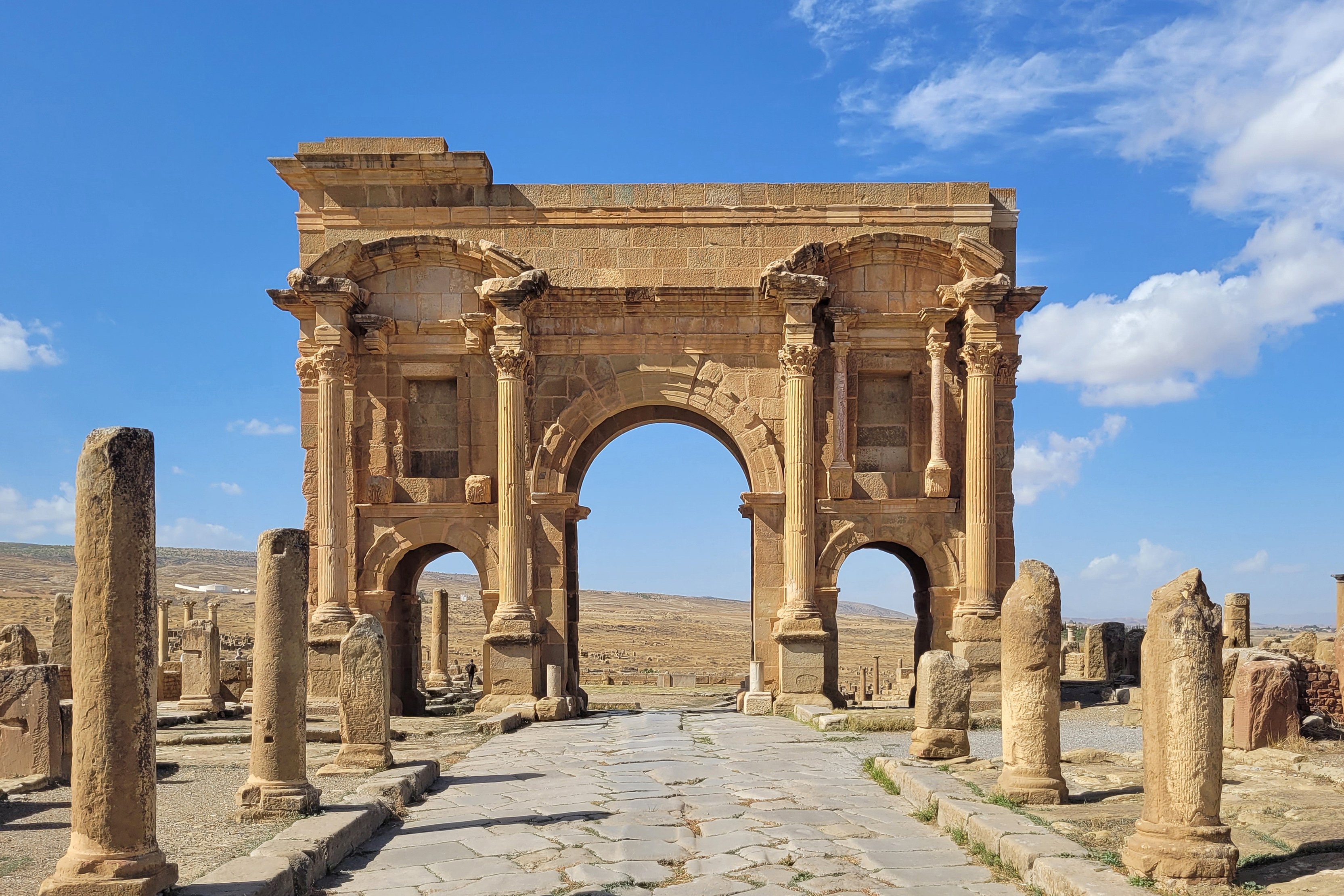
Timgad is one of the finest Roman ruins in Africa — a complete Roman colonial city that was buried under sand for centuries and emerged remarkably intact. Emperor Trajan founded it in AD 100 as a garrison town on the edge of the Aurès Mountains, about 35 km south of Batna. It was designed to keep the Berber tribes in check, though the city that grew up here was thoroughly civilian: forum, theatre, markets, temples, public baths, and thousands of ordinary shops and workshops.
What makes Timgad extraordinary is its grid plan, still legible on the ground. The original town was laid out with a surveyor's precision — streets crossing at right angles, blocks of uniform size — and then grew beyond its walls organically. Trajan's Arch stands at the western end of the main street, still imposing after two millennia. The theatre, seating around 3,500, is well enough preserved that it still hosts performances.
The site sits at 1,000 metres above sea level in a fertile highland basin, which explains both why the Romans chose it and why it was such a prosperous town. Berber raiders sacked it, Arab armies passed through, and eventually the desert wind buried much of it — which is why so much survived. The Timgad Museum on site holds sculpture, mosaics, and everyday objects that bring the city's residents back to life.
Getting here requires your own transport or a negotiated taxi from Batna. The roads are fine and the drive through the Aurès scenery is worth it in itself.