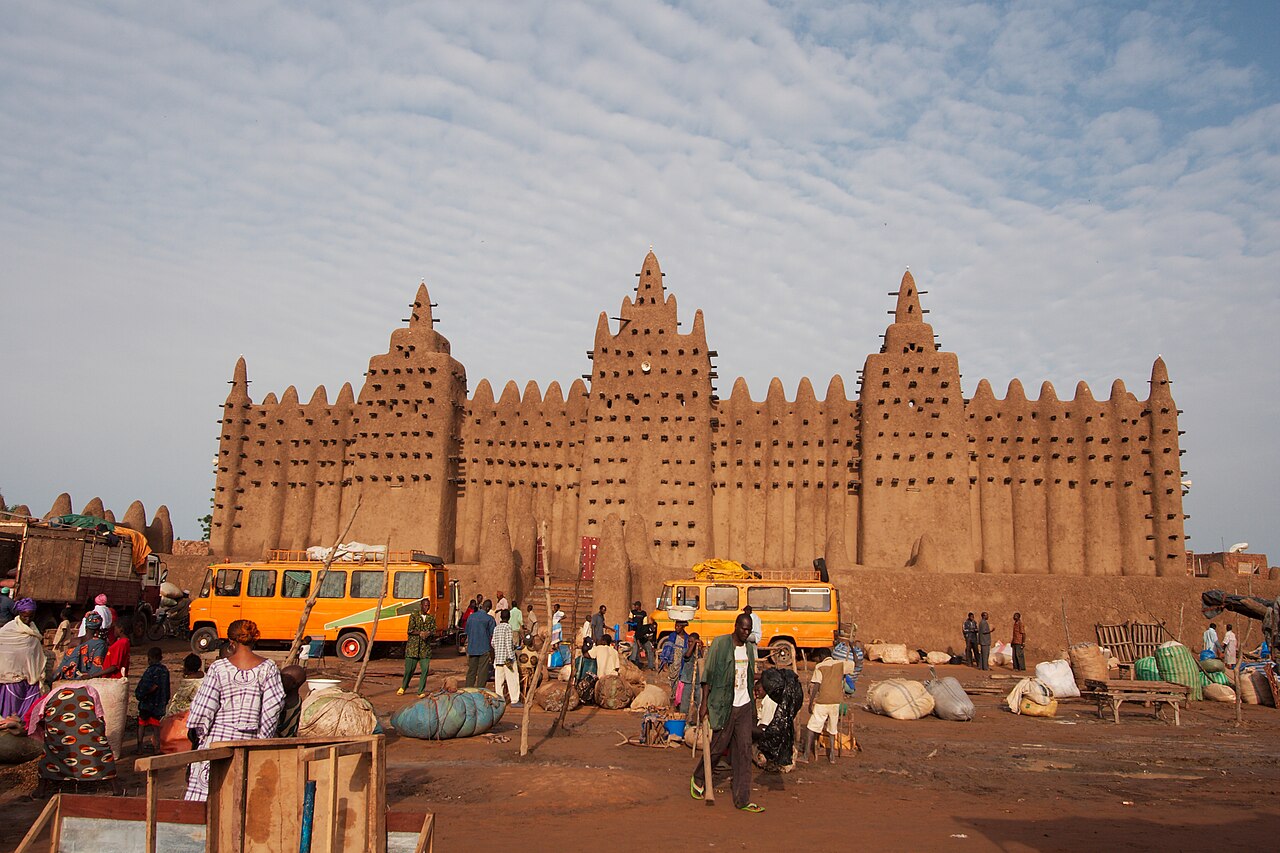
Djenné is one of the oldest cities in sub-Saharan Africa and one of the most visually striking. The entire Old Town is a UNESCO World Heritage Site, a dense cluster of mud-brick buildings on an island in the Bani River floodplain. At its centre stands the Great Mosque of Djenné, the largest mud-brick structure in the world — an extraordinary building whose soaring towers and palm-wood scaffolding have become an icon of West African architecture. Non-Muslims cannot enter, but the exterior is magnificent.
The town comes alive on Monday, market day, when the grand square in front of the mosque fills with traders from the surrounding Sahel. Women sell cloth, fish, and vegetables; merchants lay out salt blocks, spices, and livestock. It is one of the great market scenes in West Africa, and the mosque as a backdrop makes it unforgettable.
Djenné has been a centre of Islamic learning and trade since the 13th century, and the streets are lined with madrassas (Quranic schools) where children still learn to recite the Quran on wooden tablets. Wandering the narrow lanes of the old town, with its ornate doorways and rooftop terraces, is the main pleasure of a visit. The smaller Marché des Femmes (women's market) operates daily and is a more intimate experience than the Monday market. Just outside town, the archaeological mound of Djenné-Djenno marks one of the earliest known cities in sub-Saharan Africa.
Getting to Djenné from Bamako or Mopti requires planning — transport is more frequent on market days. Check current security conditions before travelling, as the wider region has experienced instability.