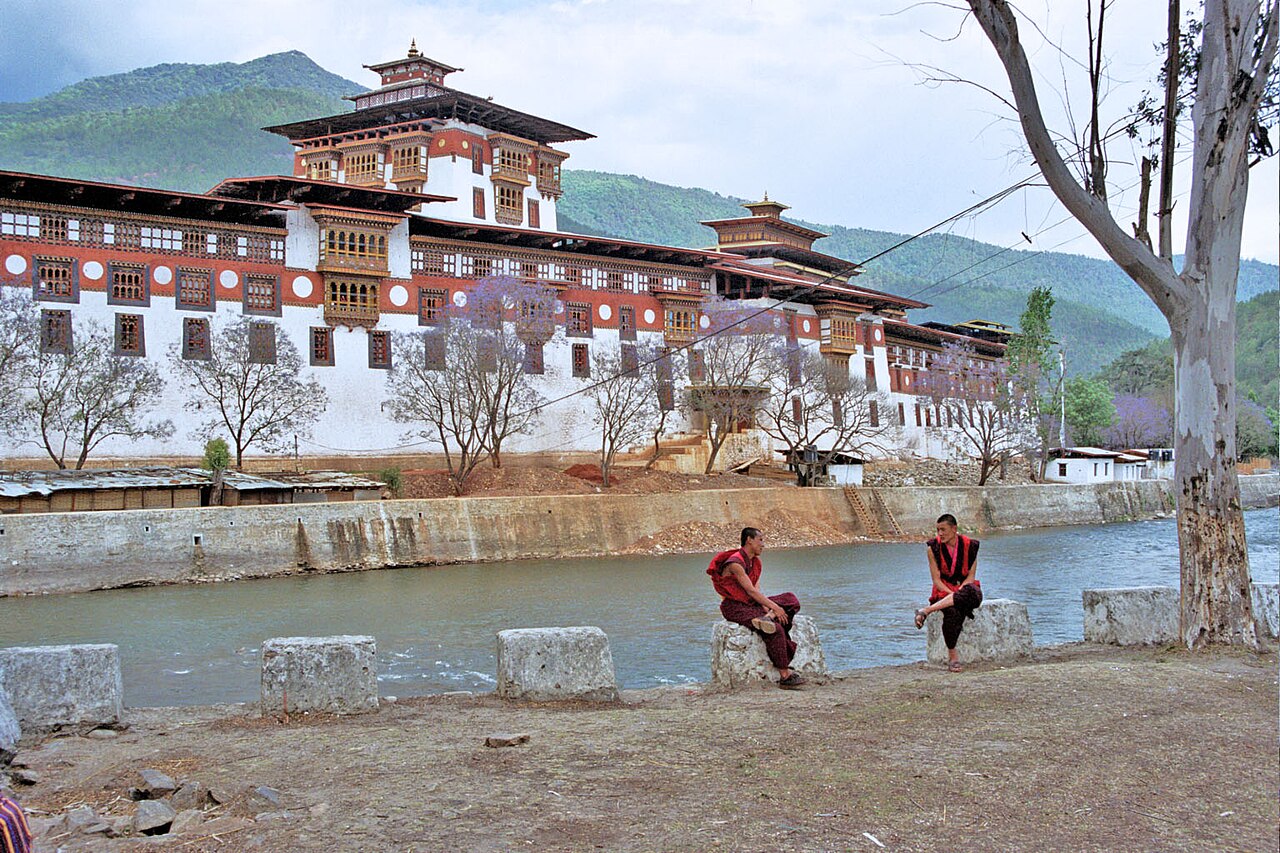
Punakha was the capital of Bhutan until 1955 and remains one of the most rewarding destinations in the country. The town sits at the confluence of the Pho Chhu (Male River) and Mo Chhu (Female River) at around 1,200 m elevation — considerably warmer than Thimphu, which makes it an attractive winter destination.
The centrepiece is Punakha Dzong, one of the finest examples of Bhutanese architecture in the country. Built in the 17th century by Zhabdrung Ngawang Namgyal, the dzong stands on the tongue of land between the two rivers, its whitewashed walls rising above the water like a fortress. It is the winter residence of the Je Khenpo — the spiritual leader of Bhutan — and some 500 monks. In spring, jacaranda trees bloom purple against its walls. The Punakha Suspension Bridge near the dzong is draped in prayer flags and offers excellent upstream views.
A short walk across the valley floor leads to Chimi Lhakhang, a fertility temple dedicated to the "Divine Madman" Drukpa Kunley, whose phallus motifs are painted on farmhouses throughout the valley. The Punakha Domchoe festival, held in late February or early March, is one of Bhutan's most spectacular, featuring traditional masked dances in the dzong's courtyard.
The approach from Thimphu crosses the Dochula Pass at 3,100 m, where on a clear day you can see dozens of Himalayan peaks stretching across the horizon. Punakha is about 75 km northeast of Thimphu and makes either a long day trip or an overnight stop.