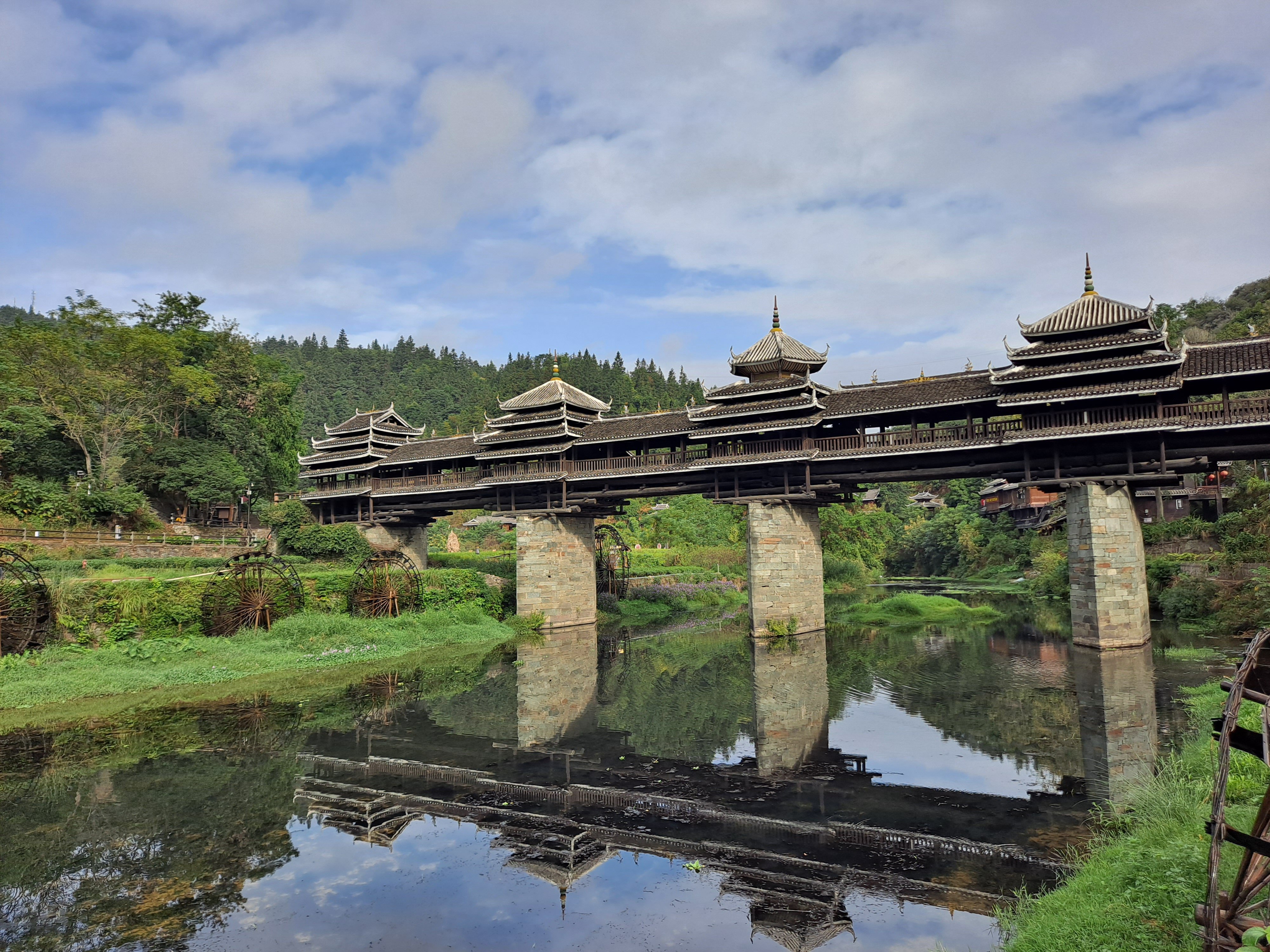
Dong minority village cluster in northern Guangxi, centred on a celebrated wind-and-rain bridge.
Chengyang is a cluster of eight Dong minority villages in the mountains of northern Guangxi, connected by footpaths and famous for the Chengyang Wind-and-Rain Bridge completed in 1912 — a covered wooden structure spanning the Linxi River, supported on stone piers, with pavilions along its length where people sit and talk out of the rain. It is one of the finest examples of Dong architecture anywhere, and the villages around it, with their drum towers rising above a landscape of terraced fields and forested ridges, make for a whole that is more satisfying than any individual element.
The eight villages are small and unhurried in a way that Longsheng and Yangshuo are not. Each has a drum tower at its centre — the traditional gathering point for community meetings, singing, and festivals — and the Dong are among the great choral traditions of China, developing polyphonic singing in isolation from outside influence. With some planning it is possible to hear performances, though these are most accessible during festivals. The autumn season, when the rice is ripe and the terraces turn from green to gold, is the best time to visit.
The hike between the villages and up to Ji Chang takes two to three hours return, passing through tea plantations and more rice terraces, with views back down to the river valley. The trail is well marked and the walking is straightforward. Most visitors come for a day trip but staying overnight in one of the village guesthouses, priced very reasonably, changes the experience significantly: the village empties of day visitors by mid-afternoon and the evenings are quiet.
Getting to Chengyang requires a high-speed train from Guilin to Sanjiang in 35 minutes, then a local bus for another 30 minutes. The entrance fee to the scenic area is reasonable and the infrastructure is unobtrusive.
Guide
Getting There
From Guilin, take the high-speed rail north to Sanjiang South station — the journey takes about 35 minutes. From Sanjiang, local buses or shared minivans run to Chengyang village; the ride takes a further 30 minutes on a good road through the mountains. Several buses a day make this connection, with more service in the morning.
Alternatively, some visitors come from Longsheng on the bus to Sanjiang and connect from there, combining a visit to both the Longji rice terraces and Chengyang in a two-day loop.
There is a scenic area entrance fee covering access to the villages and the bridge, payable at the village gate. From most guesthouses in the main village, the bridge is a five-minute walk. Motorcycles and tuk-tuks are available inside the scenic area if you prefer not to walk between villages.
Guide
When to Go
Autumn (late September to November) is the best season: the rice harvest turns the terraces golden, the weather is cool and clear, and festivals are more likely. The Dong New Year — celebrated in the eleventh lunar month, typically November — brings singing, drum tower gatherings, and the best chance of catching a genuine Dong Grand Song performance.
Late May to early June is the second good window: the paddies are newly flooded for planting and reflect the sky in silver sheets. The humidity climbs after mid-June.
Winter can bring mist and cold that is atmospheric rather than pleasant, though the light on the bridge in the early morning fog is remarkable. July and August are hot and crowded with domestic tourists.
The terraces look their best in the golden hour before 9am and after 5pm on any clear day, regardless of season. Stay overnight in the village rather than day-tripping from Guilin to experience this.