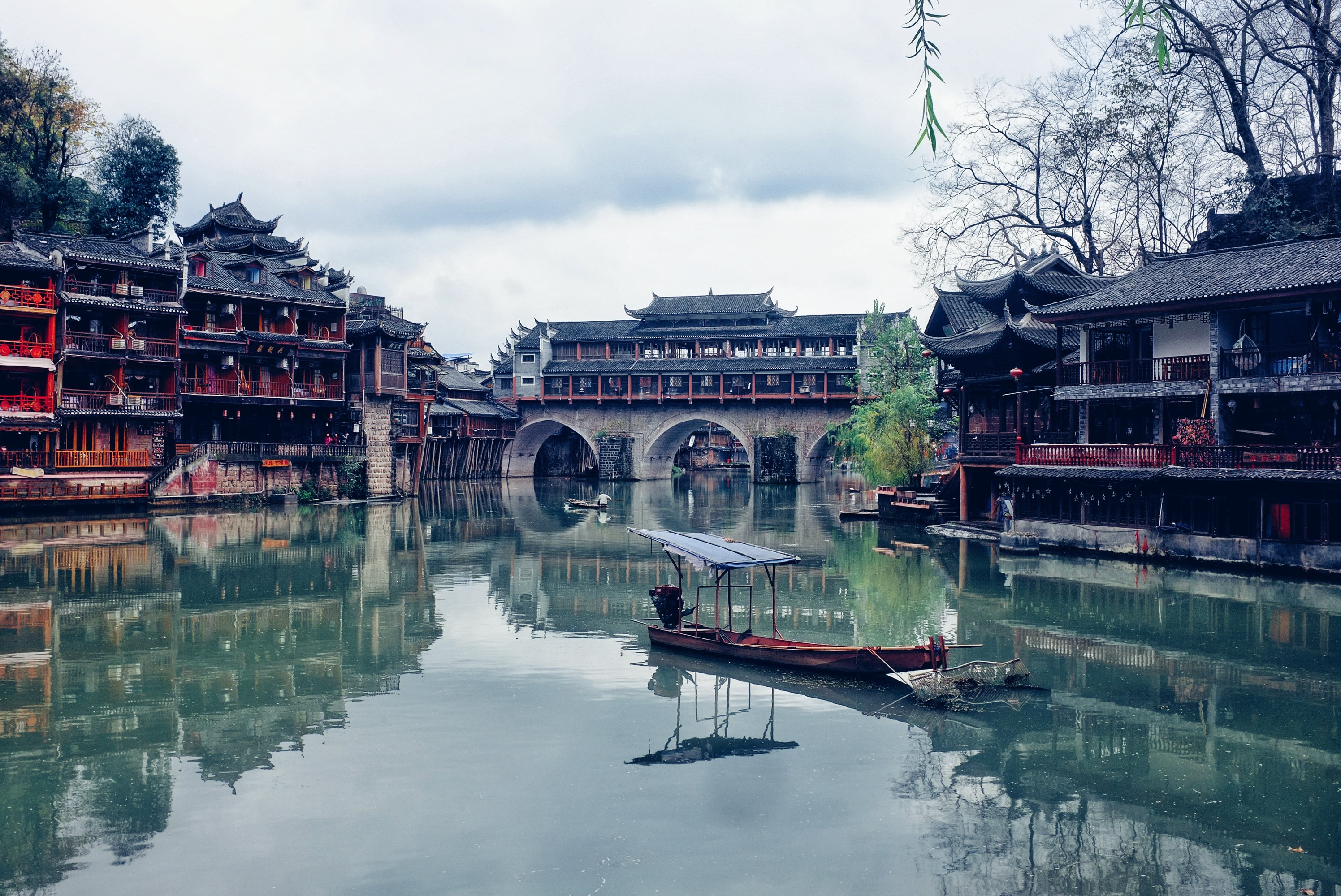
Fenghuang — Phoenix Ancient Town — sits above the Tuo River in western Hunan, a well-preserved Qing and Ming-dynasty settlement that has become one of the most photographed destinations in the province. The old quarter is built on stilts directly over the river; the wooden buildings' reflections in the water, combined with lanterns lit at night, produce images that appear on half the travel blogs in China. It is genuinely beautiful and genuinely crowded, particularly on weekends and holidays, but arriving early in the morning or late in the evening substantially reduces both the foot traffic and the noise.
The town's literary reputation rests on two figures. Shen Congwen, born here in 1902, wrote fiction set in this landscape that brought the Miao and Tujia cultures of western Hunan into the Chinese literary mainstream; his former home is open to visitors, and his grave is nearby on a hillside outside town. The artist Huang Yongyu, who created some of the most recognisable imagery of 20th-century Chinese art, also grew up in Fenghuang. The old town's architectural anchors are the East Gate Tower, the Hong Bridge (a covered bridge doubling as a marketplace), and the Yang Family Ancestral Hall. A through-ticket covering the main historical sites costs around ¥100-170.
Beyond the old quarter, the Southern Great Wall stretches across the ridgelines northwest of town. Built from the late 14th century onward specifically to contain the Miao people, it is a more modest structure than its northern cousin but occupies dramatic terrain and offers views over terraced rice fields dropping toward the valley. The Miao silverwork sold throughout Fenghuang is not all locally made, but the authentic pieces — headdresses, collar pieces, and bracelets using silver filigree techniques passed through family workshops — are worth looking for.
Fenghuang is roughly 30 minutes by bus south of Jishou, which has high-speed rail connections; alternatively, Tongren Airport in Guizhou serves the area from about 34 kilometres away. The old town fills up fast on summer weekends — arriving midweek and staying two nights allows the evenings, which are the best time, without fighting the peak-hour crowds. Dehang, a Miao gorge village with serious hiking, is an hour north and makes a good contrast to Fenghuang's more manicured tourism.