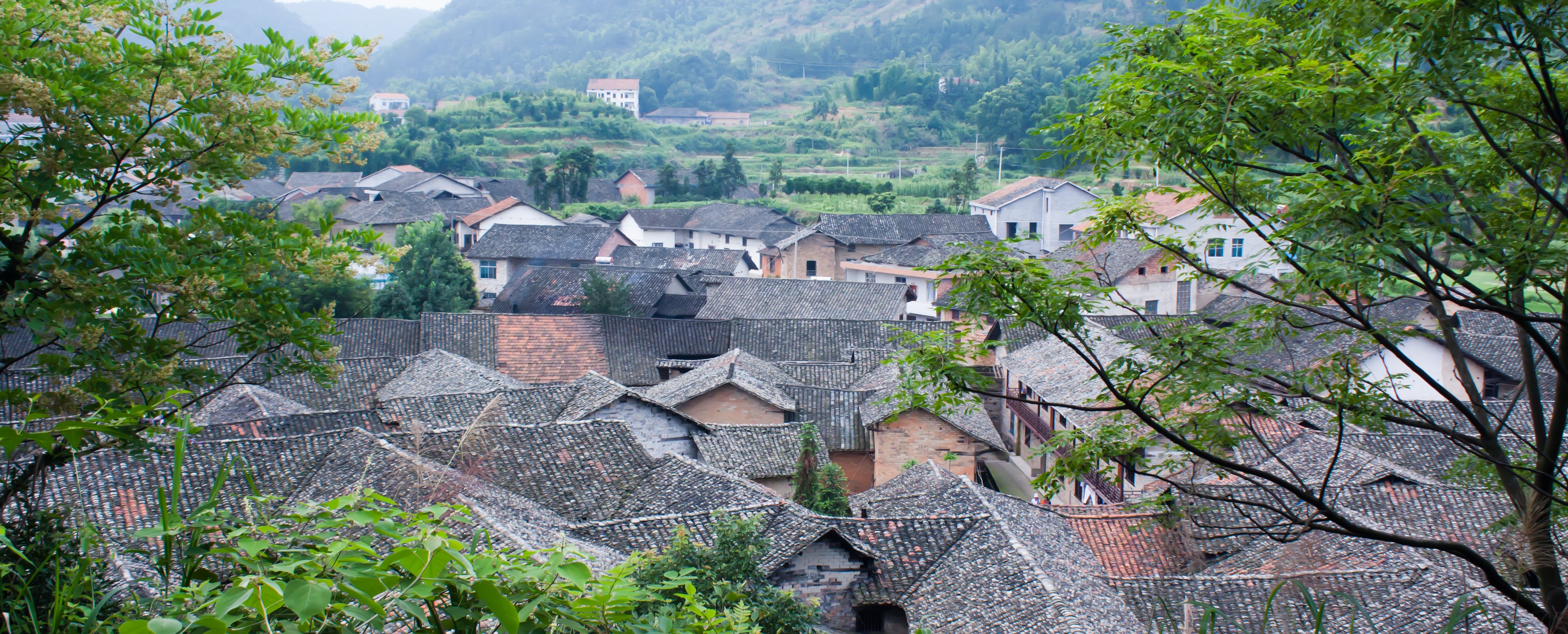
Zhangguying Village, in Yueyang County about 80 kilometres east of Yueyang city, is a Ming and Qing-dynasty residential complex covering over 50,000 square metres and containing 1,732 rooms in a continuous warren of courtyards, covered streets, and interconnected halls. The settlement was named after its founding ancestor Zhang Guying and grew over successive generations into a complete village-within-a-village: a dense arrangement of clan architecture in which every major family function — ceremonial, residential, commercial, defensive — had its designated spatial expression. It is rated by the Chinese state as the best-preserved vernacular residential complex of its period in south-central China.
The architecture belongs to a tradition common in Hunan and Jiangxi: whitewashed walls and dark tile roofs rising in stepped gables, timber structural frames visible in the interiors, carved wooden screens dividing spaces in the main halls, and stone-flagged lanes between buildings too narrow for any vehicle. The complex at Zhangguying adds to this a degree of completeness unusual in surviving Chinese historic settlements — most comparably old villages have lost significant portions to fire, demolition, or the pragmatic modifications of later centuries; Zhangguying's ensemble has remained largely intact, which is the foundation of its national designation as a Protected Cultural Site (2001) and its listing as a Famous Historical and Cultural Village (2003).
The village is about 15 kilometres from the Miluo River, the river where the poet Qu Yuan drowned in 278 BC — the origin story of the Dragon Boat Festival tradition that Yueyang claims as its own. The landscape of rice paddies, fish ponds, and bamboo groves between the village and the river is typical of the northern Hunan lowlands at their least modified.
Zhangguying is a worthwhile half-day excursion from Yueyang, reached by bus or hired car from the city. It sees relatively few foreign visitors and has a quieter, less commercially organised feel than the more promoted historic towns of western Hunan. The village complex is among the best-preserved vernacular clan settlements in south-central China.