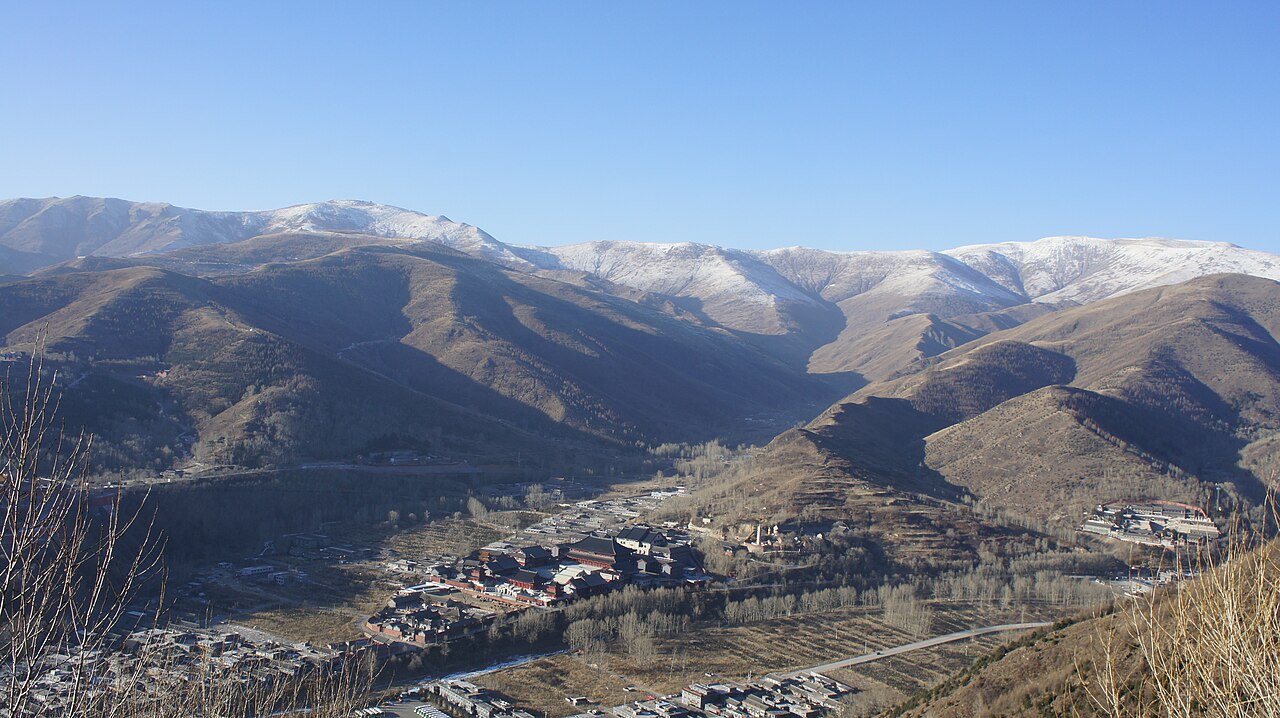
Mt. Wutai is one of China's four sacred Buddhist mountains and the only Chinese peak mentioned in Buddhist scripture. The name means "five terraces," referring to the five flat-topped peaks that ring the central valley. At 3,058 metres the northern summit is the highest point in northern China, and the whole area stays cool even in midsummer — hence its old name, the "cool platform."
Temple construction here began in the Eastern Han Dynasty and continued for nearly two thousand years. Around 76 temples survive, more than on any other mountain in China. The most important are the Xiantong Temple, Tayuan Temple with its prominent white stupa, and the Tang Dynasty Foguang Temple and Nanchan Temple — the latter two among the oldest surviving wooden structures in the country.
The monastic village of Taihuai sits deep in the alpine valley enclosed by the five peaks. This is the spiritual and practical centre of Mt. Wutai: a cluster of fifteen or so active temples and monasteries connected by walkways, surrounded by mountains thick with forest. The atmosphere is genuinely peaceful — incense smoke drifts between the halls, monks chant at dawn, and the whole place feels far removed from modern China despite the tourist buses parked at its edges. For the best high view of the whole valley, climb the 1,080 steps to Dailuoding; for the high country itself, take a minivan to the alpine summit of the North Terrace.