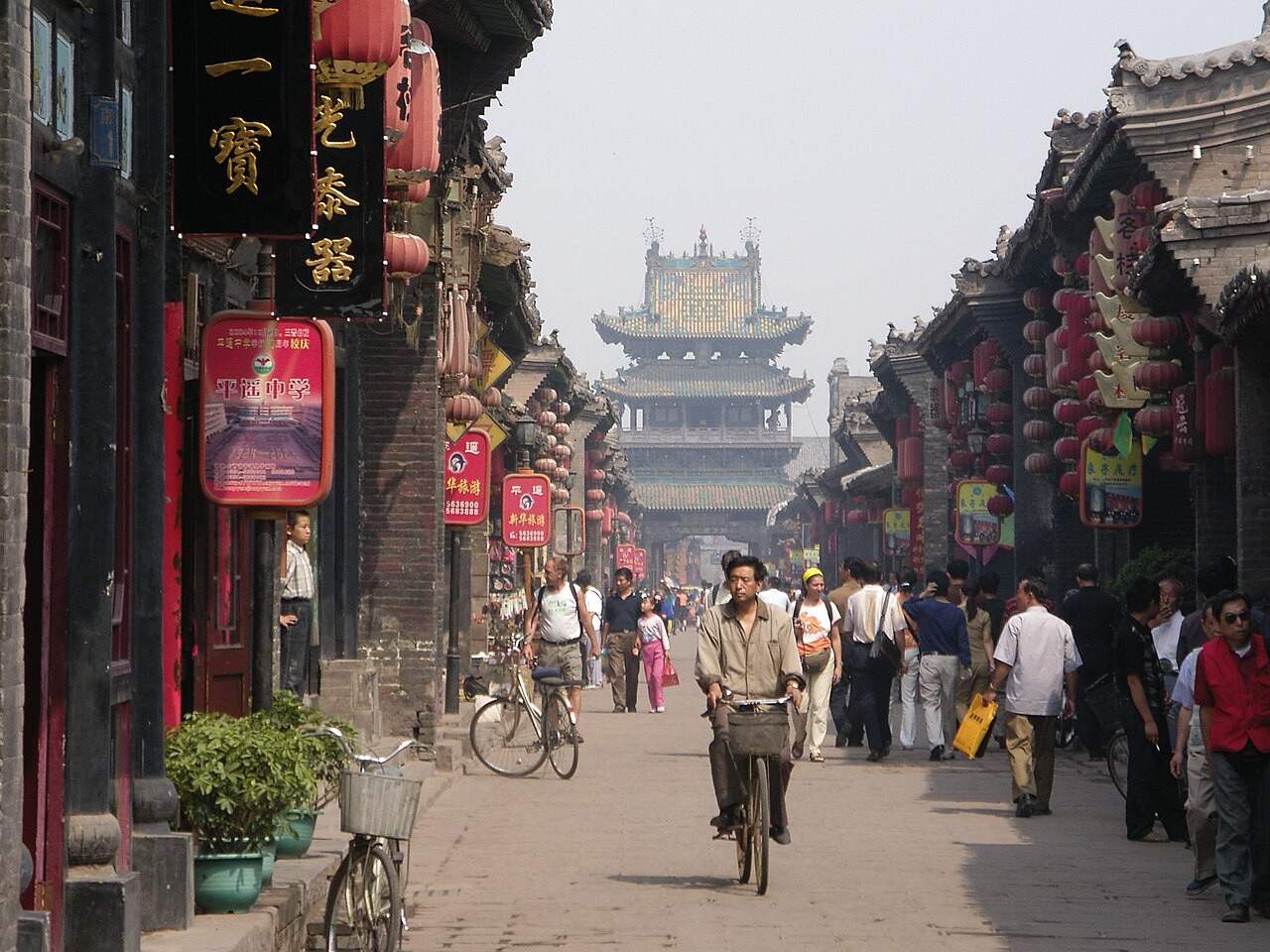
Pingyao is the best-preserved walled city in China — a compact Ming-era trading town in the middle of Shanxi Province, about 90 km south of the provincial capital Taiyuan, whose entire old town has survived almost unchanged since the 14th century. The 6.4 km city wall, built in its present form in 1370 but standing on foundations a thousand years older, still runs the complete perimeter of the old city; inside, a grid of narrow streets is lined with single-storey tiled-roof courtyard houses, banks, temples and shops almost entirely of Ming and Qing date. The whole thing is a UNESCO World Heritage Site, and more importantly, a working town — real families live in most of the old houses, and the streets are busy with bicycles and hawkers rather than tour buses.
Pingyao's golden age came under the Qing, when it became the financial capital of China. In 1823, the Rishengchang exchange shop opened here — the first of the piaohao or draft banks that allowed merchants to transfer money across the empire without carrying silver, the effective birth of modern Chinese banking. At its peak in the late 19th century, Pingyao had over twenty piaohao, half the financial system of the Qing empire was run from here, and the city was one of the wealthiest in China. The Rishengchang building, now a museum, is the most interesting single sight in town, followed by the Ancient Government Office (Xian Ya), the City Wall, the Market Tower at the centre of the main street, and the painted clay sculptures of the Shuanglin Temple and Zhenguo Temple, both a short drive outside the walls.
Come by high-speed train from Beijing (about four hours), Xi'an (three hours), or Datong. Stay inside the walls in one of the restored courtyard hotels — they are one of the great charms of visiting Pingyao, and a night in the old city is worth any discomfort. Two days here are enough; the city is small, but it is one of the best places in China to feel what the country looked like before the 20th century arrived.