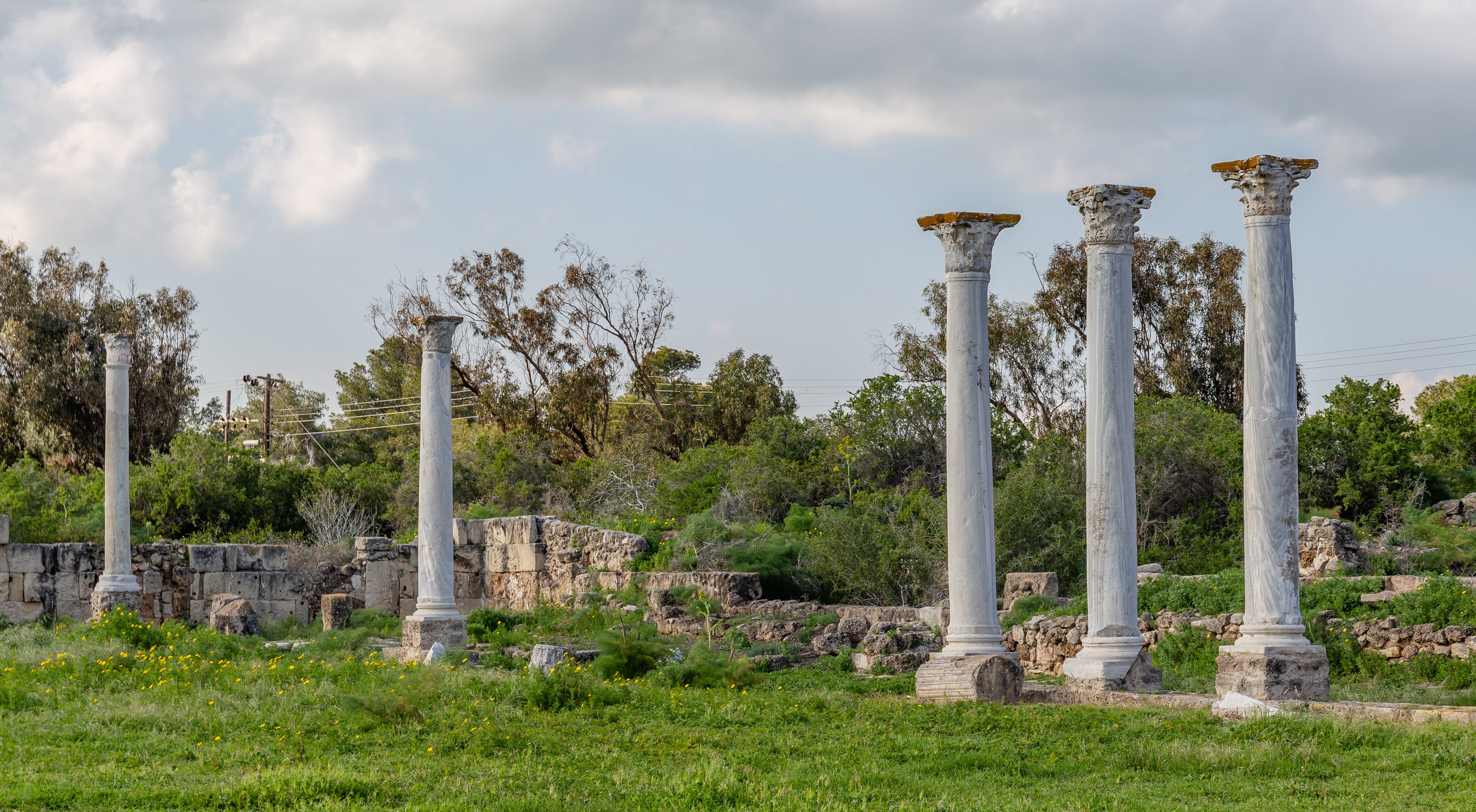
Salamis is one of the most important archaeological sites on Cyprus, spread across a large area of sandy ground and scrubby forest about 6 kilometres north of Famagusta in Northern Cyprus. According to tradition, the city was founded by Teucer (Tefkros), a hero of the Trojan War, who named it after his home island of Salamis near Athens.
The site was a major city for over a thousand years — first as a Greek city-state, then as the Roman capital of Cyprus. An earthquake in the 4th century AD destroyed much of it, and the rebuilt city (renamed Constantia) was eventually abandoned after Arab raids in the 7th century.
What remains is extensive and atmospheric. The Gymnasium and Baths complex is the most impressive surviving structure — a large palaestra surrounded by re-erected marble columns, with adjacent Roman baths featuring underfloor heating and mosaic fragments. The Roman Theatre is partially restored and gives a good sense of scale, with about 50 rows of seats. The original lower eight rows are Roman; the rest are later reconstructions. Nearby, the foundations of the Basilica of St. Epiphanios, once the largest church on Cyprus, and the remains of a temple to Zeus and a large market area are visible.
The Monastery of St. Barnabas, a short drive south, houses a small archaeological museum with finds from Salamis and the nearby Bronze Age settlement of Enkomi (ancient Alasia), one of Cyprus's oldest known towns.
The site is open and largely unshaded — bring water and sun protection, especially in summer.