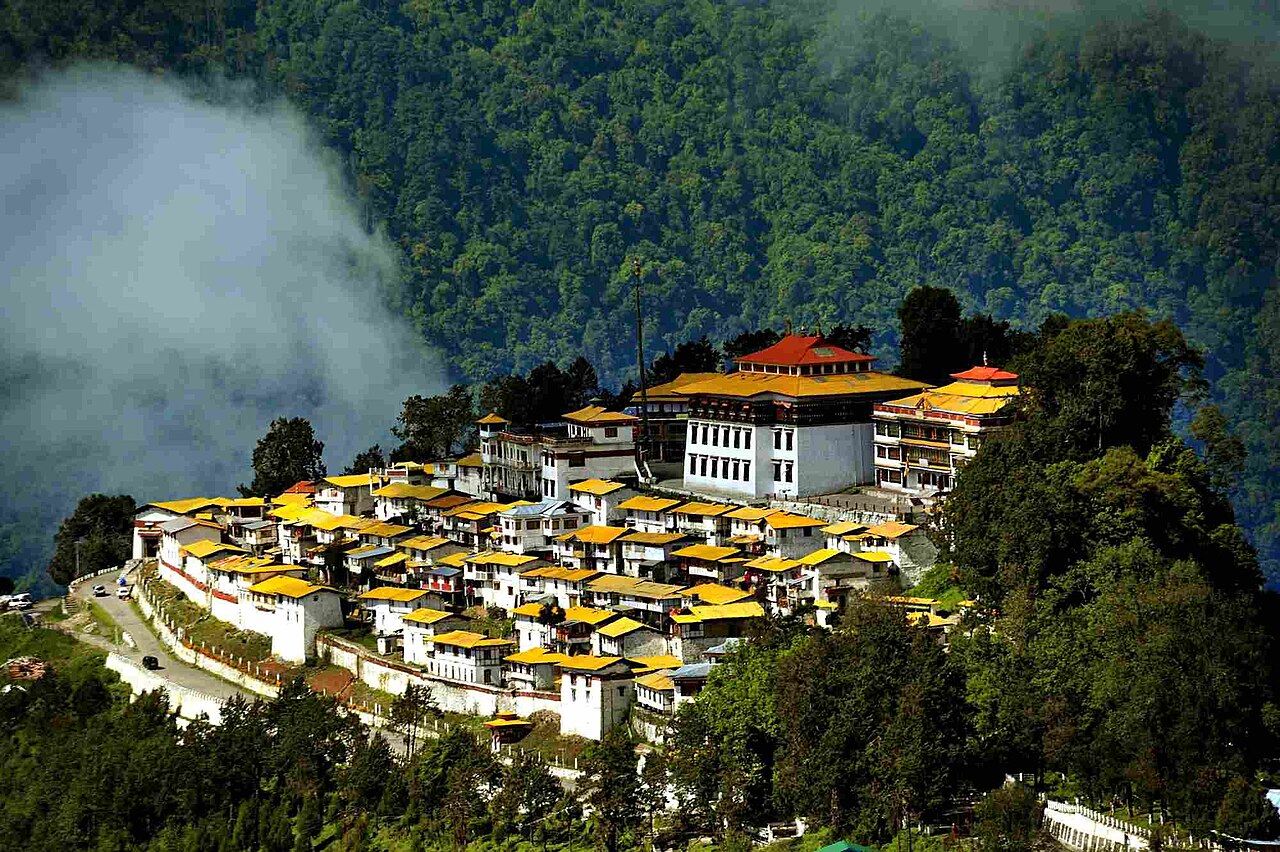
High Himalayan Buddhist town centred on India's largest monastery and Monpa mountain culture.
Situated at over 3,000 metres in the far northwest of Arunachal Pradesh, Tawang is renowned for its 400-year-old Buddhist monastery — the largest in India and second only to the Potala Palace in Lhasa. The Tawang Monastery, also known as Galden Namgyal Lhatse, was founded by Mera Lama, a contemporary of the fifth Dalai Lama. The sixth Dalai Lama was born at nearby Urgelling Monastery.
The Parkhang hall houses a remarkable library: rare handwritten and block-printed thankas, 108 gold-embossed manuscripts of the teachings of Lord Buddha, and 225 volumes wrapped in moth-proof silk adorned with paintings. The monastery complex includes a towering gilded Buddha statue and a craft centre producing fine woollen carpets.
Getting here is part of the experience — the road from Tezpur crosses the Sela Pass at over 4,100 metres, often snowbound in winter, with views of high-altitude lakes and rhododendron forests. P.T. Tso Lake, 17 km from town, is a glacial gem in a restricted border zone near the Line of Actual Control. The Tawang War Memorial commemorates the soldiers who fell in the 1962 Sino-Indian War that swept through these valleys. Tawang is also a base for trekking in the surrounding high-altitude valleys.
Guide
Getting There
Tawang requires an Inner Line Permit (ILP), which Indian citizens must obtain in advance from the Arunachal Pradesh government offices in Guwahati, Kolkata, or Delhi, or online. Foreign nationals require a Protected Area Permit (PAP) and must travel in groups of at least two with a registered guide.
The main route is by road from Guwahati (about 500 km), passing through Bhalukpong and Bomdila before climbing over the Sela Pass at 4,170 metres. The drive takes 12–15 hours with stops. Shared jeeps and private taxis operate from Guwahati and from Bhalukpong. There is no railway to Tawang — the nearest station is Rangapara North, about 80 km from Bhalukpong.
Tezpur is the nearest large town with air connections; Guwahati has the nearest international airport. The road is at its best between April and October. Sela Pass closes in heavy snow, sometimes for several days at a time between December and March; check conditions before setting out.
Guide
When to Go
The best time to visit Tawang is from April to October. Spring (April–June) brings rhododendron blooms on the hillsides and clear views of the Himalayan peaks before the monsoon arrives in June. The monsoon months (June–September) make the roads muddy and sometimes impassable, but the landscape is brilliantly green and the waterfalls are at their fullest. October brings post-monsoon clarity and golden light.
The Torgya Festival in January is one of the most important Buddhist festivals in the eastern Himalayas, with three days of masked dances performed by monks in the monastery courtyard. It is worth timing a visit around if you can handle the cold — temperatures drop well below freezing at night.
Winter (November–March) is bitterly cold, with the Sela Pass frequently snowbound. Some guesthouses close, and the mountain roads can become dangerous. If you visit in winter, carry warm clothing regardless of what the Guwahati weather looked like when you set out.