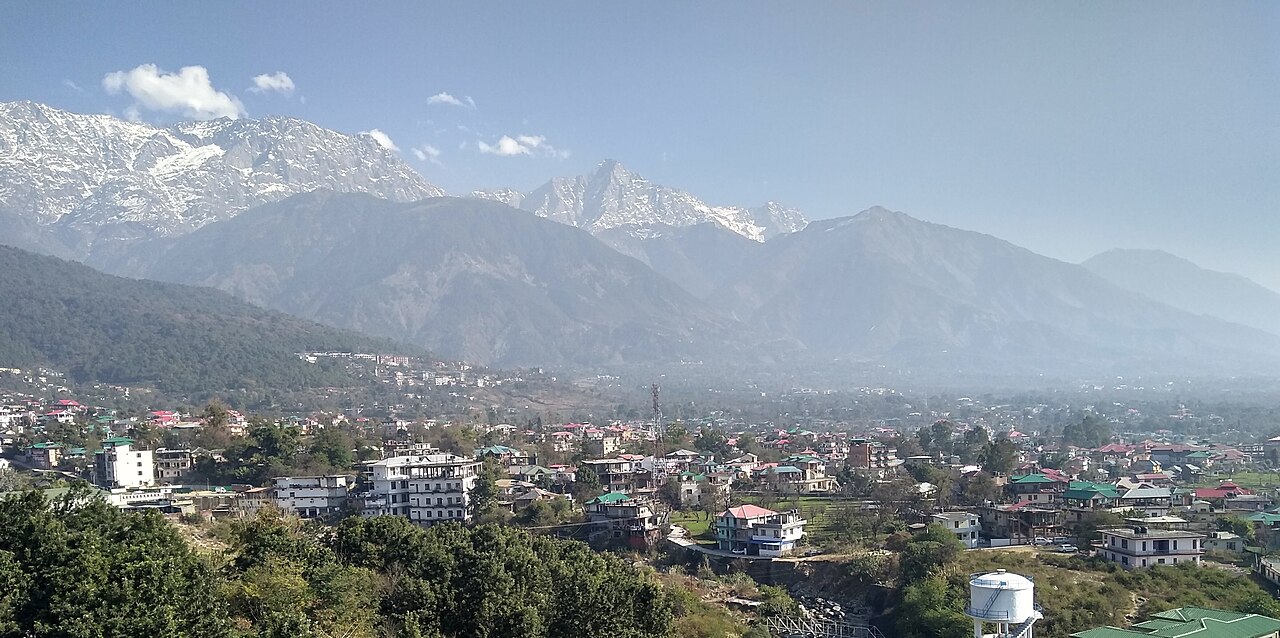
Dharamsala is a hill town in the Kangra Valley of Himachal Pradesh, stretched up the forested slopes of the Dhauladhar range at elevations between around 1,250 and 1,800 metres. Before 1960 it was a sleepy British-era cantonment and tea-growing district headquarters; since the Dalai Lama and some 80,000 Tibetan refugees settled here after fleeing the 1959 uprising in Lhasa, it has become one of the most important centres of Tibetan Buddhism outside Tibet itself — and one of the most unusual small towns in India.
The town splits into two quite distinct parts. Lower Dharamsala, down in the valley, is a dusty, unremarkable Indian administrative town. Almost everything a traveller comes for is in the upper settlement, McLeod Ganj, about 10 km (and 500 metres of altitude) further up the hill, where the Tibetan government-in-exile is based and where the Dalai Lama's private residence and the Tsuglagkhang temple complex and Namgyal Monastery sit on a hilltop at the centre of town. The small but excellent Tibet Museum and the Library of Tibetan Works and Archives give a thorough introduction to Tibetan Buddhism and to the history of the 1959 exodus. If the Dalai Lama is in residence and gives public teachings, visitors can attend — in normal times, these are free, and word gets out well in advance. The Tushita Meditation Centre above Dharamkot runs courses in Buddhist philosophy and meditation for those wanting to go deeper.
Beyond McLeod Ganj, the surrounding hills offer some of the best short walking in northern India. The popular Triund trek climbs steeply up to a grassy ridge at about 2,975 metres for extraordinary views of the Dhauladhar peaks — a long day out from McLeod or an overnight camp. Closer to town, the Bhagsu waterfall is an easy walk through the village of Bhagsunag. Below the hills, the Church of St John in the Wilderness — an 1850s neo-Gothic chapel in the pine forest that holds the grave of Lord Elgin, a Viceroy of India — is one of the strangest and loveliest colonial leftovers in the region. Further afield, the medieval Masrur rock-cut temples and the flaming-rock Hindu pilgrimage site of Jwalamukhi are rewarding day trips.
McLeod Ganj is also one of the main centres in India for Tibetan Buddhism courses, meditation retreats, yoga, and cheap but excellent Tibetan and Indian food. Expect backpackers, monks in red robes, and a cosmopolitan café culture that feels closer to Kathmandu than to anywhere else in India.