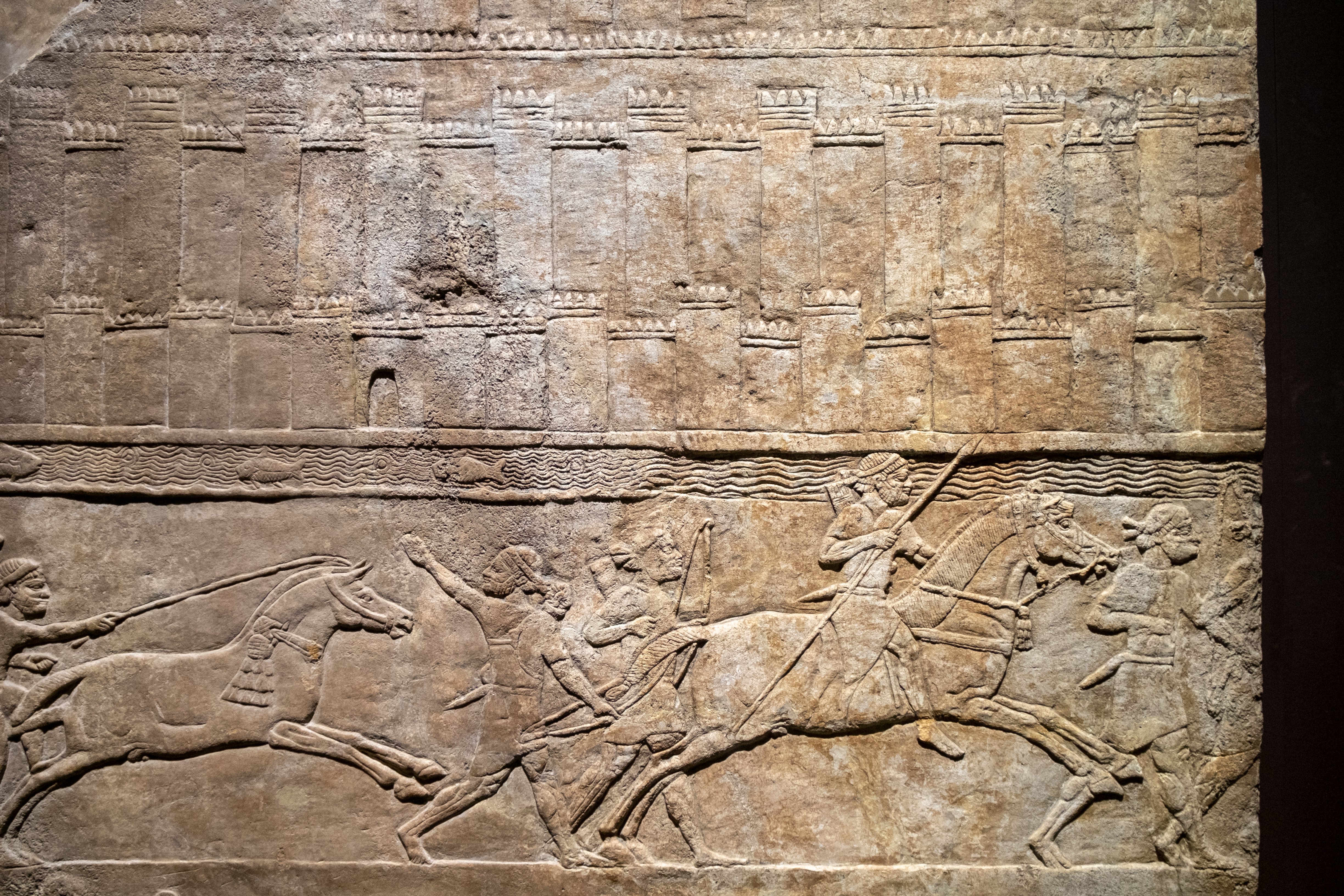
Nineveh was once the greatest city in the world — capital of the Assyrian Empire at its height, home to perhaps half a million people, and the political and cultural hub of the ancient Near East. At its peak under Sennacherib (704–681 BC), the city enclosed an area of roughly 750 hectares within walls twelve kilometres in circumference, pierced by fifteen gates each named after an Assyrian deity. It fell in 612 BC when a coalition of Medes and Babylonians sacked and burned it, fulfilling the prophecies that had made its name synonymous with pride before a fall.
The site today sits on the east bank of the Tigris, on the outskirts of Mosul. Two great mounds rise from the plain — Kuyunjik, where the royal palaces stood, and Nebi Yunus. The city was first excavated by the French in the 1840s and then more thoroughly by the British, who uncovered the vast palace of Sennacherib and, most famously, the Library of Ashurbanipal: tens of thousands of cuneiform tablets, including the oldest known version of the Epic of Gilgamesh, now in the British Museum. Some of the colossal winged bulls (lamassu) that guarded the palace gates were also taken to London and Paris, though many were later destroyed at the site.
Several of the ancient gates have been reconstructed, most notably the Shamash Gate and the Nergal Gate. A small museum near the Nergal Gate displays Assyrian relief carvings from the excavations. Note that the site and the wider Mosul region suffered severe damage during the period of ISIS control (2014–2017), and the situation on the ground changes; check current conditions before visiting.