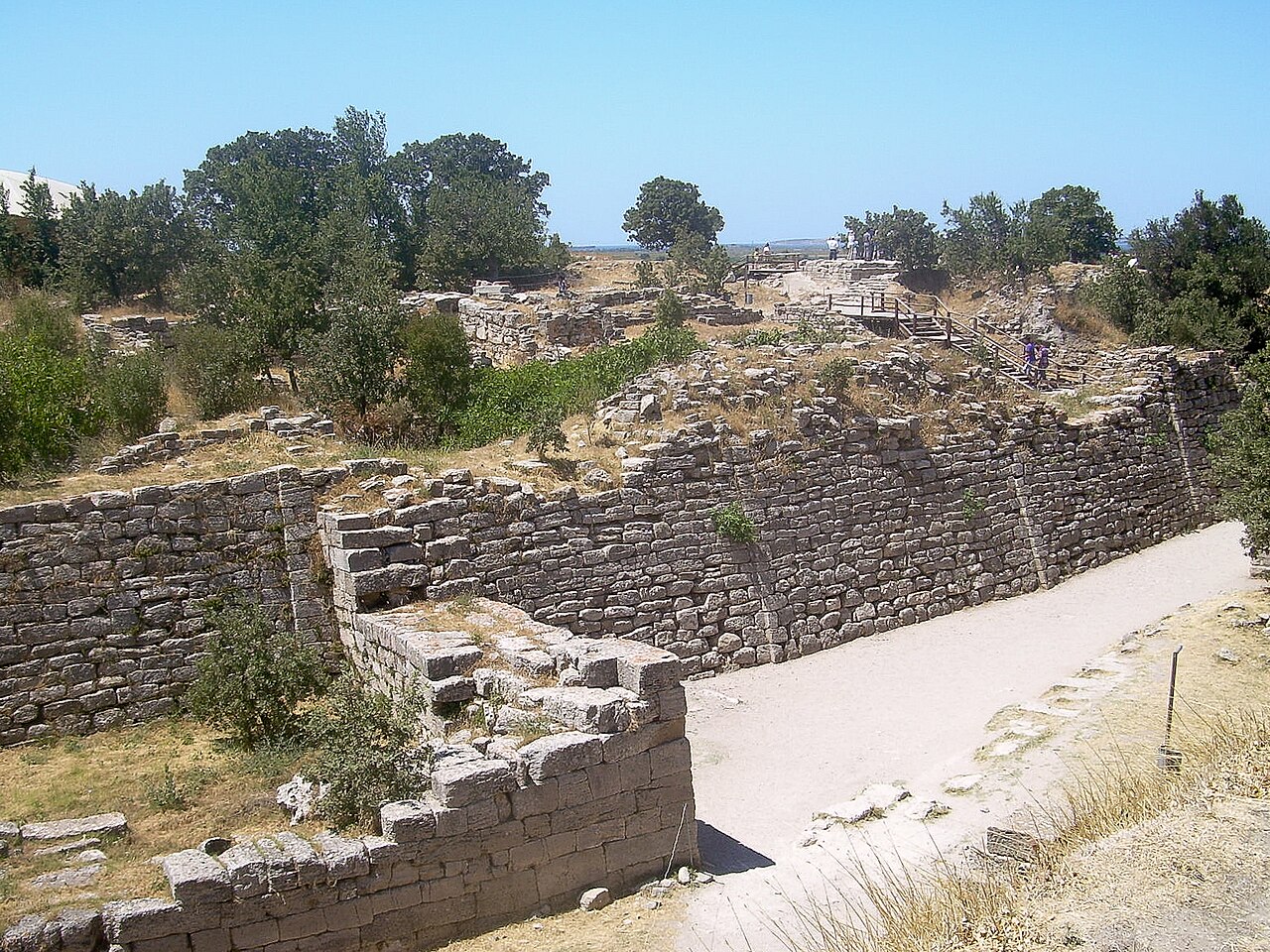
Troy — Troia, to the Turks who live nearby — is the archaeological site of the city whose sack by the Achaeans forms the spine of Homer's Iliad. It sits on a low mound called Hisarlık, about 30 km south-west of Çanakkale and a few kilometres from the Aegean coast, and for most of history it was thought to be a myth. Then, in the 1870s, the German businessman and self-taught archaeologist Heinrich Schliemann, armed with his copy of Homer and an obsessive certainty, began digging into the mound and to his and the world's astonishment, found the ruins of not one but nine successive cities, stacked on top of each other over some three and a half thousand years.
Expectations should be managed. Unlike Ephesus or Pergamon, Troy is not a place where you can wander among standing columns and colonnaded streets. What you see today, on a walk around the archaeological site, is a complicated tangle of mudbrick walls, stone foundations, and labelled excavation trenches spanning nine layers of occupation — Troy I (3000 BC) at the bottom, Troy IX (Roman-era Ilium) at the top, and somewhere in between (probably Troy VI or VIIa, around 1200 BC) the city that could have inspired Homer's legend. The most striking single feature is Schliemann's Trench, the colossal gash through all nine cities cut by the first excavator. The best-preserved structures are the East Gate and the cyclopean walls of Troy VI; on top of the mound, the small Roman Odeon and Bouleuterion mark the last of the nine cities.
The on-site visitor experience has improved considerably since the Troy Museum opened next to the archaeological site in 2018 — a striking red-Corten-steel cube designed to look like a buried artefact. The museum displays the finds from the various Troys, including replicas of the famous gold "Treasure of Priam" (the originals, taken by Schliemann and later by the Soviets, are now mostly in Moscow), and explains each of the nine layers. Allow two hours for the museum and one to two hours for the site itself. And yes, there is a wooden horse at the entrance, built in 1975 — touristy but unavoidable, and popular with the children.
Most visitors come as a day trip from Çanakkale (30 km away) or on a longer tour from Istanbul combining Troy with the Gallipoli battlefields on the opposite shore of the Dardanelles. If you can, stay the night in Çanakkale — walk along the waterfront in the evening, eat fresh fish, and come to Troy in the early morning before the tour groups arrive.