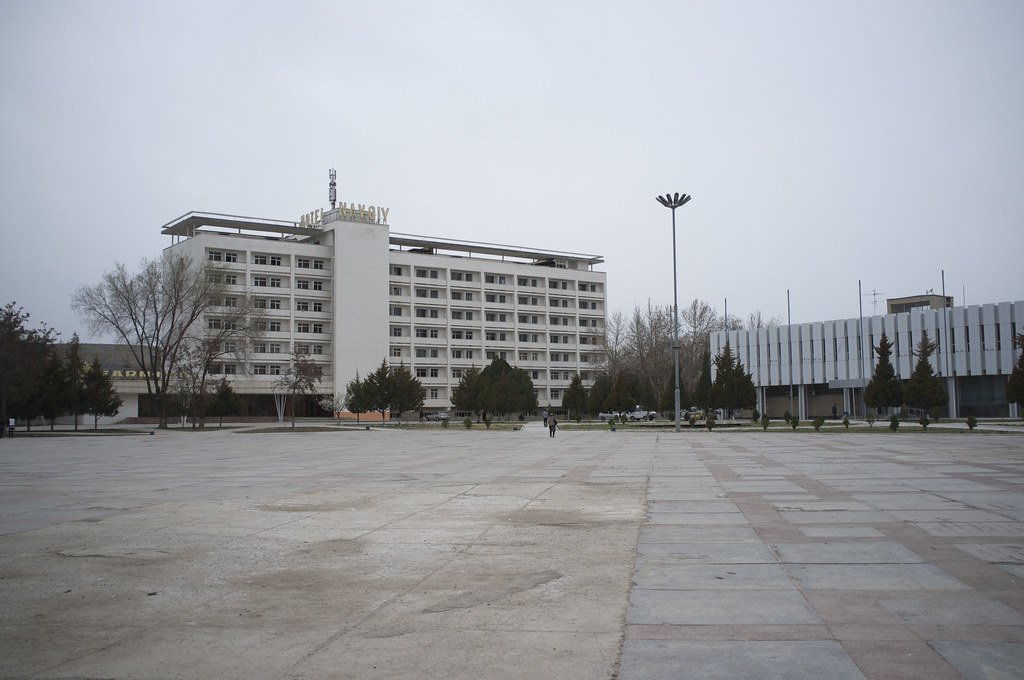
Navoi is the most Soviet city in Uzbekistan — and that is saying something. Built from scratch in the 1950s as an industrial centre, it was administered directly from Moscow rather than Tashkent, and supplied with goods unavailable anywhere else in Central Asia. The Soviet town centre — wide boulevards, rectangular apartment blocks, and geometrically perfect parks — is a textbook of Soviet urban planning, dropped into the desert between Samarkand and Bukhara.
Few travellers stop here, but for anyone interested in Soviet-era Central Asia, Navoi is a fascinating detour. The city remained "closed" well after Uzbekistan's independence, and something of that isolation lingers in the atmosphere. The nearby ancient town of Karmana — medieval Kermine — has Islamic monuments worth seeing, and the Sarmishsay gorge, with its thousands of prehistoric petroglyphs, is one of the most remarkable outdoor sites in the region. The surrounding steppe also offers camel trekking — a handful of operators run multi-day trips into the desert.