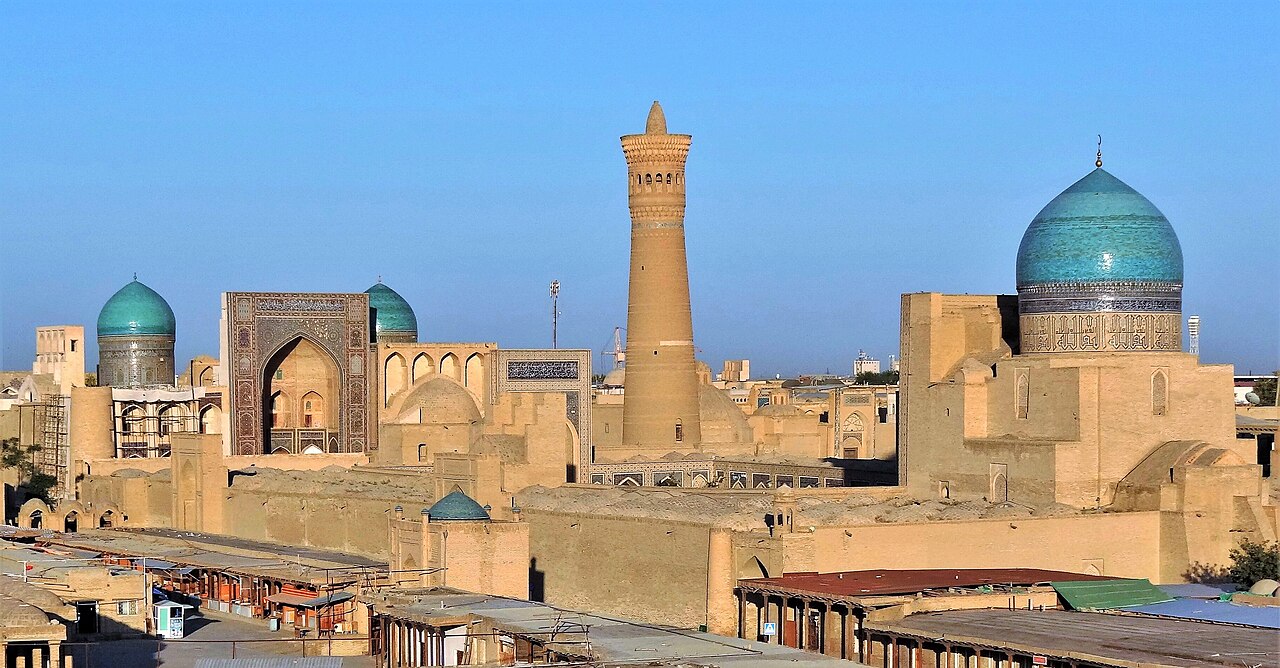
Bukhara is one of the most famous cities on the ancient Silk Road. Samarkand is maybe a bit more famous, but Bukhara wins hands down when it comes to atmosphere. This city is alive.
The old part of town offers an incredible number of sights. The first or last stop of any visit should be the Lab-i-Hauz, a great place to relax, sit, drink tea (or something stronger) and watch the fountains restart. Seen from the teahouse tables, the Ark or Citadel is at the other end of town. Between those two are magnificent Koranic schools, impressive mosques, and the Kalyan Minaret — a 47-metre tower of patterned brick that Genghis Khan reportedly spared from destruction because he was struck dumb by its beauty.
The Po-i-Kalyan complex — the minaret, the Kalan Mosque, and the blue-tiled Mir-i-Arab Madrasah — is the heart of the city and one of the great Islamic architectural ensembles of Central Asia. North of it, the Ulugbek and Abdulaziz Khan Madrasahs face each other across a narrow lane, and the domed bazaars between them and the Lab-i-Hauz are still functioning markets. In the park west of the Ark, the Samanid Mausoleum — built around 905 AD and considered the founding monument of Central Asian Islamic architecture — sits quietly beneath the trees, surrounded by far fewer visitors than it deserves.
Bukhara was a centre of Islamic scholarship and Sufi mysticism for centuries, and this depth shows up in the lesser-visited corners: the Magok-i-Attari Mosque buried several metres below street level, the Zindon prison where Victorian-era British officers were famously imprisoned before being beheaded, the Saif ed-Din Bokharzi Mausoleums in the quieter eastern neighbourhood. A short taxi ride north brings you to Sitorai Mokhi-Khosa, the last emir's summer palace, built in 1911 by Russian architects and now a museum of the emirate's final years.