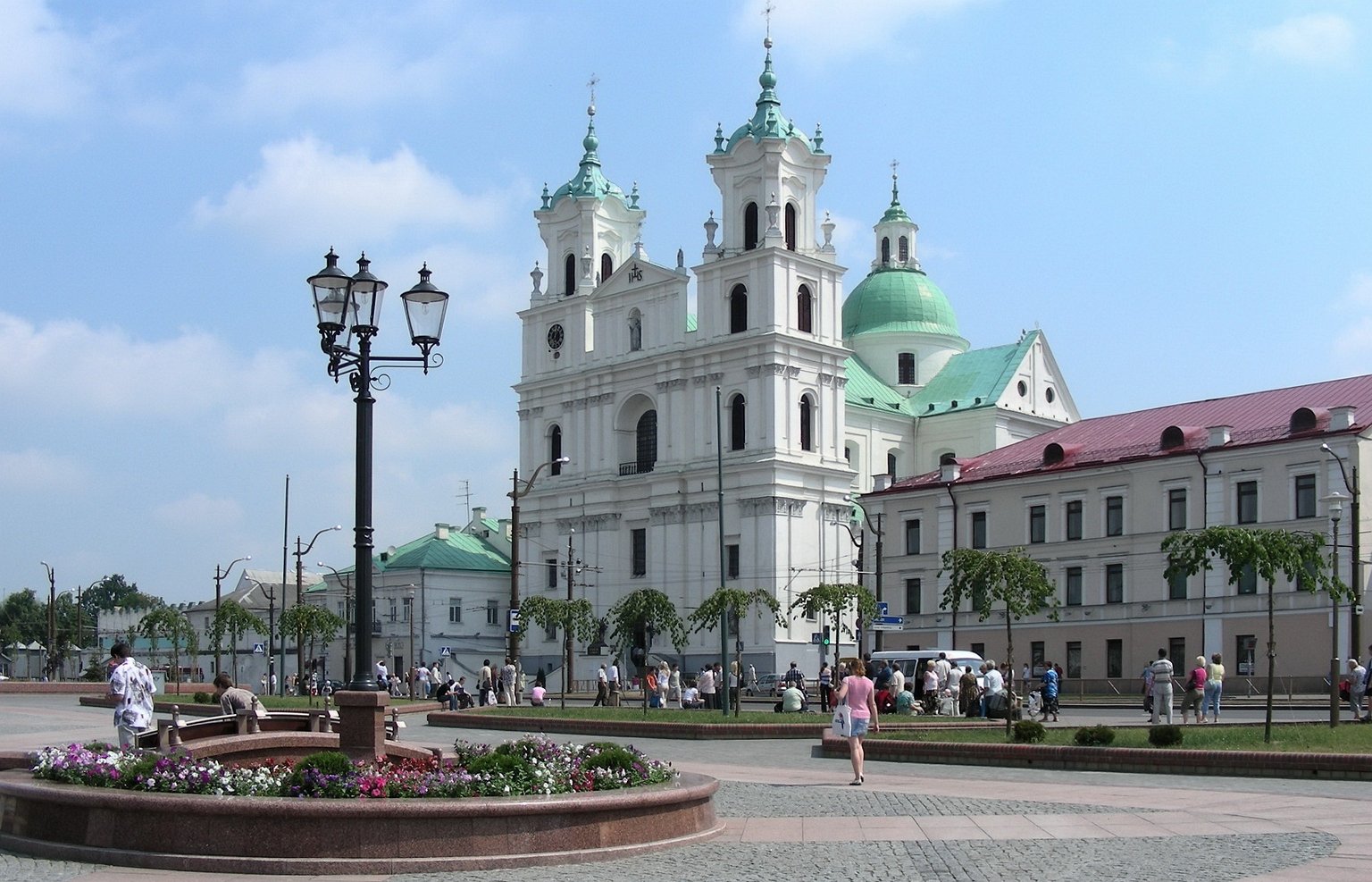
Hrodna — Grodno in Russian — sits on the high right bank of the Nioman river in the far west of Belarus, a stone's throw from the Polish and Lithuanian borders. It is one of the few Belarusian cities to escape wholesale destruction in the Second World War, and as a result it has the richest stock of old architecture in the country: baroque churches, Orthodox cathedrals, a surviving synagogue, and two castles overlooking the river.
The city has been Lithuanian, Polish, Russian, German, Soviet, and Belarusian by turns. Founded in the 12th century, it became a favoured residence of the Grand Dukes of Lithuania and later a second capital of the Polish-Lithuanian Commonwealth — King Stefan Batory held court here in the 16th century, and several sessions of the Polish Sejm were held in what is now the New Castle. That mixed heritage shows on every corner. The Old Castle, originally built in the 11th century and rebuilt by Batory, sits on a bluff above the river; the New Castle next door was added in the 1730s by the Saxon kings of Poland. Between them is the cathedral of Saints Francis Xavier (the Farny Kastsyol), a towering baroque Jesuit church whose mechanical clock, installed in the 15th century, is said to be one of the oldest still working in Europe.
The old town itself is quiet, walkable, and surprisingly pretty. Savieckaja Street, the pedestrian spine, runs past pastel townhouses, cafés, and the 12th-century Kalozha Church — a small, strange Orthodox church built of brick and coloured stones, half of which fell into the river in the 19th century and was rebuilt in wood. The Great Synagogue, one of the oldest in Europe, has been restored and is open to visitors.
Hrodna sees few foreign tourists, and Belarus is not an easy country to travel in, but the city is a natural entry point from Poland or Lithuania — and a gentler introduction to Belarus than the austere grandeur of Minsk.