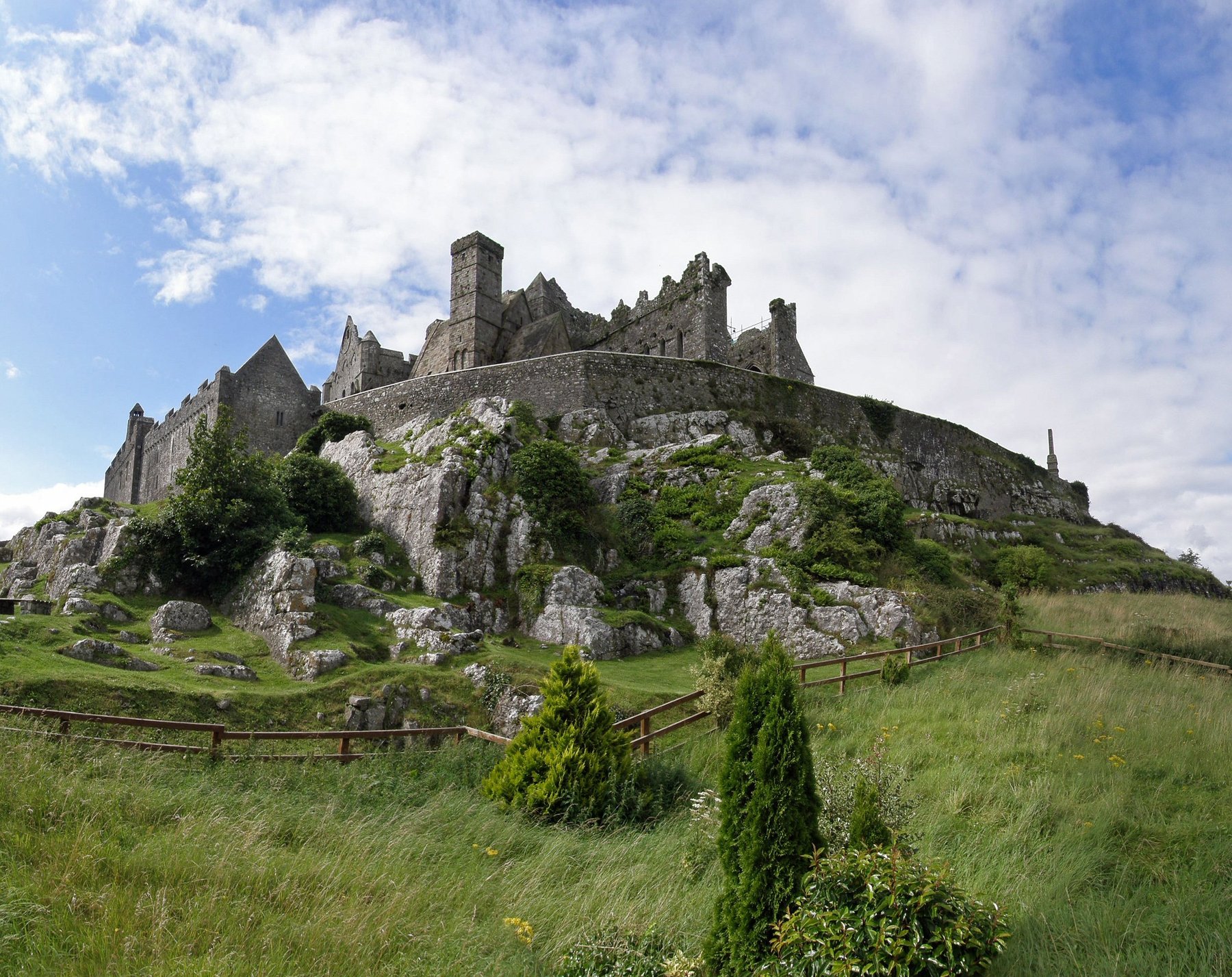
Cashel is a small town in County Tipperary, a little more than two hours south-west of Dublin, and is entirely overshadowed — both literally and figuratively — by the Rock that stands above it. The Rock of Cashel is a 60-metre outcrop of limestone rising straight out of the surrounding Tipperary plain, topped by one of the most dramatic collections of medieval buildings in Ireland: a round tower, a Romanesque chapel, a Gothic cathedral, and a 15th-century Hall of the Vicars Choral. Seen from the road at dawn or dusk, silhouetted against the sky, it is one of those rare sights that actually lives up to a thousand years of reputation.
The Rock was the seat of the Kings of Munster from the 4th century until 1101, when King Muirchertach Ua Briain granted it to the Church. St Patrick is said to have baptised King Aengus here in 450. Cormac's Chapel, built between 1127 and 1134 under King-Bishop Cormac Mac Carthaigh, is the first and finest Romanesque church in Ireland — inside, you can still see traces of the original 12th-century frescoes that decorated the walls. The larger cathedral next to it is 13th-century, built across the transepts and now roofless after being burned in 1495 by Gerald Fitzgerald, Earl of Kildare — who, when asked by Henry VII why he had burned the cathedral, reportedly replied "because I thought the archbishop was inside." The Round Tower, 28 metres high and the oldest building on the Rock, is an 11th-century marker of the site's importance.
Below the Rock, the Brú Ború cultural centre stages live performances of traditional Irish music and dance on summer evenings — a genuine showcase rather than a tourist set-piece. Hore Abbey, a ruined 13th-century Cistercian monastery, is a short walk from the Rock across an open field and almost always empty — arguably more atmospheric for the solitude than its more famous neighbour. The GPA Bolton Library off the main street holds one of the most important collections of early printed books in Ireland, including incunabula and early Irish texts.
Cashel itself is a small market town with a couple of good pubs and several decent places to eat. Most visitors come as a day trip from Dublin, Kilkenny, or Cork, but staying a night means you can walk up to the Rock at last light or first light, when the coach parties are gone and the ruins are at their best.