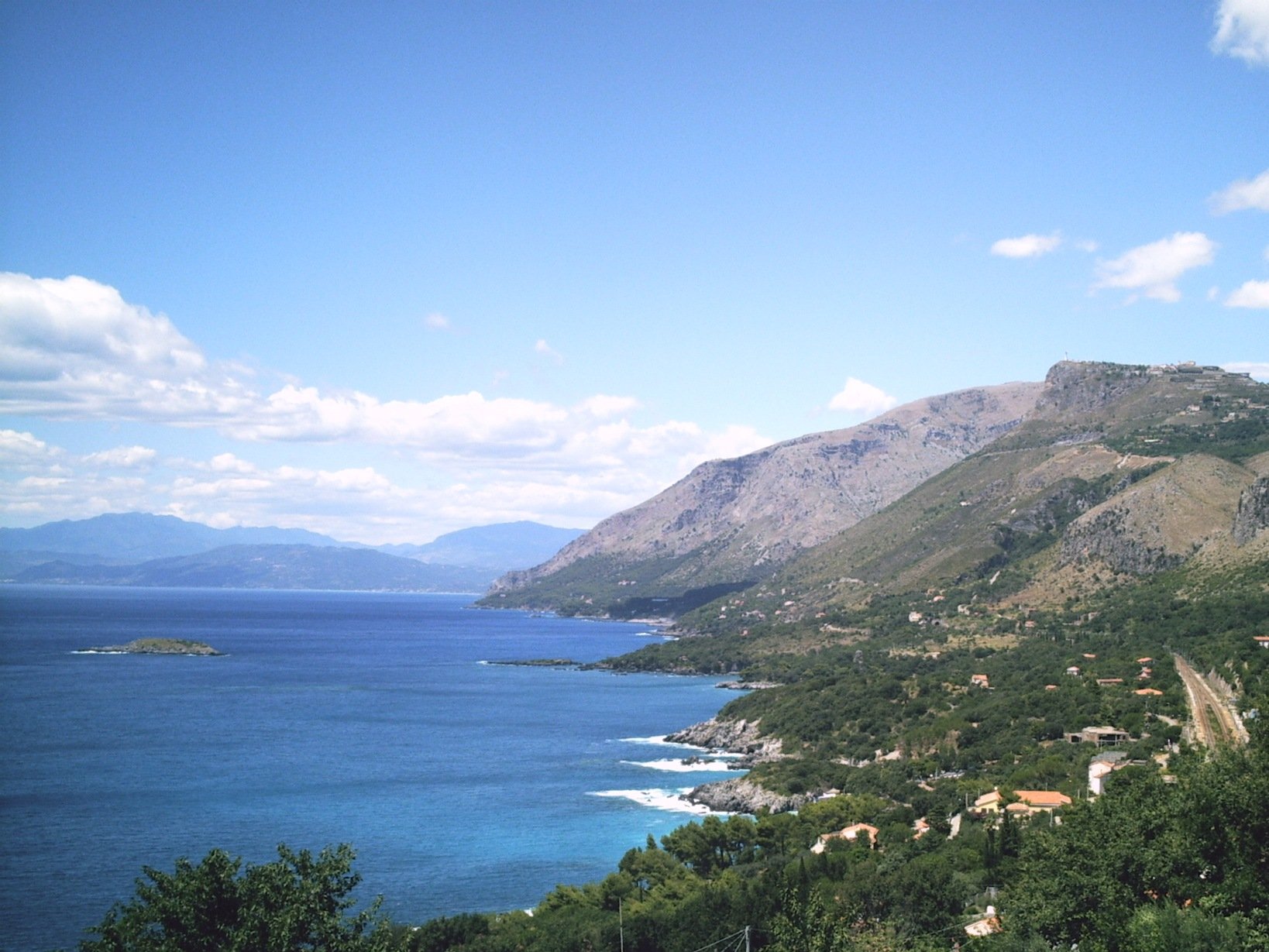
Basilicata's short Tyrrhenian coast, where cliffside Maratea overlooks coves and mountain-backed beaches.
The Costa di Maratea is Basilicata's only stretch of coastline — roughly 30 kilometres of dramatic cliffs, hidden coves, and clear Tyrrhenian water wedged between Calabria to the south and Campania to the north. It is one of southern Italy's least-known coastal areas, which is precisely its appeal.
The main town, Maratea, is actually a collection of small settlements strung along the hillside above the sea. The medieval borgo sits high up, clustered around narrow lanes and stone churches, with views down to the water. On the peak of Monte San Biagio above the town stands the Cristo Redentore — a 22-metre marble statue smaller than Rio's but striking against the sky, and a good hike or short drive for the panorama.
The beaches are small and rocky by Italian standards, many accessible only by boat or steep paths through the macchia. Cala Jannita, known locally as the Black Beach for its dark sand, is probably the most famous. Others — Cala di Filocaio, Spiaggia d'a Gnola — are quieter and feel genuinely wild. In summer, boat excursions from Maratea Porto visit the best coves.
The coast is not a resort strip — there are no high-rise hotels or big beach clubs. Accommodation is mostly small hotels and agriturismi scattered through the hills. The food is excellent: fresh seafood, hand-rolled pasta, and the fiery peperoni cruschi (fried dried peppers) that are Basilicata's signature. Getting here by public transport is possible but slow; a car opens up the winding coastal road properly.
Guide
Eating Out
Basilicatan cuisine is among the most distinctive in southern Italy, and Maratea's position on the coast adds excellent seafood to the regional repertoire. Look for spaghetti alle alici (with fresh anchovies), zuppa di pesce (fish soup with whatever the boats brought in that morning), and the local grilled dentice (sea bream). On land, the essential Basilicatan flavouring is peperoni cruschi — dried red peppers fried in olive oil until brittle, used to season pasta, meat, and as a snack in their own right. They appear on every menu.
Restaurants in the Porto are reliable but busy in high season; the better places are slightly inland or in the borgo. Prices are lower than you would expect for a coastal location, partly because the area has less package-tourism infrastructure than comparable parts of the Amalfi or Cilento coasts.
Guide
Getting There
Maratea has its own railway station on the Salerno–Reggio Calabria line, served by intercity and regional trains. Journey time from Naples is around 2.5 hours; from Rome (Termini) around 4 hours, usually with a change at Salerno. The station is at Maratea Porto, at sea level — a bus or taxi is needed to reach the borgo 3 km above.
By car, the coast is reached via the A2/A3 autostrada and then the SS18 coastal road. The winding coastal road is narrow in places and best driven slowly; in summer it can get congested at the most popular beach access points. The nearest airports are Naples (170 km) and Lamezia Terme in Calabria (80 km), both with car rental. There is no regular public bus service linking the various settlements along the coast, so a car or scooter is the most practical way to explore.