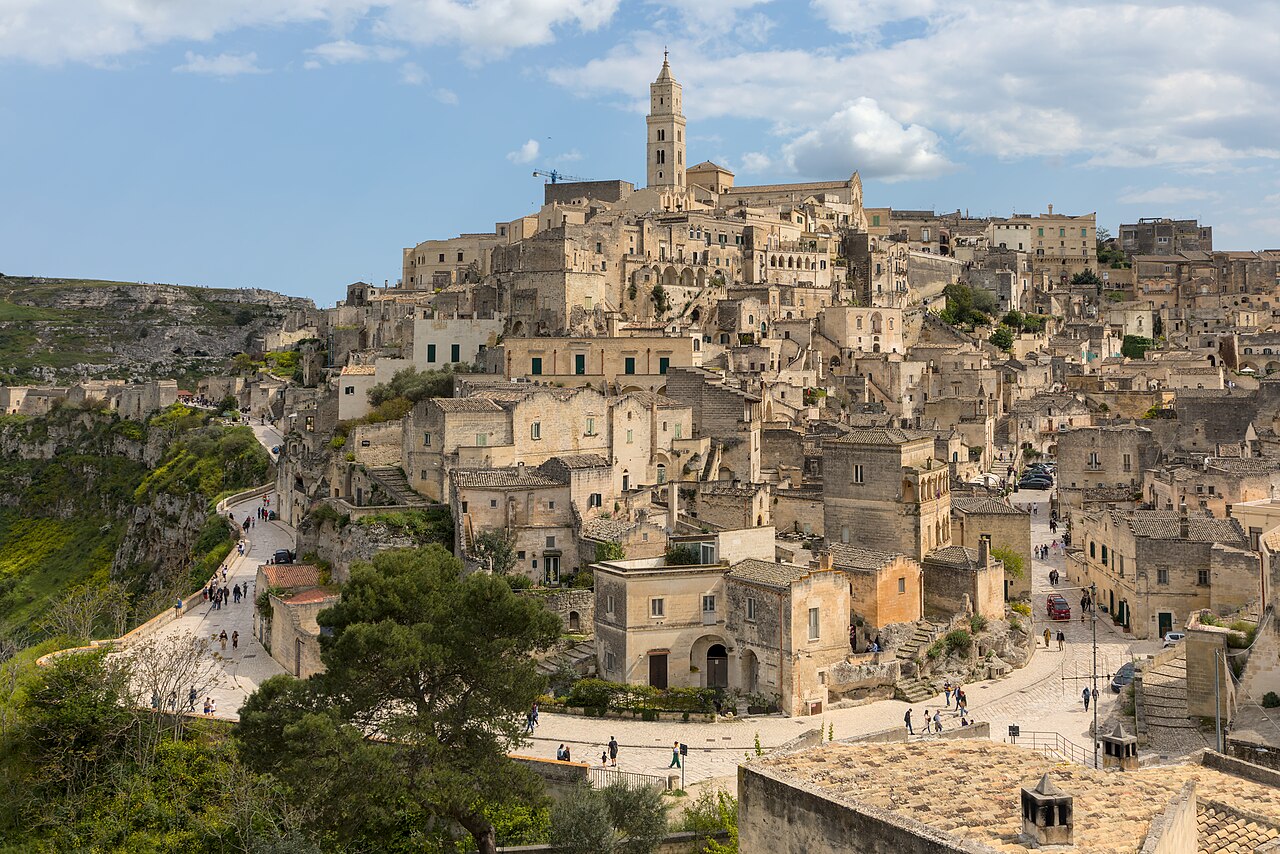
Matera is one of the most astonishing cities in Italy — a place where people have lived continuously since the Palaeolithic, carving homes, churches, and entire neighbourhoods into the soft tufa rock of two ravines. The result is the Sassi, a dense labyrinth of cave dwellings, rock-cut churches, and terraced alleyways that earned Matera its place on the UNESCO World Heritage list in 1993. It is also one of Europe's oldest continuously inhabited settlements.
The Sassi are divided into two districts: the Sasso Caveoso to the south, the older and more rugged of the two, and the Sasso Barisano to the north, which has been more thoroughly restored and now holds most of the hotels and restaurants. Walking between them along the ridge — past the Matera Cathedral at the apex — gives you views down into both ravines and across to the Murgia plateau on the far side, a wild, eroded landscape dotted with over 150 rock churches that served Byzantine monks seeking isolation.
The city was famous in Italy long before UNESCO arrived, though not in a flattering way. The Sassi were home to tens of thousands of people living in desperate poverty until the 1950s, when the government forcibly relocated residents to new housing on the plateau above. Carlo Levi's memoir Christ Stopped at Eboli brought the misery to national attention. Today the caves are being carefully restored — many are now boutique hotels, restaurants, and galleries, and MUSMA occupies cave rooms in the Sasso Caveoso as a museum of contemporary sculpture — but the history sits close to the surface, and Matera wears it honestly.
Matera has become increasingly popular since it was named a European Capital of Culture in 2019, but it remains genuinely distinctive. Come for the rock churches (including the eerie Crypt of the Original Sin outside town), the canyon walks, and the particular quality of light on the stone at dusk.