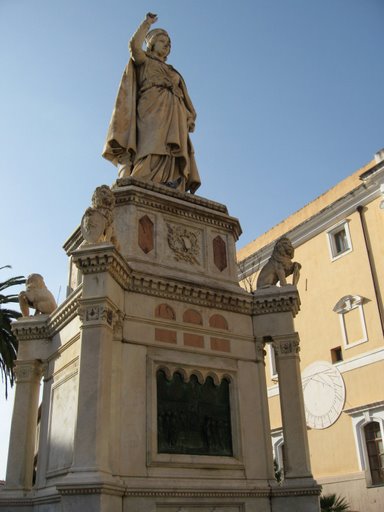
Oristano sits on the flat Campidano plain facing the Gulf of Oristano on Sardinia's west coast. It's a provincial town with a relaxed pace and an impressive medieval centre — less touristy than Cagliari or Alghero and none the worse for it.
The Piazza Roma is the heart of town. The Torre di Mariano II (also called the Torre di San Cristoforo), a 13th-century tower, dominates the square. The Antiquarium Arborense, just off the piazza, has a strong collection of Nuragic and Phoenician artefacts and some excellent painted altarpieces from the medieval Arborean period, when Oristano was the capital of an independent Sardinian kingdom.
The city is famous for Sa Sartiglia, one of Italy's most spectacular traditional festivals. Held on the last Sunday of Carnival and the Tuesday before Ash Wednesday, it involves masked horsemen performing acrobatic feats at a gallop, trying to thread a sword through a hanging star. If you can time your visit for Carnival (February), Sa Sartiglia alone is worth the trip.
The Sinis Peninsula, 20 km west of Oristano, is the site of Tharros — a Phoenician and Roman city founded in the 8th century BC and occupied until the 11th century AD. The ruins sit on a narrow headland above the sea with views to the islands of San Pietro and Sant'Antioco. The Peninsula also has some beautiful beaches and the strange, shallow Stagno di Cabras lagoon, where the famous muggini (grey mullet) and their roe — bottarga — are harvested.
South of Oristano, the Costa Verde offers long, undeveloped beaches backed by enormous sand dunes, with the ruined 19th-century mining town of Ingurtosu and the Montevecchio mine complex adding industrial archaeology to the mix.