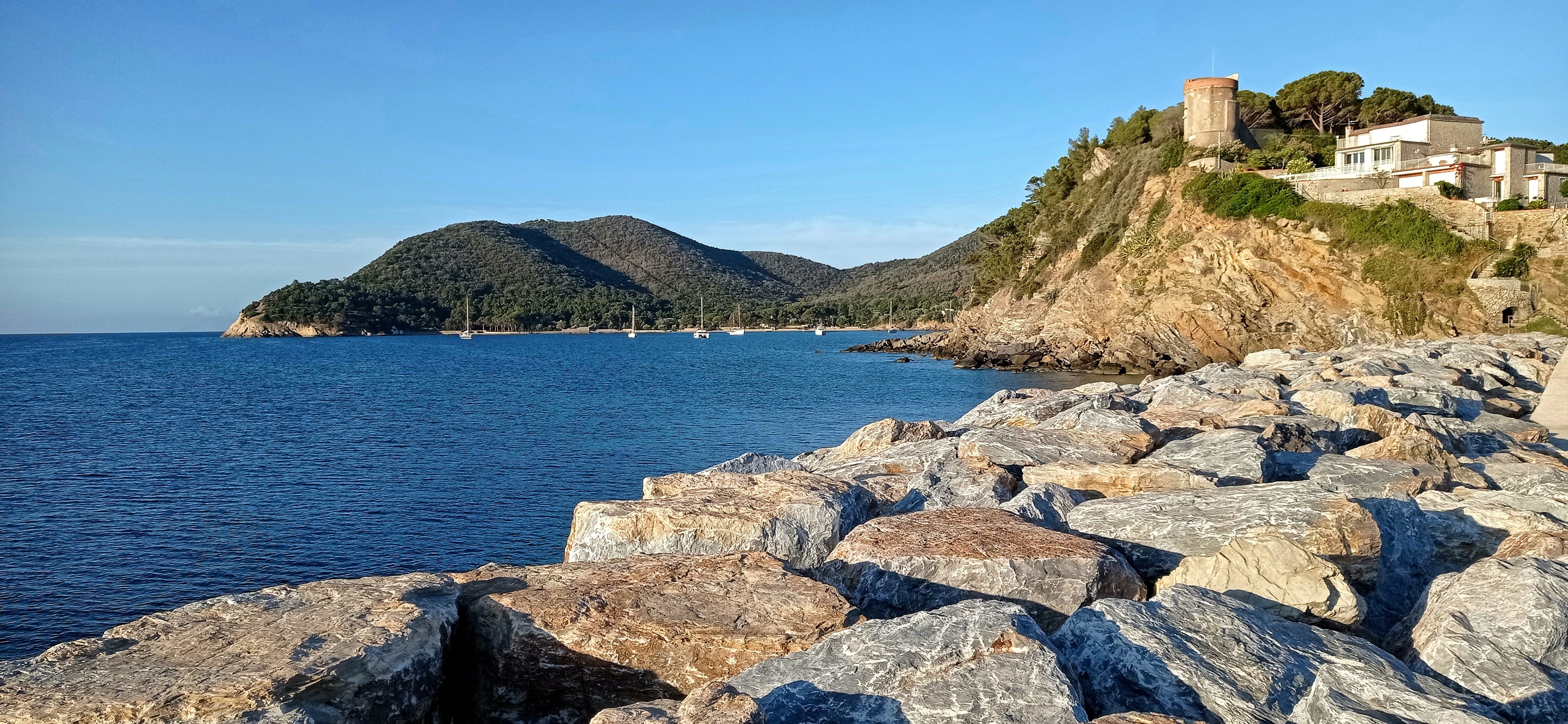
South-coast Elba resort town built around the island's longest sandy beach and a small fishing harbour.
Marina di Campo sits on the south coast of Elba where a broad, flat-bottomed valley meets the sea, giving the town what the rest of the island mostly lacks: a long sandy beach. At nearly two kilometres of fine golden sand, it is the largest beach on Elba, and that fact drives the town's entire economy. This is the family resort side of the island — busier and more commercial than Portoferraio or Marciana Marina, but hard to argue with when the water is clear turquoise and the beach is this wide.
The old fishing village centre clusters around a small harbour at the western end of the bay, where boats still go out at night and the waterfront restaurants serve what they brought back. The modern resort stretches east along the beach, backed by pine woods and a flat grid of streets that fills solidly in July and August. A few kilometres inland, at La Pila, sits the only airport in the Tuscan Archipelago — small, seasonal, but a useful entry point for visitors flying in from northern Europe.
History here runs deeper than the sunbeds suggest. The area has been inhabited since ancient times; Roman-era graves were found near the Castiglione hill above town, and the round watchtower at the harbour dates to the sixteenth century, built by the Pisans to watch for Barbary pirates. The municipality itself is relatively young, founded in 1894, but the village it was carved from — then known simply as Campo — had been a small fishing community for centuries, surrounded by vineyards on the hills and a pine forest that still gives the coast its character.
Come here for the beach, the diving on the offshore reefs, and the easy access to the rest of the island. The airport and the beach together make Marina di Campo the busiest entry point after Portoferraio in summer. Go in May, June, or September and you get the beach to yourself and restaurants that are open but not frantic.
Guide
Beaches
The beach at Marina di Campo is the longest on Elba — nearly two kilometres of fine golden sand curving around a sheltered bay, with the pine forest as a backdrop and the water staying shallow and calm well out from shore. The central stretch, in front of town, is lined with beach clubs (stabilimenti) that rent sunbeds and umbrellas by the day; you can usually find a fee stretch at the eastern end, where the beach widens out near the campsite area.
West of town, just past the harbour, the coast turns rocky and quieter almost immediately. Several small coves — Cala di Mola and Cala Morcone — are reachable by footpath or by kayak and tend to be much less crowded than the main beach.
Further west along the coast road, Fetovaia is widely considered one of the most beautiful beaches on Elba: a narrow crescent of white sand almost enclosed by granite headlands, with exceptional water clarity. It is a popular excursion from Marina di Campo — about 10 km along a scenic coastal road. Come early in summer; by mid-morning the small car park is full.
Guide
Eating Out
Marina di Campo's restaurants follow the Elban pattern: the emphasis is on seafood, the local wine shows up everywhere, and quality correlates loosely with distance from the beach front. The harbour area has the highest concentration of places to eat, ranging from good trattorie to tourist-facing pizzerias; for better food at better prices, explore the streets one or two blocks back from the waterfront.
The local specialities are the same you will find across the island: cacciucco (a dense Livornese-style fish soup), grilled or fried anchovies, and pasta with seafood. For meat, the Elban tradition leans towards grilled pork and wild boar stew — Campo is close enough to Monte Capanne's chestnut forests that the game is genuinely local. Finish with schiaccia briaca, a dense cake made with pine nuts, sultanas, and Aleatico wine. The sweet Aleatico itself — a red dessert wine indigenous to the island — is worth trying on its own.
The harbour is a working one, and a few boats still go out at night; ask at the fishing quay in the morning and you may be able to buy directly from whoever just came in.
Guide
Getting There
Marina di Campo is on the south coast of Elba, accessible once you reach the island.
By ferry: The main ferry port for Elba is Portoferraio, reached from Piombino on the mainland (roughly an hour by standard ferry, thirty minutes by hydrofoil). From Portoferraio, Marina di Campo is about 18 km by road — a 25-minute drive. Toremar and Moby run frequent crossings year-round; book ahead in summer, and well ahead in August.
By air: The small airport at La Pila, just 3 km from Marina di Campo, has seasonal connections from several Italian and northern European airports. It is the most convenient entry point for the south coast, though flights are limited and more expensive than the ferry. Check Skyalps and Silver Air for current routes.
By bus: The island bus service (ATL Elba) connects Portoferraio with Marina di Campo several times a day. Journey time is about 40 minutes. Services reduce significantly outside the summer season.
By car: Having a car or scooter is useful for exploring the rest of the island. Several rental agencies operate in Marina di Campo itself, so you can arrive by ferry or plane and hire locally.