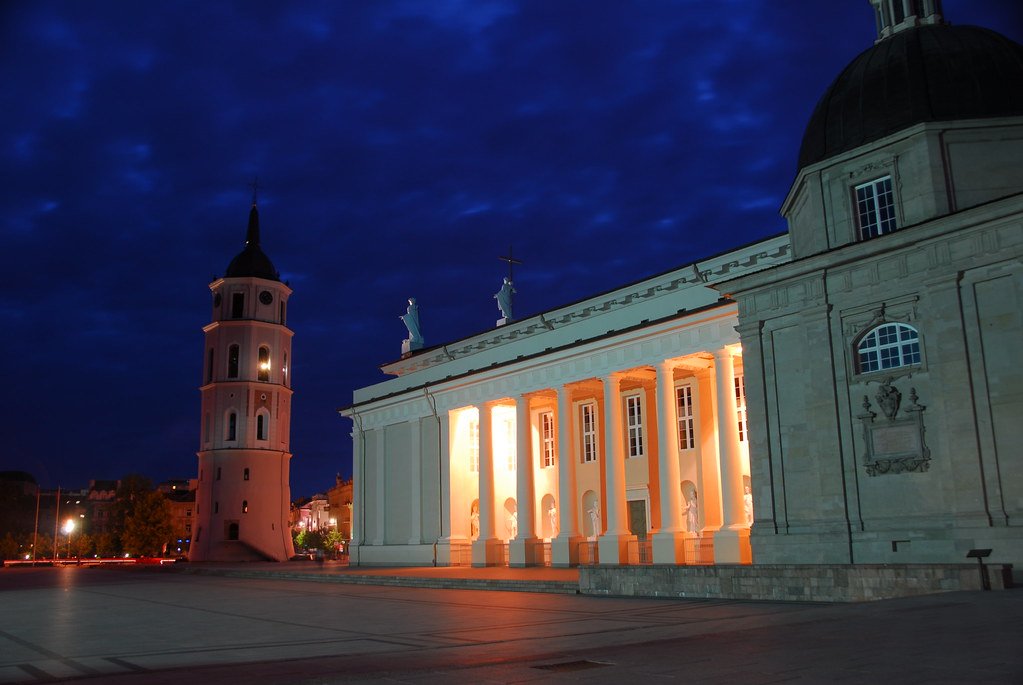
Vilnius is a city that reveals itself slowly. The Lithuanian capital has one of the largest surviving medieval old towns in Europe — a UNESCO World Heritage Site since 1994 — and yet it remains far less visited than its Baltic neighbours Tallinn and Riga. That relative obscurity is part of its appeal.
The Old Town is a maze of narrow cobbled streets, Baroque churches, and hidden courtyards. The skyline is dominated by church spires — Vilnius has more than 40 churches, and the variety of architectural styles is remarkable. St. Anne's Church is a Gothic masterpiece so elegant that Napoleon reportedly wanted to carry it back to Paris. The Cathedral, at the foot of Gediminas Hill, is a neoclassical landmark built on the site of a 13th-century pagan temple.
Climb the tower of Gediminas Castle for the best views over the Old Town. The Hill of Three Crosses, nearby, is the city's most recognisable symbol — three white crosses standing on a hilltop. The Gates of Dawn are the only surviving medieval city gateway, housing a miracle-working icon of the Virgin that draws pilgrims from across Lithuania and Poland.
Just across the river from the old town, the bohemian Užupis district declared itself an independent republic in 1997. Its constitution — displayed on a wall in 25 languages — includes articles guaranteeing the right of every dog to be a dog. Walk across the bridge, read the constitution, and find the mermaid on the riverbank.
Vilnius has a dark 20th-century history. The Museum of Occupations and Freedom Fights, in the former KGB headquarters on Gedimino Avenue, documents Soviet-era repression with the prison cells preserved. The Jewish quarter, once one of the great centres of Jewish intellectual life in Europe, was virtually destroyed during the Holocaust; the killing site at Paneriai is 10 km from the city centre. Vilnius University, founded in 1579, has 13 interconnected courtyards at the heart of the old town that reward exploration.
The city is compact and walkable. Public transport runs on buses and trolleybuses, and taxis are cheap by Western European standards.