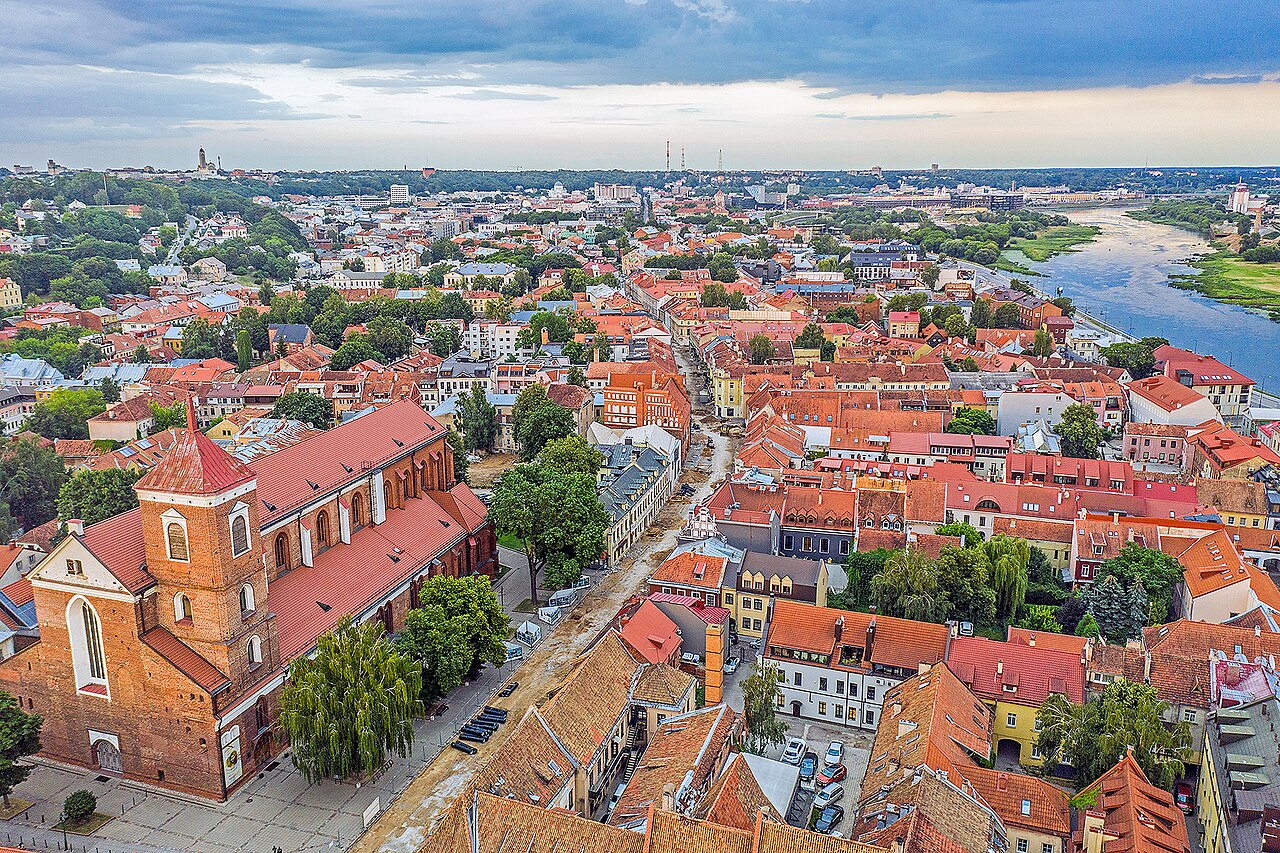
Lithuania's second city sits at the confluence of the Nemunas and Neris rivers, and many Lithuanians will tell you it is the most Lithuanian city of all. During the interwar years Kaunas served as the provisional capital, and that era left behind a remarkable collection of Art Deco and modernist architecture now recognised by UNESCO.
The most atmospheric part of town is the Old Centre around the Town Hall square, where 16th-century merchant houses line cobbled streets. The Town Hall itself — nicknamed the White Swan for its slender tower — is the centrepiece. Northwest of the square stand the remains of Kaunas Castle, first built in the mid-14th century to hold off the Teutonic Knights. Only fragments of wall and a round tower survive, but the setting at the rivers' junction is dramatic. Northeast, the Cathedral dates from the era of Vytautas the Great, though most of its current form is 18th-century Baroque.
The modern city stretches east along Laisves aleja (Freedom Avenue), a broad, tree-lined pedestrian boulevard running 1.6 km through the New Town. At its far end, the Church of St Michael the Archangel dominates Independence Square, alongside the Mykolas Zilinskas Art Gallery — home to one of the strongest art collections in the Baltics.
Kaunas has an unusual density of museums. The Devil's Museum houses over 3,000 devil figures from around the world, including a notorious carving of Hitler and Stalin dancing over Lithuanian skulls. The Ninth Fort, just outside town, is a sobering memorial — originally part of the city's defensive ring, it became a Nazi execution site during WWII and is now a museum documenting those crimes. The Sugihara House is equally important: it was here that a Japanese diplomat defied his government to issue thousands of transit visas to Jewish refugees in 1940, saving around 6,000 lives.
The Freedom Monument at the eastern end of Laisves aleja marks the city's political memory — demolished during the Soviet occupation and rebuilt after independence. The Historical Presidential Palace in the Old Town documents the interwar period when Kaunas was the national capital. The Vytautas the Great War Museum on Independence Square completes a trio of sites that together make Kaunas one of the best places in the region to understand 20th-century Baltic history.