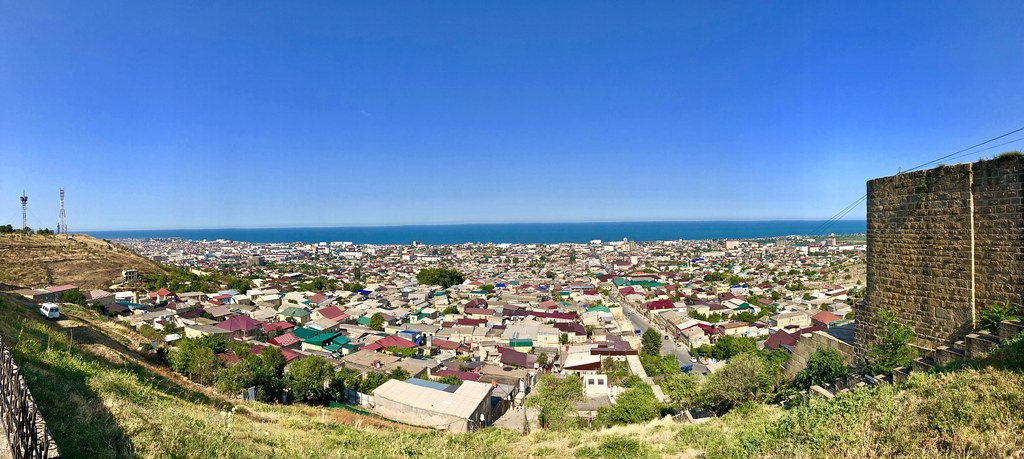
Derbent is arguably the oldest city in Russia, wedged onto a narrow three-kilometre strip of land between the Caspian Sea and the Caucasus mountains. That geography made it the key to controlling movement between south-eastern Europe and the Middle East for millennia, and every empire that wanted the Caucasus came here first — Sassanids, Arabs, Khazars, Mongols, Persians, and Russians all left their mark. The result is a city that wears its history openly, in the form of massive ancient walls, a well-preserved citadel, and a layered cultural identity that mixes Russian, Azerbaijani, Lezgin, and Tabasaran influences.
The city sits on the slopes of the Tabasaran mountains (part of the Greater Caucasus range), with the Caspian glittering to the east. Two great defensive walls run from the mountains down to the sea, dating from the 6th century under the Sassanid dynasty. Much of that stonework is still standing. The citadel, Narin-kala, crowns the hill above the old town and encloses 4.5 hectares of ancient baths, cisterns, a caravanserai, and a mosque converted from a Christian basilica. Derbent's historical core is a UNESCO World Heritage Site.
The population of around 90,000 is predominantly Azerbaijani, with significant Lezgin and Tabasaran communities — the North Caucasus at its most ethnically diverse. Islam has been present here since the Arab conquest of 654 AD, making Derbent one of the oldest Muslim cities in the former Soviet Union. The Juma Mosque, built inside a 6th-century Christian basilica with a 15th-century madrassa attached, tells that story in stone. An ancient synagogue belonging to the Mountain Jewish community and an Armenian church add further layers to the city's religious history. On the Caspian shore north of town, a beached Soviet Ekranoplan provides a surreal Cold War coda.
Getting to Derbent from elsewhere in Russia requires navigating both distance and the realities of Dagestan — a region that has seen significant instability, though Derbent itself is generally considered safer than other parts of the republic. Russian visa procedures add another layer of complexity for foreign visitors. But for those willing to make the effort, the city is unlike anywhere else in Russia: ancient, multilayered, and largely off the tourist trail.