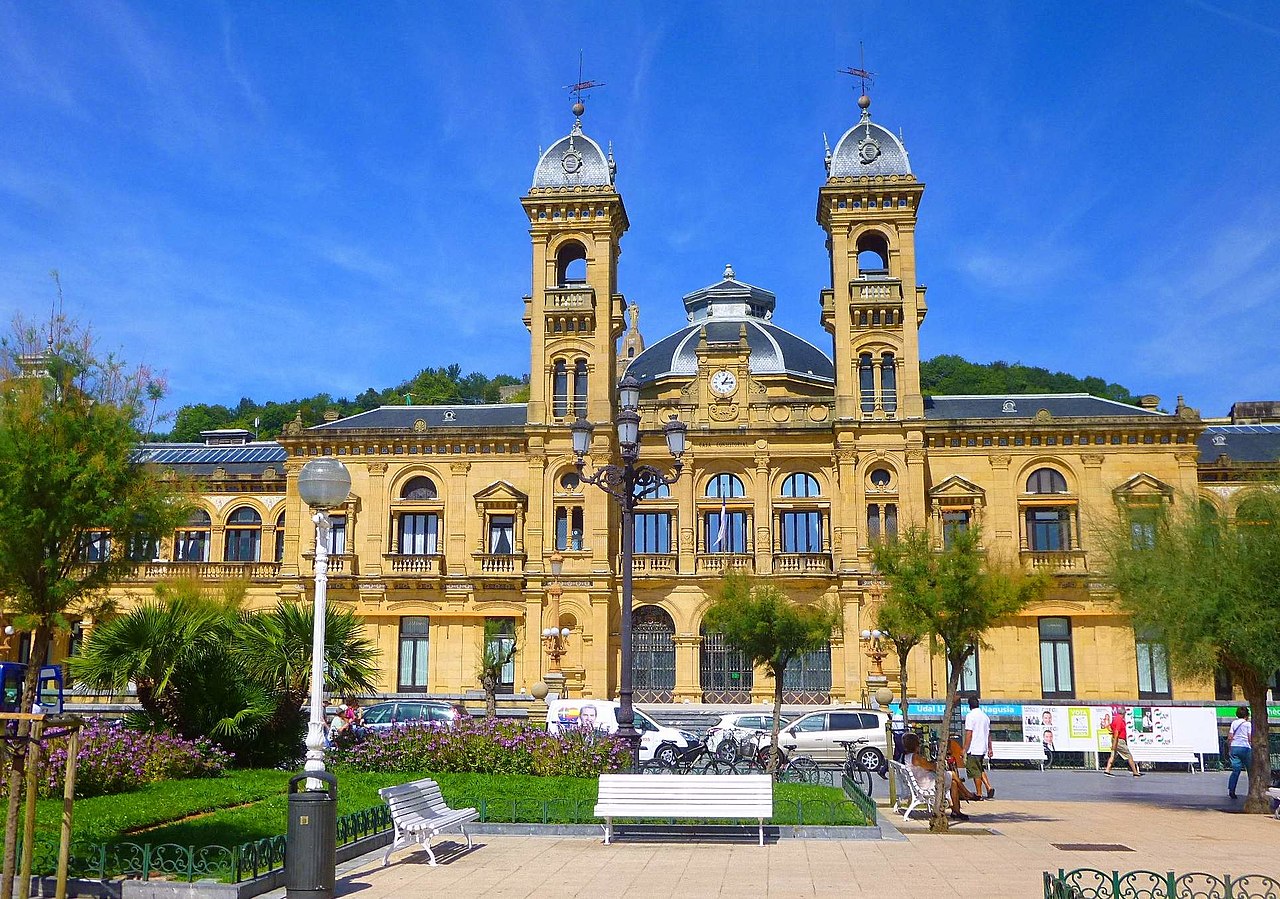
San Sebastián — Donostia in Basque — is a small, impossibly elegant city on the Bay of Biscay in the north-eastern corner of Spain, just 20 kilometres from the French border. It is widely considered one of the most beautiful small cities in Europe, and unlike most of Europe's prettiest places it has earned the reputation on its own terms rather than for any single monument. The setting is extraordinary: a perfect crescent bay (the Bay of La Concha) bounded by two wooded hills and a small island, an elegant 19th-century city wrapping around it, and a medieval old town (the Parte Vieja) tucked at one end that is widely acknowledged as having the best food per square metre of anywhere in the world.
Playa de la Concha is the most famous urban beach in Spain — a long curve of fine pale sand right at the foot of the old town, with a white iron railing and parasols that appear each morning like clockwork. Walk the paseo (the seafront promenade) west to Monte Igueldo for the classic elevated view back over the city, or east to Monte Urgull for the old fortress and the giant statue of Christ at its summit. Beyond the bay, Playa de la Zurriola, on the other side of the Urumea river, is where the surfers go.
The real reason to come is the food. San Sebastián has more Michelin-starred restaurants per capita than any city in the world — including three of Spain's three-star places (Arzak, Akelarre, and Martín Berasategui) — but it is the tapas bars of the Parte Vieja, where the Basques invented their own version of tapas called pintxos, that make this the food capital of Europe. Walk the narrow streets around Calle Mayor and 31 de Agosto after 8pm, push your way up to the bar of one pintxo place after another, and eat small plates of perfectly constructed bites — anchovies on bread, gilda skewers, stuffed txangurro crab, grilled foie on caramelised apple. Most people do five or six bars in an evening. Wash it down with txakoli, the dry, slightly sparkling local white, poured from bottles held high to aerate it.
In September, San Sebastián hosts the Festival Internacional de Cine at the Kursaal, one of Europe's top film festivals alongside Cannes, Venice, and Berlin, which turns the whole city into a ten-day red carpet. The San Telmo Museoa is the best place to understand Basque history and culture. It is also the place to base yourself for exploring the Basque country: Bilbao and the Guggenheim are 100 km west, the French Basque coast (Biarritz, Saint-Jean-de-Luz) is 30 km north, and the wine region of Rioja Alavesa is 90 km south. Come in late spring or early autumn to avoid the worst of the crowds and get the best weather — the Atlantic rain, which the Basques call sirimiri, is a permanent feature of the climate the rest of the year.