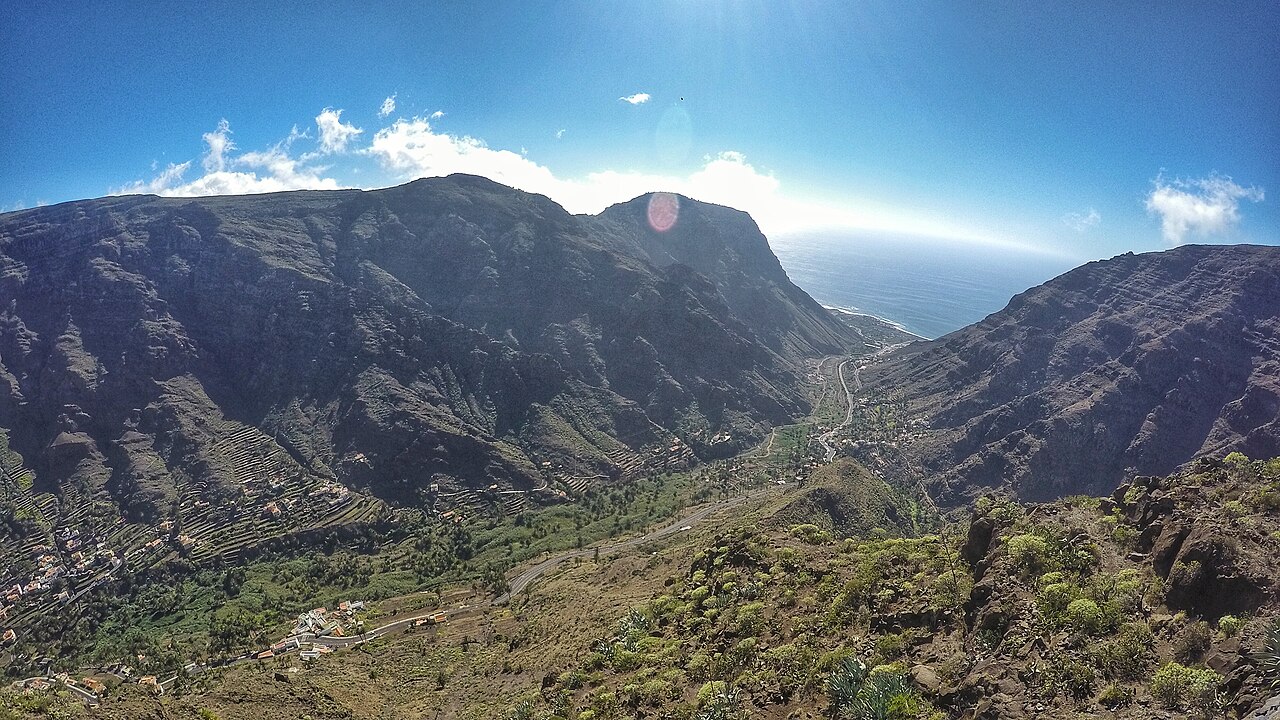
La Gomera valley resort of terraced cliffs, black-sand beaches, and long-stay alternative travellers.
Valle Gran Rey is a steep valley on the western coast of La Gomera, one of the smaller Canary Islands. The valley drops dramatically from the central highlands to the sea, its terraced sides once covered in palm groves and banana plantations. Since the 1970s it has been a magnet for alternative travellers and long-stay visitors drawn by the warm winters, cheap rents, and unhurried pace.
The settlement is really a string of small villages. La Playa at the bottom has a black sand beach, a handful of restaurants, and the harbour at Vueltas where ferries run to Tenerife and fresh catch is sold straight off the boats. Higher up, La Calera clings to the valley wall with spectacular views. The whole area is excellent for walking — trails lead up through the terraces to the laurel forests of Garajonay National Park, a UNESCO World Heritage Site.
Valle Gran Rey remains one of the most relaxed corners of the Canaries, a world away from the mass tourism of Tenerife's southern coast.
Guide
Getting There
Valle Gran Rey is reached by ferry from Los Cristianos in southern Tenerife (Fred Olsen and Naviera Armas run multiple daily crossings; about 50 minutes). From there, a public bus (lines 1 and 5) crosses La Gomera from the port of San Sebastián de La Gomera to Valle Gran Rey in about 1.5 hours, passing through the central mountains. Taxis and rental cars are available at San Sebastián.
La Gomera also has a small airport near San Sebastián, with direct flights from Gran Canaria, Tenerife Norte, and a few mainland Spanish cities. The airport is small and flights are not always reliable, so the ferry from Tenerife is often the more dependable option.
Guide
When to Go
Valle Gran Rey is a year-round destination. Winter (December–March) is the peak season — mild temperatures (20–25°C), low rainfall, and the draw of warm Atlantic sunshine attracting northern Europeans escaping their winters. The valley fills with German and Scandinavian long-stay visitors in January and February.
Summer is warm (27–30°C), the sea is at its best for swimming, and crowds are thinner than in winter. The laurel forest trails in Garajonay are at their most atmospheric in autumn, when mist frequently descends into the upper forest. There is no bad time to visit.