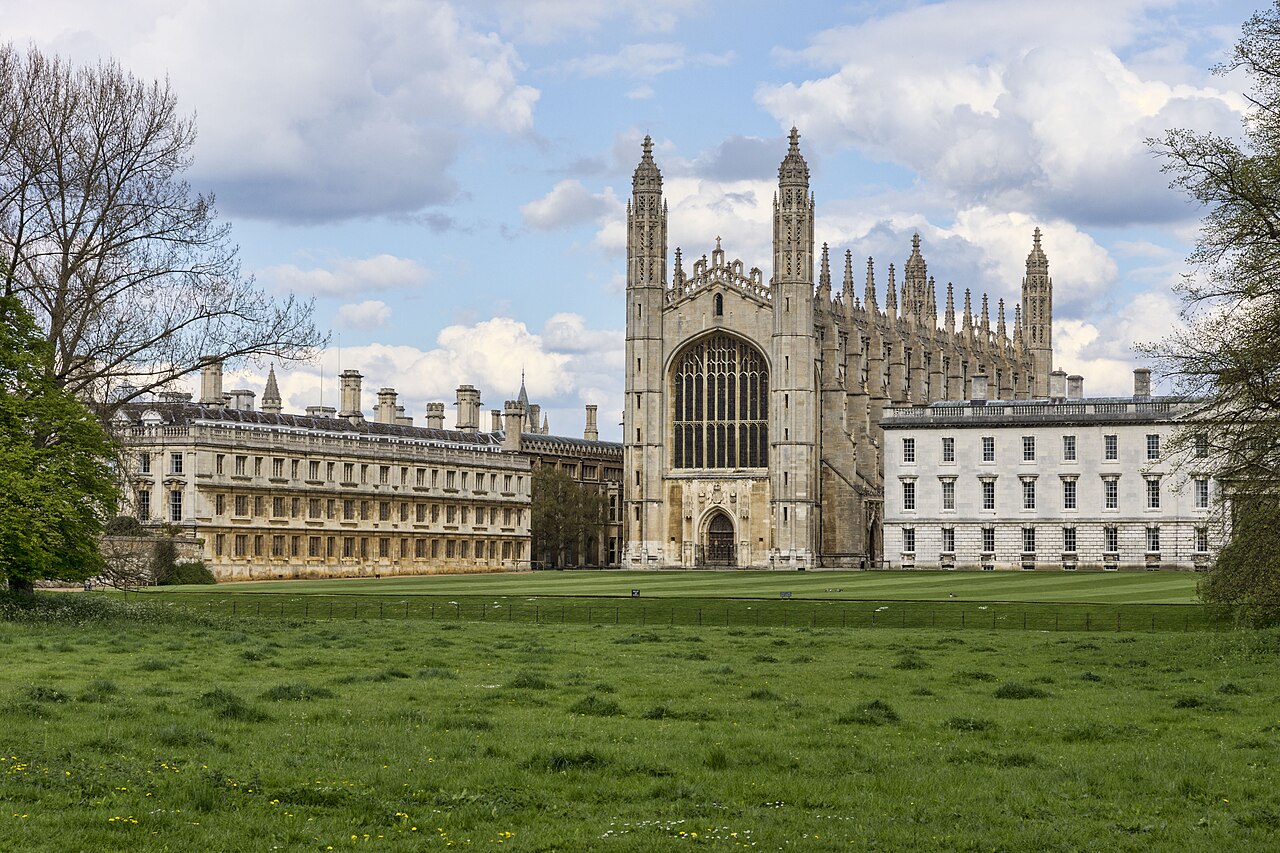
Cambridge is one of the two great English university cities, a small market town of about 145,000 people on the River Cam roughly 80 km north of London. The university was founded in 1209 by scholars fleeing a riot in Oxford, and for the eight centuries since then it has produced more Nobel laureates than almost any other institution on earth — Newton, Darwin, Rutherford, Crick and Watson, Turing, Hawking, and so on. Today Cambridge is a curious mixture of the 16th century and the 21st: medieval stone courtyards and punts drifting under willow trees, and, a mile up the road on the Madingley Road, the enormous science parks and biotech startups that have earned the region the nickname "Silicon Fen".
The city is built around the 31 colleges of the University, each a self-contained community of students, Fellows, chapels and dining halls. A handful of the most famous — King's, Trinity, St John's, Clare, Queens' — sit along the river on the stretch known as The Backs, where the college lawns run down to the Cam through a succession of bridges. King's College Chapel (begun by Henry VI in 1446, completed by Henry VIII in 1515) is one of the great late-Gothic buildings in Europe, with the largest fan vault in the world and Rubens' Adoration of the Magi over the altar; the chapel choir's Christmas Eve service of Nine Lessons and Carols is broadcast live from here around the world every year. Trinity College, the largest, has the extraordinary Wren Library with its collection of Isaac Newton's and Ludwig Wittgenstein's manuscripts. St John's College has the covered Bridge of Sighs across the river. Gonville and Caius College was home to Stephen Hawking for most of his career. Note that many colleges charge a small entrance fee in term time, and some close entirely during exam periods.
Beyond the colleges, the Fitzwilliam Museum is a surprisingly rich collection of Egyptian antiquities, Italian and Dutch masters, and French impressionism, all free and rarely crowded. The Mathematical Bridge at Queens' College is a famous wooden structure often incorrectly attributed to Newton. And the defining Cambridge experience — indispensable in summer, questionable in February — is punting on the Cam, either along the college Backs or upstream to the village of Grantchester, where you can moor up, have tea at the Orchard, and pretend for an afternoon that nothing has really changed since Rupert Brooke wrote about the place in 1912. The Corpus Clock on King's Parade and the Eagle pub where Crick announced the discovery of DNA are two more essential stops.