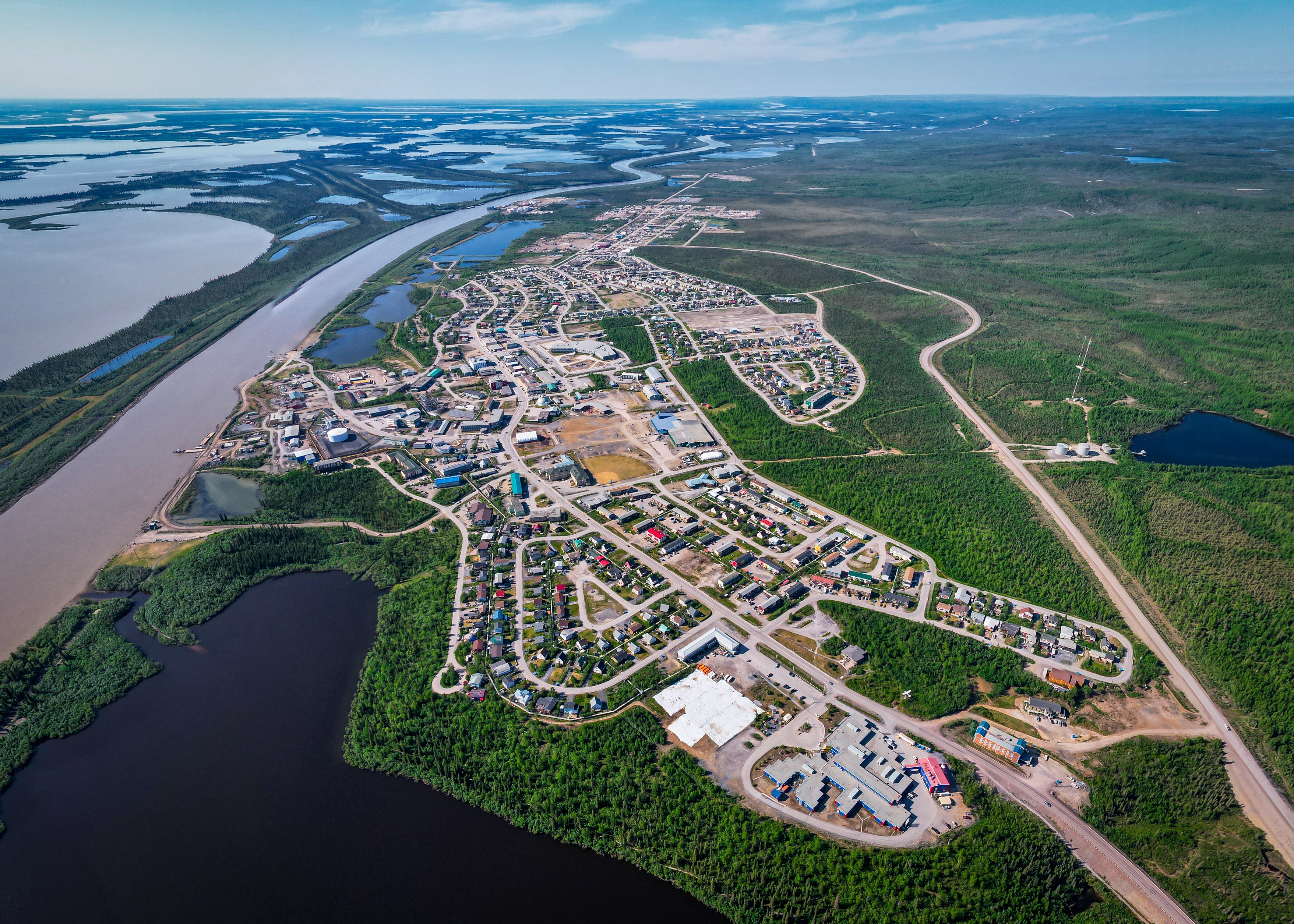
Inuvik
©
Inuvik

Inuvik

Northwest Territories town on the Mackenzie River Delta at the end of the Dempster Highway.

Inuvik sits at the end of the Dempster Highway in Canada's Northwest Territories — the northernmost point you can reach by public road in North America until you turn onto the Tuktoyaktuk Highway and continue another two hours to the Arctic Ocean. It is a small town of about 3,000 people on the Mackenzie River Delta, built in the 1950s as an administrative centre and now serving as the main hub for the western Arctic.

The town is above the treeline and above the Arctic Circle. In summer the midnight sun shines for 56 days straight, and in winter the sun disappears for 30 days. The igloo-shaped Our Lady of Victory Church is the town's most distinctive building, but the Community Greenhouse — built into a converted hockey arena and growing tomatoes 200 km above the Arctic Circle — is the more remarkable story. The small Midnight Sun Mosque, trucked and barged 4,000 km from Winnipeg in 2010, sits at the north edge of town. The Great Northern Arts Festival in July draws Inuit, Gwich'in, and circumpolar artists from across the Arctic.

Most visitors come for the Dempster Highway itself — one of the great drives in North America, 740 kilometres of gravel road across Arctic tundra from Dawson City in the Yukon — or for the northern lights, which are reliably visible on clear nights from late August through April. In summer, the boat tours of the Mackenzie Delta are the best way to get out beyond the town.

Guide

Getting Around

Inuvik is small — fifteen minutes' walk end-to-end. The Igloo Church, the greenhouse, the visitor centre, the museum, the supermarket, and most hotels are all within that radius and on foot is the obvious way.

A taxi service runs in town; cars can be rented (book months ahead in summer). For trips out — the Mackenzie Delta, the Tuktoyaktuk Highway, aurora viewing — most visitors use the local tour operators (Tundra North Tours, Arctic Chalet, Up North Tours) rather than self-driving. Renting a vehicle for the Dempster from Whitehorse or Dawson City is more common.

Guide

Getting There

The classic approach is the Dempster Highway from Dawson City in the Yukon — 740 kilometres of gravel road across Arctic tundra. Stop at the visitors centre in Dawson before you start for current conditions and advice. The road is mostly coarse gravel that will crack your windshield if you follow another vehicle too closely or drive too fast — 70 km/h is the sensible maximum. Bring spare tyres, spare fuel, and get glass coverage on your rental car. You will be glad you did.

The drive is extraordinary — hundreds of kilometres of open tundra, wild horses, eagles, snow on the ground in July, and the crossing of the Arctic Circle. The only stop between Dawson and Inuvik is Eagle Plains, roughly the midpoint. It has fuel, a restaurant, a mechanic, and a motel — book ahead if you want to stay overnight. In summer, ask for a room on the east side of the building; the midnight sun keeps west-facing rooms uncomfortably warm.

You can also fly — Canadian North operates scheduled flights from Yellowknife and Whitehorse. Since 2017, the Inuvik-Tuktoyaktuk Highway extends the road system to the Arctic Ocean.

Guide

When to Go

Inuvik has two real seasons and two short transitions between them — and which one you want depends on what you have come for.

Summer (June–early August) is the time of the midnight sun — 56 days when the sun does not set. Temperatures climb into the high teens (°C); the delta opens up; the Dempster Highway is at its driest. It is also when the Great Northern Arts Festival runs in mid-July and when mosquitoes are at their worst. The flat light of 2 a.m. takes some getting used to; the windows of most hotels have heavy curtains.

Aurora season (late August–mid-April) brings the northern lights, the dog-sledding, and the ice road to Aklavik. The deep winter months are punishingly cold (-30°C and worse, multiple weeks below -40°C). February and March are the sweet spot — long nights for the lights, days starting to return, temperatures slightly less brutal.

Shoulder seasons (May, September–October) are short and difficult: break-up and freeze-up mean roads, ferries, and ice crossings are all unreliable. Aim for one of the two main seasons rather than around them.