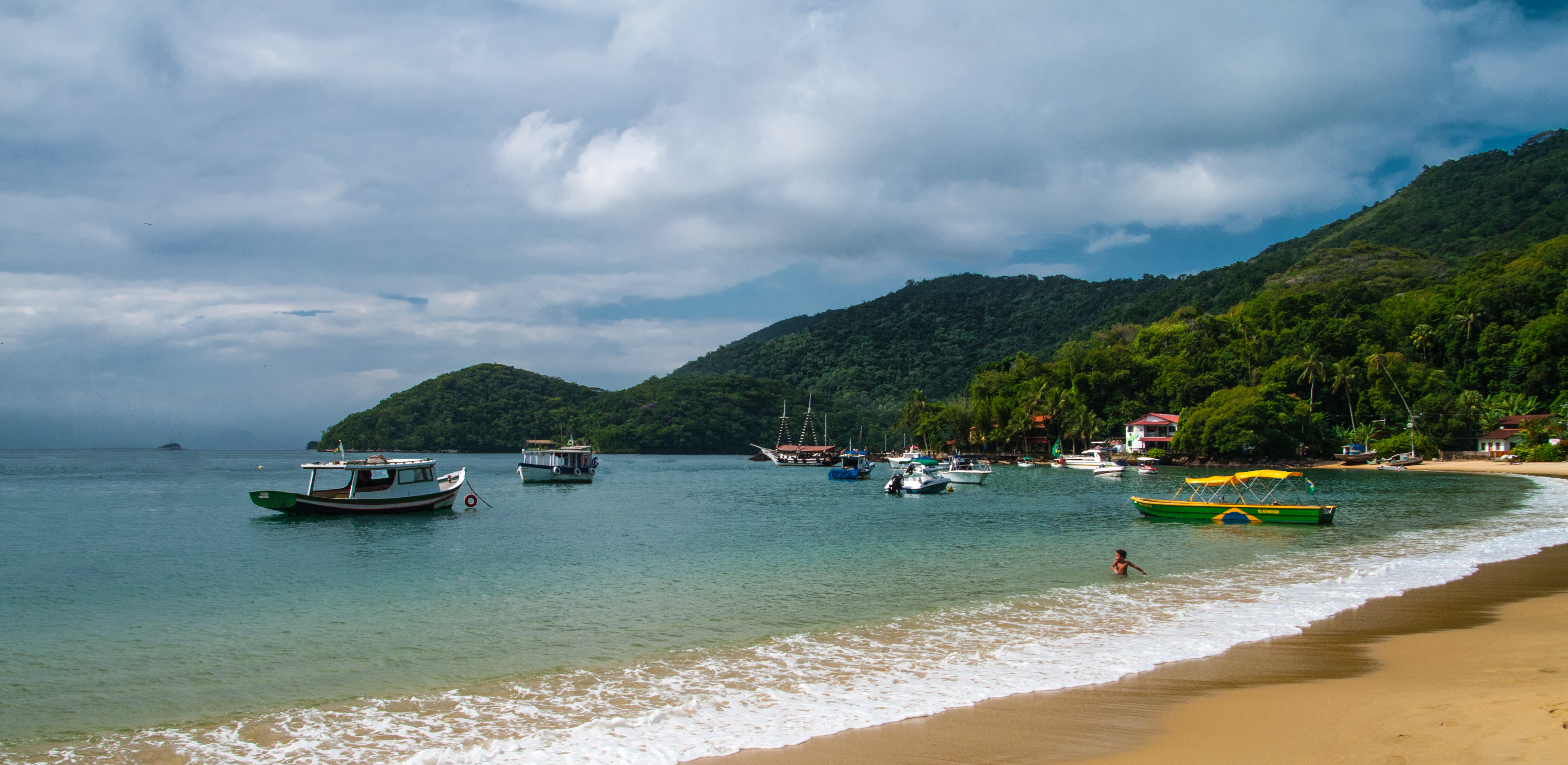
Car-free Atlantic Forest island on Brazil's Green Coast, known for trails and beaches.
Ilha Grande is a 193 km² island of Atlantic Forest, granite peaks, and unreasonably beautiful beaches, set in the great bay of Angra dos Reis on Brazil's Green Coast. There are no roads on the island, no cars, no banks, and almost no street lighting; visitors get around on foot, by boat, or — in the village — by handcart. It is one of those rare destinations that arrived in the twenty-first century as a working ecological reserve rather than as a resort, and the result is a place where the rainforest comes right down to the sand.
Most boats land at Vila do Abraão, a loose grid of pousadas, restaurants, dive shops, and small bars facing a horseshoe bay on the north coast. Abraão is the only real settlement and the obvious base. From here, trails fan out across the steep, forested interior — past the ruins of the old prison and the aqueduct, up to the granite summit of Pico do Papagaio, or all the way across the island to Lopes Mendes, which regularly turns up on lists of the world's best beaches.
The island's strange history is part of what kept it wild. For more than a century it housed a leper colony and then a notorious maximum-security prison (the Cândido Mendes penitentiary, blown up in 1994); it also held a yellow-fever quarantine station. Development was forbidden throughout, and when the prison closed the whole island was designated a state park. The forest is now home to howler monkeys, caimans, sea turtles, and, on the southern beaches, a thriving population of nesting birds.
Practical notes: bring cash. There is one slow ATM in Abraão and it is often broken. Boats run to Abraão from Angra dos Reis, Conceição de Jacareí, and Mangaratiba on the mainland, several times a day. Stay at least two nights — three or four is better. The water is clear, warm, and full of fish; bring a snorkel mask if you have one.
Guide
Eating Out
Ilha Grande eats well. Almost all of the restaurants are in Abraão, clustered along the waterfront and on the inland sand streets behind it, with a handful of beach kiosks elsewhere on the island.
The local speciality is fish moqueca — a Bahian-style stew of white fish, coconut milk, palm oil, tomato, and coriander, served bubbling in a clay pot with rice and pirão (a manioc-flour porridge). Almost every restaurant in town does its own version; one pot easily feeds two. Grilled shrimp and caldeirada de peixe (a brothier fish stew) are also widely available.
For a budget meal, the simple per-kilo buffets a block back from the waterfront are excellent value — pick what you want, pay by weight, get a plate of grilled fish, rice, beans, salads, and fried banana for around R$45-65 a head. Several bakeries sell pastries and good coffee from early morning. Reserve at the better restaurants in summer; queues can be long.
Guide
Getting Around
There are no cars on Ilha Grande. The two ways to get around are on foot, using the network of forest trails that crisscross the island, and by boat. In Abraão, luggage and freight move on wooden handcarts pulled by locals.
Walking: Trails are numbered and marked, but distances are deceptive — the steep terrain and humidity slow you down. The official trail map (available at the state park office) gives realistic walking times.
Boat taxis: Small boats line up along the Abraão beachfront throughout the day and run to most of the major beaches on the north and east coasts. A spot on a shared boat to Praia das Palmas (for the Lopes Mendes walk) costs around R$15-25 per person, more for the round-the-island tours.
Schooners (escunas): Day trips from Abraão circle the island or cover the main beaches in a single loop. Prices are reasonable, especially if you negotiate with one of the captains directly on the beach.
Guide
Getting There
The only way to reach Ilha Grande is by boat. Three mainland ports run regular services to Vila do Abraão.
From Angra dos Reis: The classic departure. State-run ferries (Barcas SA) take about 90 minutes and run twice a day; private fast catamarans take 30–40 minutes and run hourly. The ferry terminal is a 15-minute walk from the Angra dos Reis bus station.
From Conceição de Jacareí: A small fishing village halfway between Angra and Paraty on the BR-101. Schooner-style boats run several times a day to Abraão, taking about 50 minutes. Most direct transfers from Rio go via here.
From Mangaratiba: A daily ferry takes about 90 minutes. Slightly less convenient unless you are coming from the Rio side.
Getting to the ports: From Rio de Janeiro, regular Costa Verde buses run to Angra dos Reis (about 3 hours) and Mangaratiba; many tour operators run direct van services from Rio to Conceição de Jacareí.