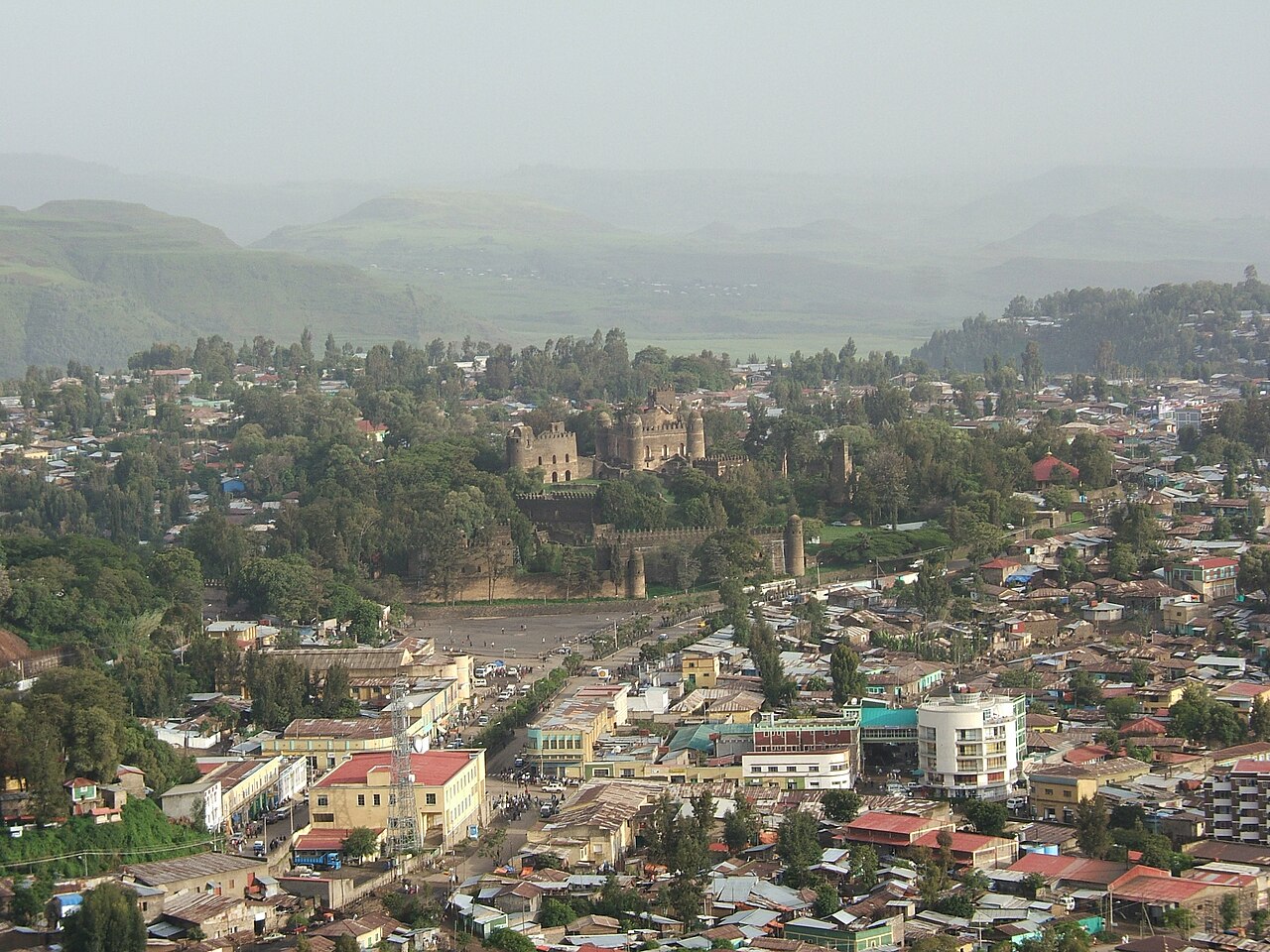
Former Ethiopian royal capital known for Fasil Ghebbi's castle complex and Gondarene church art.
Gondar was founded by Emperor Fasilidas around 1635 and served as Ethiopia's royal capital for over two centuries. It is famous for a remarkable complex of medieval castles — a walled enclosure called the Royal Enclosure (Fasil Ghebbi) — that looks more like something from medieval Europe than from equatorial Africa. UNESCO has recognised the site as a World Heritage area, and it remains the centrepiece of any visit to the city.
The church of Debre Berhan Selassie, a short walk from the enclosure, is considered one of the finest examples of Gondarene ecclesiastical art. Its interior walls and ceiling are covered in paintings, including the celebrated ceiling with its rows of cherub faces — hundreds of winged heads looking down in every direction. The church survived the 1888 sack of Gondar by the forces of the Mahdi reportedly because a swarm of bees drove the attackers away; locals regard this as divine protection.
Gondar is probably the most immediately impressive of Ethiopia's historical towns, though it may be less profoundly moving than Lalibela or Axum. The city is large by Ethiopian standards — around 350,000 people — and it has a reputation as one of the most welcoming stops on the northern historic circuit. The town centre retains some Italian colonial-era architecture from the occupation of 1936–41. Nearby, the village of Wolleka was home to the Beta Israel (Ethiopian Jewish) community before most emigrated to Israel in the 1980s and 1990s.
Gondar is well placed as a base for visits to the Simien Mountains, one of Africa's great highland wilderness areas and another UNESCO World Heritage Site. The city also hosts one of Ethiopia's most spectacular celebrations of Timkat — the Ethiopian Orthodox Epiphany — in January, when thousands gather at the Fasilidas Baths for a ritual blessing of the water.
Guide
Bars and Cafes
Ethiopia's coffee culture is alive in Gondar. The traditional coffee ceremony — roasting beans over charcoal, grinding them by hand, and serving three small cups in succession — is offered at many traditional restaurants and some guesthouses. It is worth sitting through at least once.
Tej houses (tej bet) are a Gondar speciality. Tej is a fermented honey wine, served in flask-shaped bottles, and the tej houses are informal neighbourhood institutions — usually a few tables in a bare room, very cheap, and mostly frequented by local men. They are welcoming enough to travellers who wander in. The Piazza area has several options.
The hotel bars on the ridge above town — including the Goha Hotel with its view over the Royal Enclosure — are where foreign visitors tend to end up in the evening, and the terrace setting makes the slightly inflated prices worth it.
Guide
Getting Around
Gondar's central sights — the Royal Enclosure, Debre Berhan Selassie church, and the Fasilidas Baths — are all within walking distance of each other and of most hotels. The enclosure is a short walk from the central Piazza; the church is about 1.5km further northeast.
Bajaj (auto-rickshaws) are the standard local transport for getting across town quickly. Fares are cheap by any standard and negotiated before you get in; a ride from the Piazza to the church should cost a few birr.
Taxis (usually blue-and-white minivans) cover longer distances, including the run to Azezo for the airport. Agree the price before departure.
On foot: The city centre is walkable and most hotels place guests within easy reach of the main sights. The streets are hilly — Gondar sits on a ridge — and the going gets steeper as you head toward the church, but nothing is arduous.
For day trips to the Simien Mountains, guides and vehicle hire are arranged through hotels or the Ethiopian Wildlife Conservation Authority office. Most visitors hire a 4WD through their hotel; this is the most practical option given road conditions.
Guide
Getting There
By air: Gondar Airport (GDQ), also called Atse Tewodros Airport, is served by Ethiopian Airlines from Addis Ababa with several flights daily. The flight takes about an hour. Ethiopian Airlines also operates regional connections to Lalibela and Axum, making it straightforward to link Gondar into a northern circuit itinerary without backtracking to Addis. The airport is about 17km south of the city centre, near the town of Azezo.
By bus: Long-distance buses connect Gondar to Addis Ababa (roughly 12–14 hours), Bahir Dar (3–4 hours), and Axum (7–8 hours on an improved road). Selam Bus and Sky Bus are the main operators for the Addis Ababa route and are worth booking in advance. The main bus station is in the centre of town.
By road: The road north from Bahir Dar to Gondar runs along the eastern shore of Lake Tana and is fully paved. The drive takes 3–4 hours in good conditions. The road to Axum continues north and has improved significantly in recent years, though some sections remain rough.
Guide
When to Go
Gondar sits at around 2,200 metres elevation, which keeps temperatures moderate year-round — rarely above 25°C and rarely cold. The main Ethiopian rainy season (kiremt) runs from June through September, bringing heavy afternoon rains that can make roads to the Simien Mountains difficult. October to January is the classic window: clear skies, green landscapes after the rains, and pleasant walking weather.
Timkat (Ethiopian Epiphany) falls in mid-January (usually January 19–20) and is the single best reason to time a visit. Gondar's celebrations are considered the most theatrical in Ethiopia. Priests carry the tabot (a replica of the Ark of the Covenant) in candlelit procession to the Fasilidas Baths on the eve of the festival; the following morning, the pool is blessed and the faithful wade in. The streets are packed with white-clad worshippers and the singing continues through the night. Book accommodation months in advance.
Fasika (Ethiopian Easter) in April or May is another major celebration, with midnight church services and feasting. The exact date moves with the Ethiopian Orthodox calendar.
The shoulder months of February–March and October–November combine good weather with smaller crowds. Avoid the rainy season if you plan to trek in the Simiens.