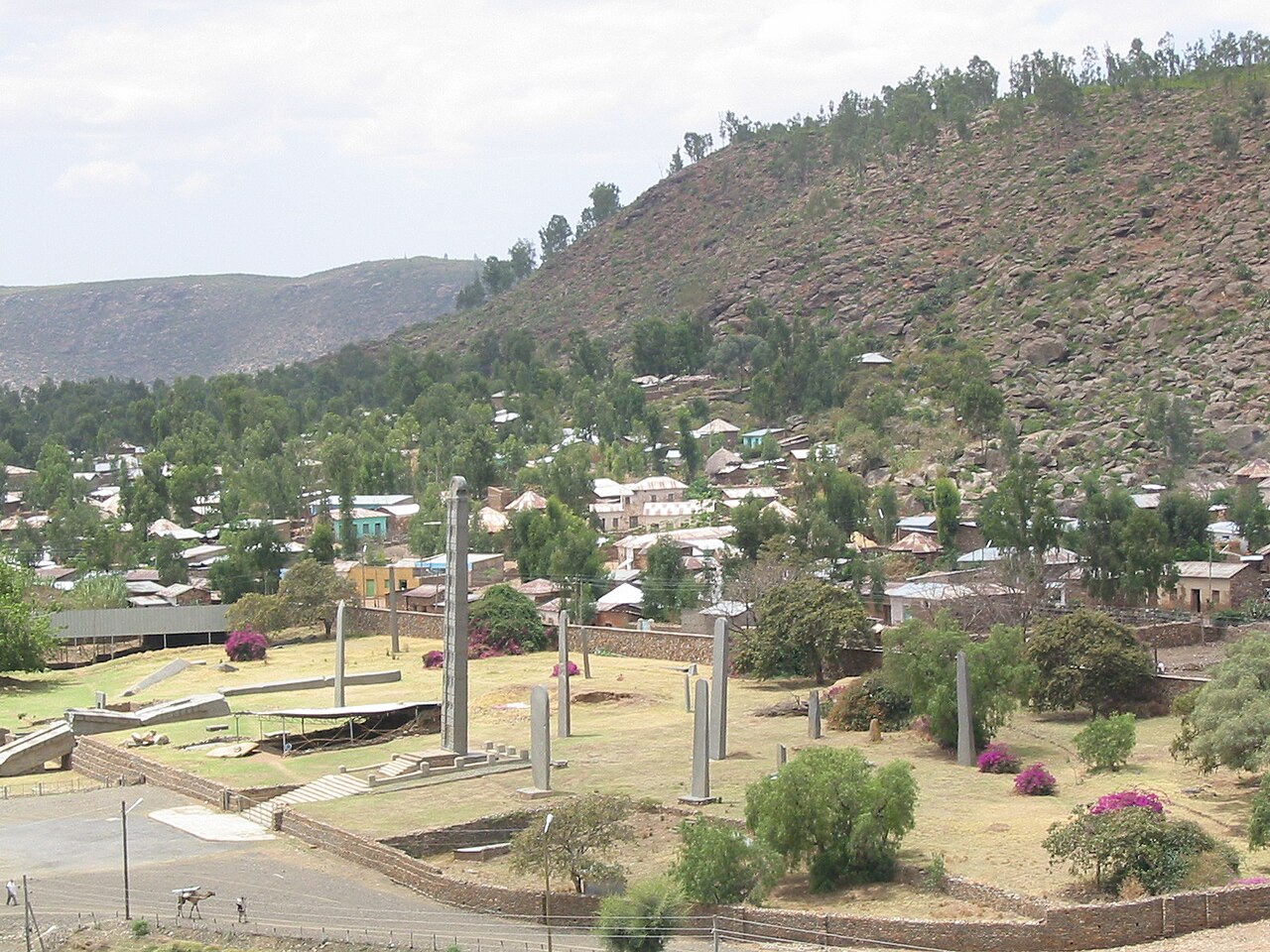
Axum is one of the oldest continuously inhabited cities in Africa and the historical heart of Ethiopian civilisation. For over a thousand years it was the capital of the Aksumite Empire, a trading power that connected the Roman world with India and controlled the Red Sea coast. Today it is a small, quietly atmospheric town in Tigray province, about 565 kilometres north of Addis Ababa, its ramshackle buildings painted in faded pastels.
The most striking remains are the stelae — giant carved obelisks, some over 20 metres tall, each cut from a single piece of stone around the 4th century AD. The largest still standing marks the Northern Stelae Field, a UNESCO World Heritage Site. Nearby are the ruins of ancient palaces, including what tradition calls the Dungur Palace (said to be the Palace of the Queen of Sheba), and Mai Shum — a large reservoir still in use today.
The city's greatest claim, however, is religious. Ethiopian tradition holds that Menelik I, son of the Queen of Sheba and King Solomon, brought the Ark of the Covenant from Jerusalem to Axum, where it has remained ever since. The Ark is said to rest in the Chapel of the Tablet, a small building next to the Cathedral of St Mary of Zion. The chapel is guarded day and night by a single monk — the only person permitted to enter. No one else has ever been allowed to see it.
The cathedral compound includes two churches: the old cathedral, built in the 17th century by Emperor Fasilides, and a modern one built by Haile Selassie in the 1960s, which houses a museum displaying the crowns of ancient Aksumite kings. The Axum Archaeological Museum within the stelae park offers further context on the kingdom's coins, inscriptions, and royal burials.
From Axum, a worthwhile day trip leads 80 kilometres northeast to the Temple of Yeha — one of the oldest standing structures in sub-Saharan Africa, built around 700 BC and still partly in religious use today. The Tombs of Kings Kaleb and Gebre Meskel, 1.8 kilometres northeast of the stelae field, can be entered on foot — underground chambers of precisely fitted megalithic stone.