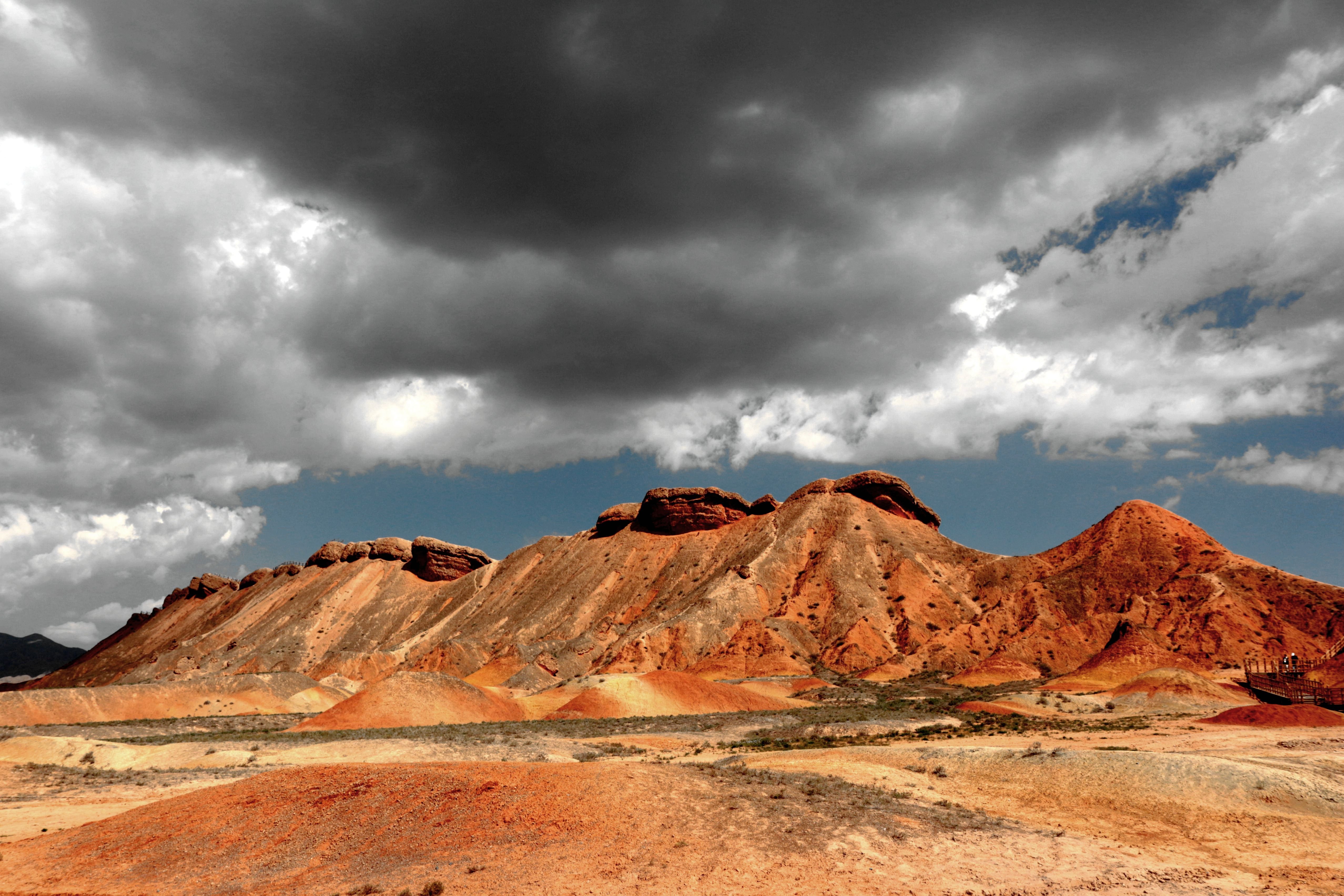
Zhangye Danxia Geological Park
©
Zhangye Danxia Geological Park

Zhangye Danxia Geological Park

Gansu geological park west of Zhangye, famous for striped danxia hills in red and ochre bands.

The Zhangye Danxia National Geological Park contains the most visually disorienting landscape in China, which is saying something in a country not short of geological theatre. Forty kilometres west of Zhangye, erosion has cut through millennia of layered sedimentary deposits to expose horizontal bands of red, orange, yellow, grey, green, and white — colours that look applied rather than natural, as if someone has cross-sectioned a stack of coloured paper. The Chinese name translates roughly as "seven-colour danxia," and while the count is approximate, the description is not.

The geological story begins about two hundred million years ago, when this area was a basin collecting sediment from the surrounding mountains. Different minerals — iron oxides for the reds and oranges, chlorite for the greens, gypsum for the whites — precipitated in different layers as conditions changed. The Qilian Mountains then rose, tilting and exposing the whole sequence, and water cut the current landscape over the past ten million years or so. The result is hills that look painted from a distance and, up close, reveal grain and texture that confirms they are unmistakably real rock.

The park has four main viewing areas connected by shuttle buses. The most dramatic views come from Platforms 3 and 4, where the ridgelines catch afternoon light best, typically between 4 and 6 in the evening. Sunrise light on Platform 1 is also widely photographed. The park is busiest on summer weekends; weekday visits in May or September offer more room to move.

The site is purely for looking at: the formations are roped off and the paths keep you on elevated walkways. Zhangye city, forty kilometres east, is the logical base, with accommodation across all price ranges and a high-speed rail connection to Lanzhou.

Guide

Getting There

The park is forty kilometres west of Zhangye, the nearest city with train connections and accommodation. Shuttle buses run from Zhangye to the park entrance throughout the day in the main season (roughly April through October), with reduced frequency in winter. The ride takes about forty-five minutes.

Taxis and private drivers offer round trips with waiting time, which gives you more control over timing — useful if you want to stay for the afternoon light and then return after dark. Agree on the price and waiting time before you depart. From Zhangye West Station (high-speed rail), the park is accessible by taxi; allow extra time as the station is on the outskirts of the city.

Guide

Things to Do

The park is purely a place for looking at extraordinary rock formations. The four main viewing areas — connected by shuttle buses — are the only practical way to see it. Allow two to three hours for a satisfying visit, more if you want to catch both early morning and late afternoon light.

Guide

When to Go

The park is open year-round, but the best conditions are May through October. Summer weekends bring large crowds; a weekday visit in May or September offers the same views with considerably more room on the walkways. Avoid the hottest part of summer days (midday in July and August) when the light is flat and the heat intense.

Late afternoon is consistently the best time: the sun is low, the colours saturate, and the shadows cut across the ridges to reveal the three-dimensional structure of the formations. Sunrise at Platform 1 is worth the early start for a different quality of light. Winter visits are possible — the park stays open and the crowds are minimal — but the roads to the park can ice over and some shuttle bus routes may run reduced schedules.