Zhangye sits roughly in the middle of the Hexi Corridor, the narrow strip of habitable land between the Tibetan plateau and the Gobi Desert that was, for two millennia, the only viable route between China and Central Asia. It was a garrison town during the Han Dynasty, a Buddhist centre during the Tang, and a stopping point for Marco Polo in the thirteenth century. The city still has a frontier atmosphere, a modest place where the history feels embedded rather than curated.
The main reason most travellers stop here is the Zhangye Danxia National Geological Park, about forty kilometres west of the city, where millennia of erosion have exposed layered sedimentary rock in improbable bands of red, orange, yellow, and grey. The effect is genuinely disorienting — the hills look painted. Shuttle buses run between the four main viewing platforms and three hours is enough to see them properly; the light is best in late afternoon.
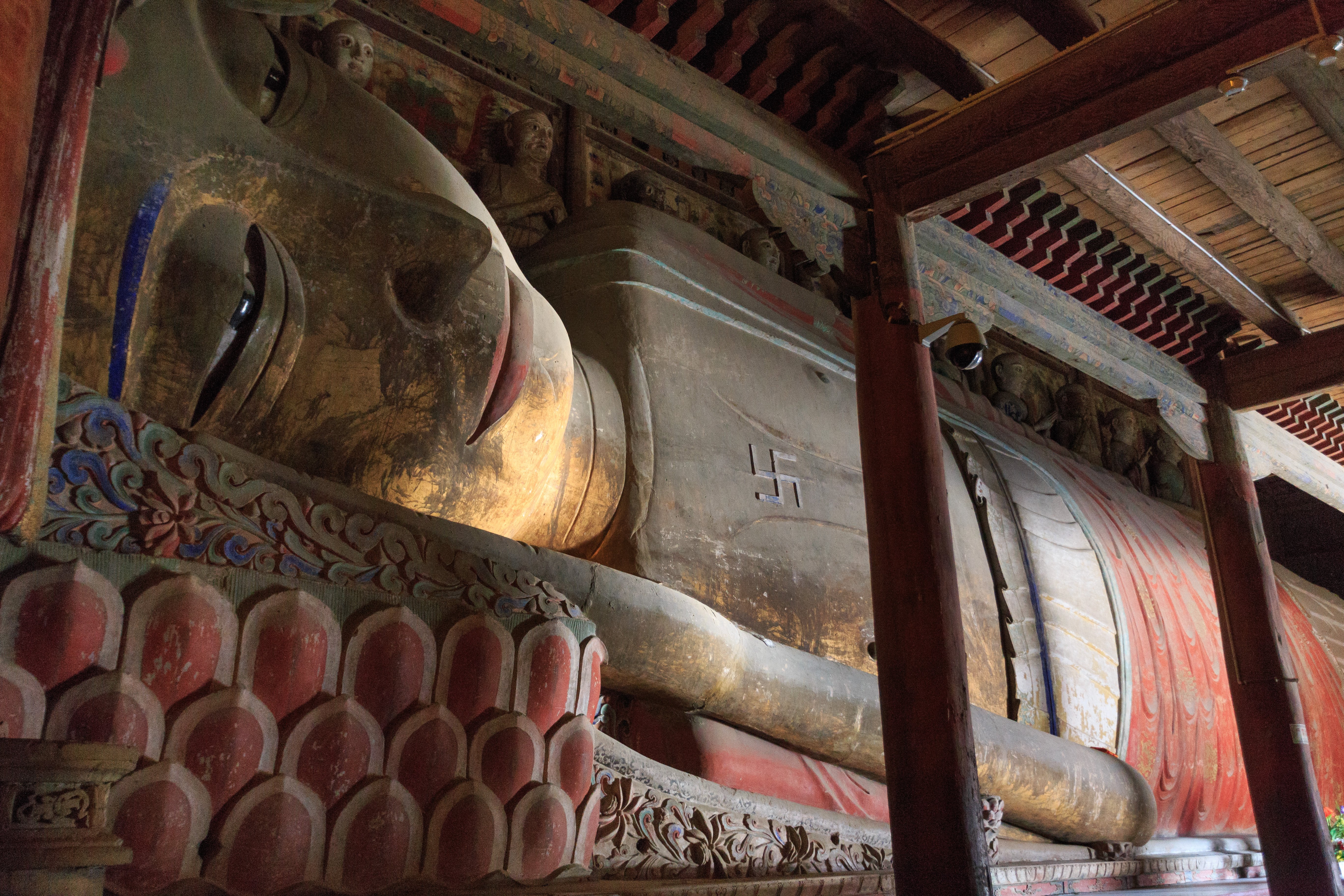
In the city itself, the Dafo Temple contains the largest indoor reclining Buddha in China, a 34.5-metre lacquered figure that dates to the Western Xia dynasty in the eleventh century. The surrounding complex is calm and well-maintained. South of the city, the Mati Si temple complex has grottoes carved into a sheer cliff face, with tight vertical passages connecting chambers stacked up the rock.
Zhangye West Station, on the high-speed rail line, connects to Lanzhou in three to three and a half hours and to Dunhuang by a combination of train and bus. It is a natural overnight stop if you are travelling the Hexi Corridor by rail, well-placed between Lanzhou and Jiayuguan or Dunhuang.