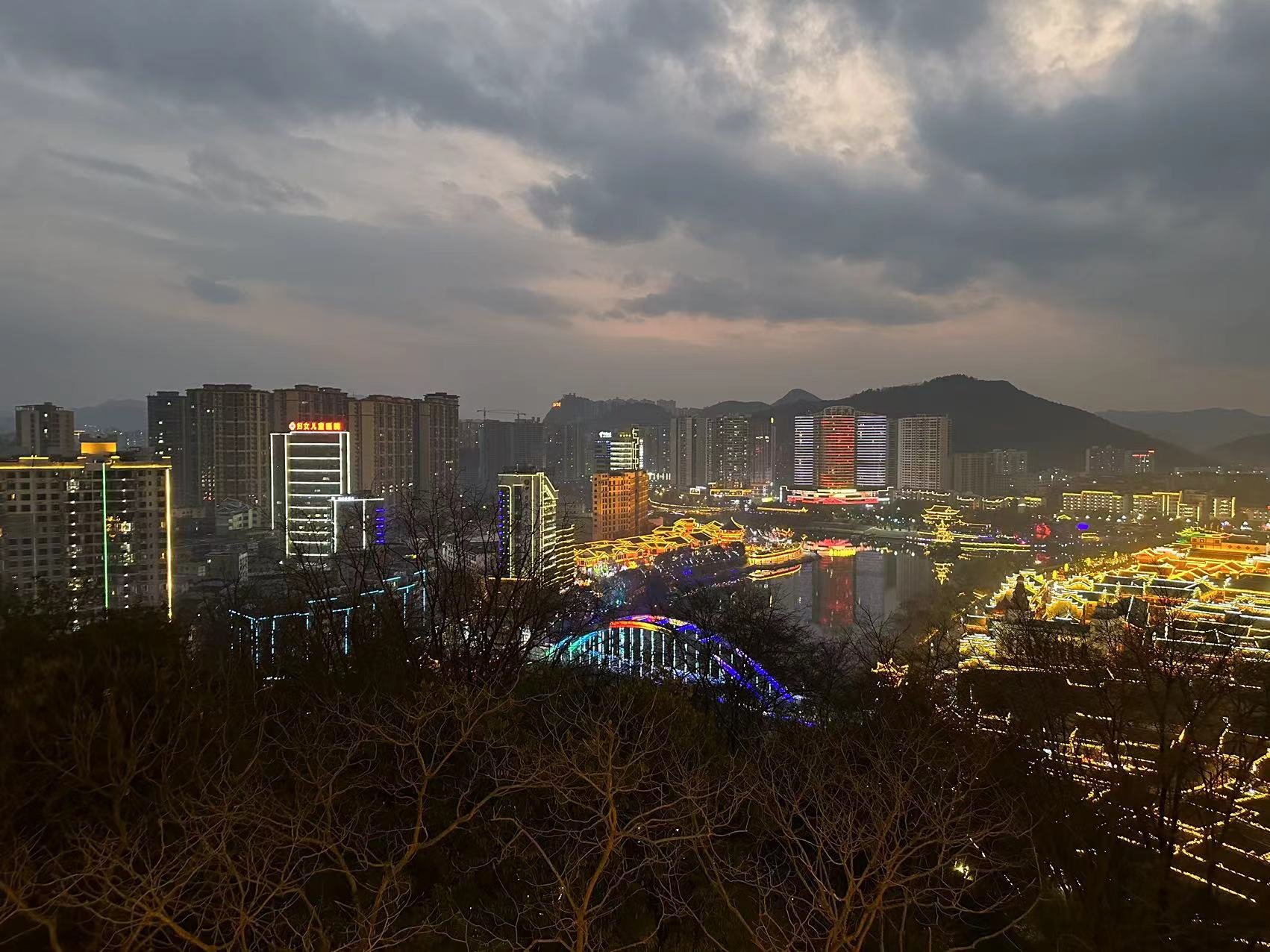
Tongren is the city in northeastern Guizhou from which most people approach Mount Fanjing (see /asia/china/guizhou/mount_fanjing), the province's highest peak and a UNESCO World Heritage Site. The city itself is a prefecture-level centre with a decent range of hotels and transport connections, positioned where the plateau drops toward Hunan province — the landscape changes noticeably as you come in from the west, the karst giving way to higher, wilder ridge country.
The city's own attractions are secondary to Fanjing but worth noting. Miao Wangcheng, a fortified Ming Dynasty settlement about 25 kilometres northeast, is a walled compound of over four square kilometres that served as a Miao chieftain's administrative centre — one of the tusi sites, the semi-autonomous hereditary chieftainships that the Ming and Qing dynasties used to govern frontier regions they couldn't directly administer. The ruins are extensive and largely unrestored, which means they're also largely uncrowded. Shiqian Hot Spring, southwest of the city, occupies a valley where natural mineral springs emerge at consistent temperatures; it's China's first nationally designated hot spring resort and considerably less developed than that description suggests.
The route to Mount Fanjing departs from Tongren's tourist bus station at 8:30 each morning, arriving at the mountain base at Jiangkou in about 90 minutes. From the base, a cable car or a very long staircase (8,888 steps — the number is deliberate, eight being the luckiest number in Chinese numerology) reaches the upper slopes. The mountain is known for the red fir forests below the treeline and the extraordinary geology above it, where the summit splits into two rock pillars with temples perched improbably on top of each.
Tongren has an airport with connections to major cities, and high-speed rail links via the Shanghai-Kunming line. The combination makes it surprisingly accessible for somewhere that still feels genuinely remote.