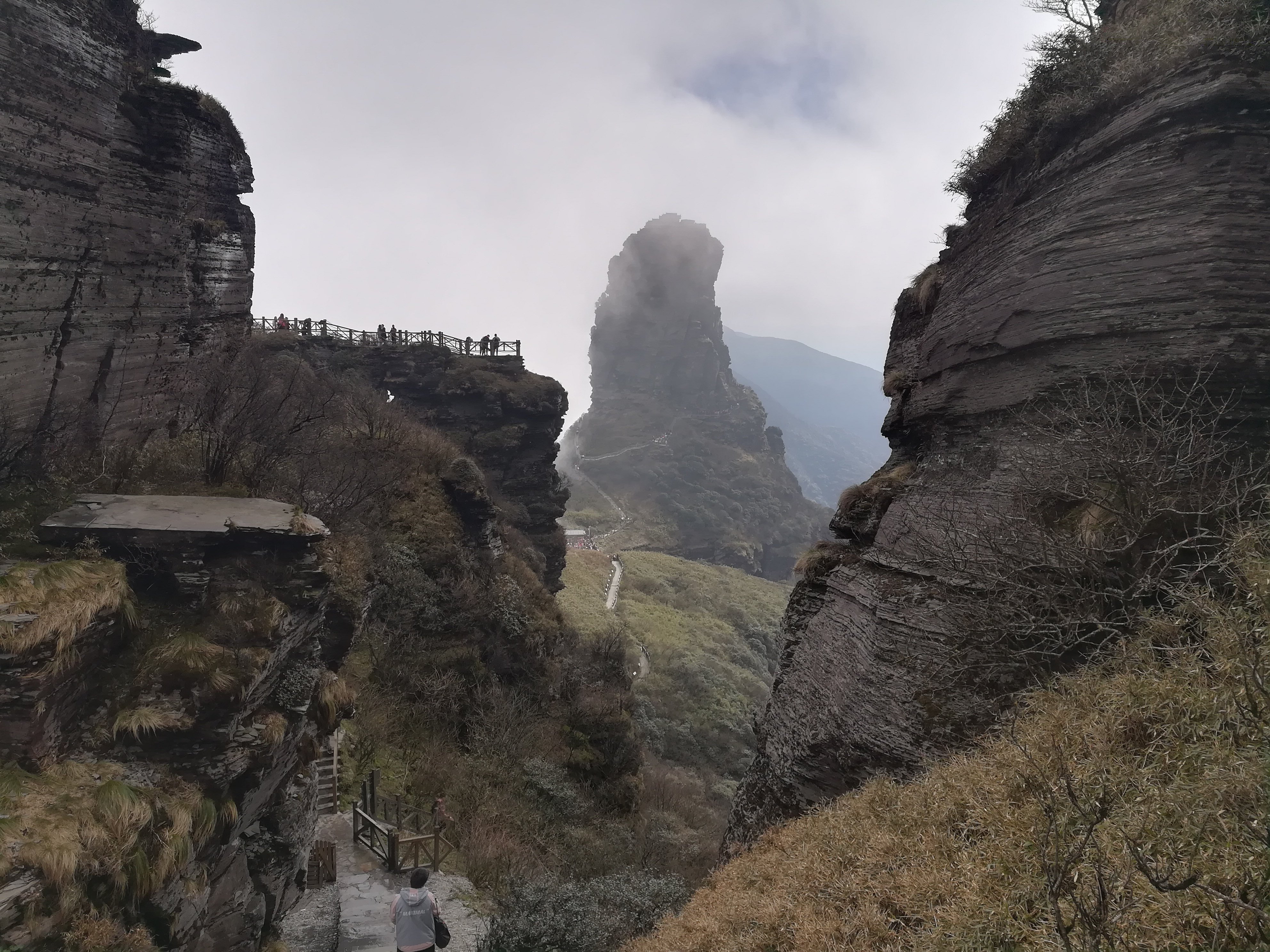
Sacred Guizhou mountain where Buddhist summit temples rise above rare cloud-forest habitat.
Mount Fanjing, known in Chinese as Fanjingshan, is the highest point in Guizhou at 2,570 metres and has been a sacred Buddhist mountain since the Ming Dynasty. The UNESCO World Heritage designation, awarded in 2018, recognised both the exceptional biodiversity of its cloud forests — the mountain is one of the last habitats of the Guizhou snub-nosed monkey, a species found nowhere else — and the cultural significance of the temples at its summit. The combination of conservation biology and mountain Buddhism makes Fanjing unusual even among China's many holy mountains.
The summit geology is what distinguishes Fanjing from other high peaks in southern China. The mountain top splits into two separate rock pillars, rising almost vertically from the ridge, and each pillar has a temple at its crown: Jinding on the main peak and Laojin on the adjacent one. A narrow stone bridge between them, the Golden Knife Gorge, is where the two temples meet. From below, the silhouette of the two pinnacles with their red-walled temples against sky or cloud is the image that has defined Fanjing in Chinese Buddhist iconography for five centuries. Getting up to them involves either the cable car (which covers much of the elevation) and then a very long staircase — 8,888 steps, the number chosen for its auspicious resonance — or the full ascent past Huguo Temple from the base.
The forest below the summit is where the biodiversity lies. Red fir and birch dominate the higher slopes; below the treeline, subtropical mixed forest with over 2,000 vascular plant species. Mist covers the mountain for much of the year, and the cloud forest in morning light — mosses and ferns on every surface, visibility dropping to a few dozen metres — has the quality of somewhere that hasn't quite decided to exist in the ordinary world.
Fanjing is most directly reached from Tongren (see /asia/china/guizhou/tongren), 90 kilometres to the northeast. Daily tourist buses run from Tongren's tourist bus station to the Jiangkou base area. The entry fee covers transport from the gate to the cable car base. Allow a full day for the return trip.
Guide
Getting There
Fanjingshan is most directly reached from Tongren, 90 kilometres to the northeast. Daily tourist buses run from Tongren's tourist bus station to the Jiangkou base area; the journey takes about two hours. From Guiyang, you can reach Tongren by high-speed rail (about 1.5 hours) and connect to the tourist bus from there.
The base area at Jiangkou has the ticket office, cable car terminus, and the start of the hiking trails. The entry ticket covers transport from the park gate to the cable car base. The cable car reduces the ascent time considerably and is worth the additional cost for most visitors; the full hiking ascent from the base takes a full day and requires good fitness.
Allow a minimum of a full day for a cable car visit to the summit. An overnight stay at the base area or in Jiangkou town gives access to early morning light on the mountain, when the mist conditions are best, before the main wave of day-trip visitors arrives.
Guide
When to Go
Fanjingshan is covered in cloud and mist for roughly 250 days of the year, and this is part of its character rather than an obstacle to it. Clear summit views are more likely from October through December and in March and April, when the weather systems that create the persistent cloud are less dominant. Summer (June–August) is warm and very wet — the mountain receives substantial rainfall, the forest is at its most lush, and mist covers the summit most days but clears occasionally for views of extraordinary quality.
Spring (April–May) is the most popular season: the azaleas that grow on the upper slopes bloom in a display that has made the mountain famous in China beyond its Buddhist significance. The flowering period is short — two to three weeks — and draws large visitor numbers. Autumn is quieter and often clearer.
The mountain is accessible year-round, but winter below the treeline can be cold and the summit frequently ices over. The cable car may close during severe weather. Check current conditions before visiting in January and February.