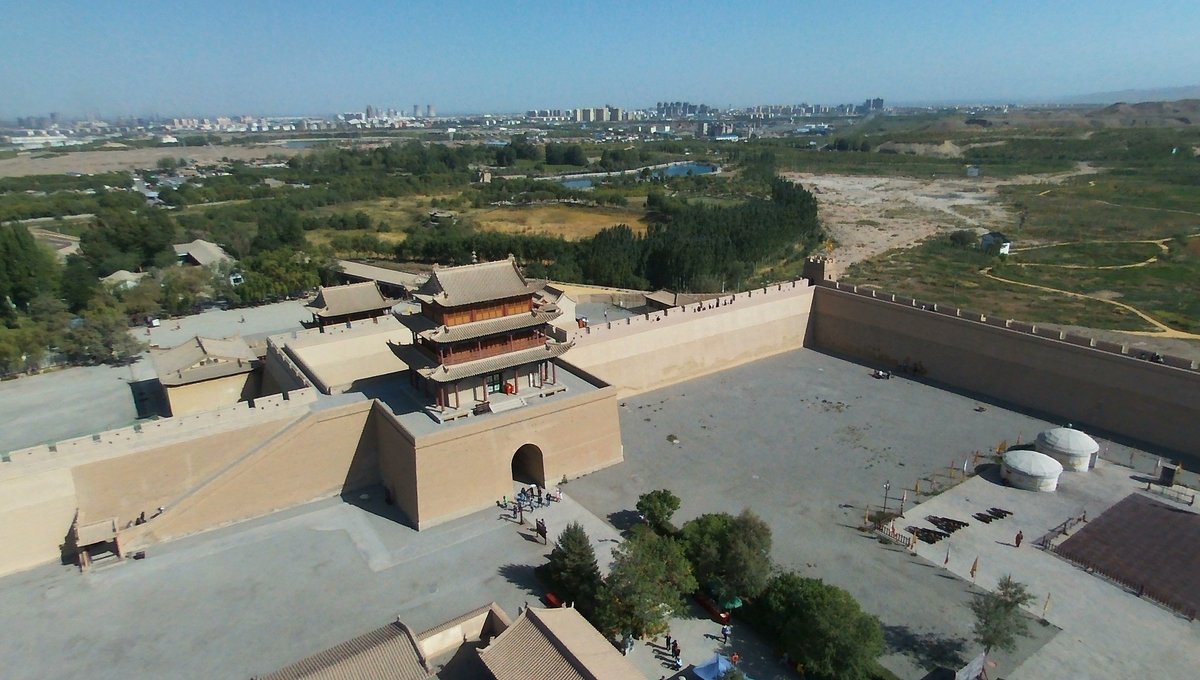
Jiayuguan was, for most of Chinese imperial history, the end of the world. The fort here — the Jiayu Pass — was the westernmost stronghold of the Ming Great Wall, the last outpost of Chinese civilization before the desert took over. Soldiers posted here who fell out of favour were said to have been "sent beyond the pass." The name means "last fort under heaven." Standing on the ramparts now, with the snow-capped Qilian Mountains behind you and the Gobi stretching ahead, the phrase stops feeling metaphorical.
The Jiayu Pass itself is the main draw: a trapezoid fortress complex with watchtowers, inner and outer walls, and a Great Wall Museum that contextualises the structure's history and construction. The fort was built in 1372, early in the Ming Dynasty, and remained the effective western terminus of Han Chinese territory for two centuries. Seven kilometres away, the Overhanging Wall section climbs steeply up a ridge and gives a sense of how the wall negotiated difficult terrain. South of the fortress, the First Pier of the Great Wall marks the exact southern end of the Ming wall's western terminus.
The Wei Jin Tombs, several kilometres east of town, are painted brick burial chambers from the third to fifth centuries; the interior murals show scenes of daily life from that era with unusual informality and colour. Photography is prohibited inside, which means you actually look at them.
Jiayuguan is on the high-speed rail line, with connections to Lanzhou in about four hours and to Dunhuang by bus in five to eight hours. The city itself is primarily an industrial centre, built around steel production, but it is a comfortable base for a day or two around the fort and the surrounding Great Wall sites.