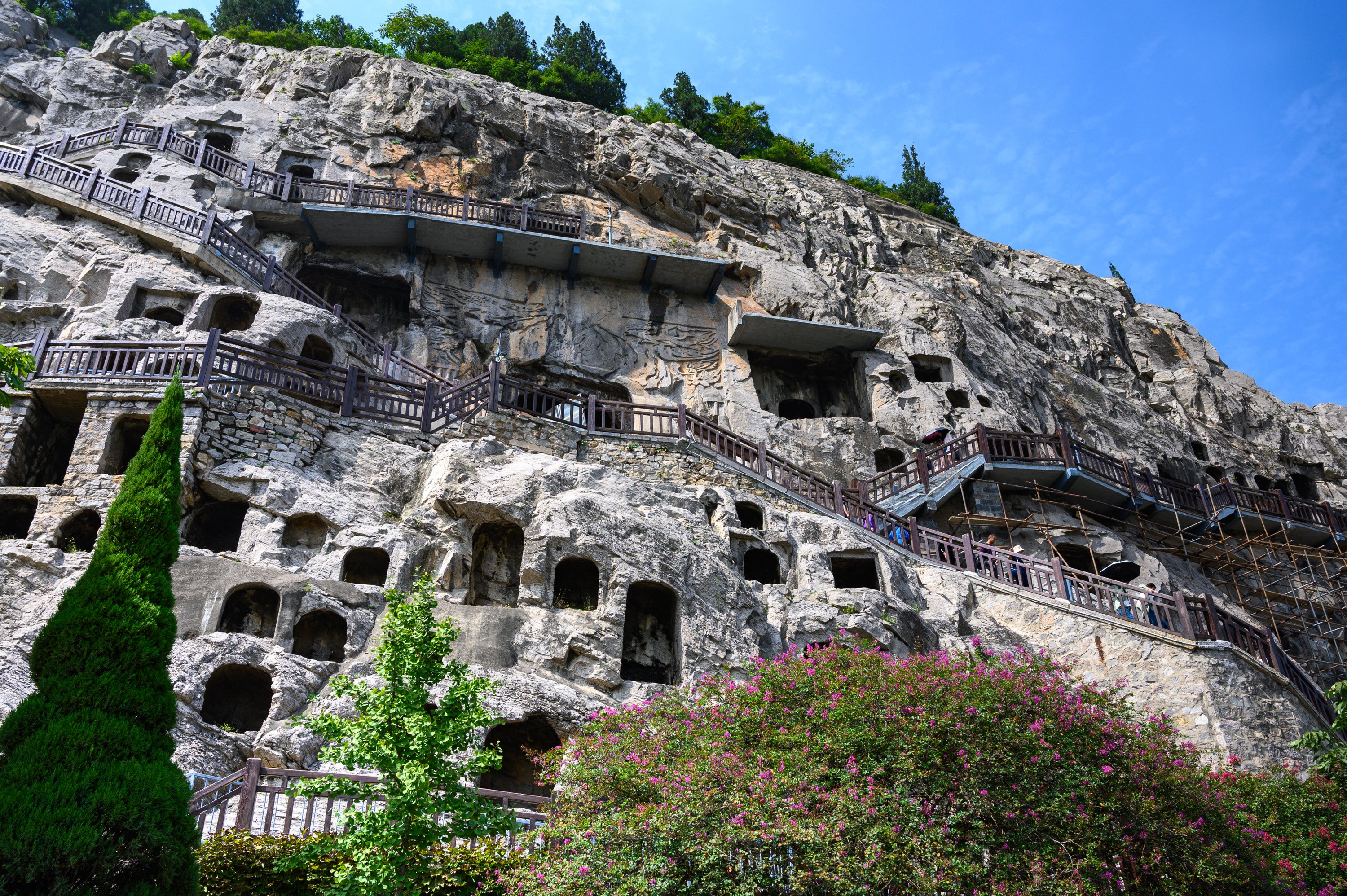
The Longmen Grottoes rank among the supreme achievements of Chinese Buddhist sculpture. Cut into the limestone cliffs on either side of the Yi River 13 kilometres south of Luoyang, the site contains over 2,100 cave-temples and more than 100,000 individual statues, ranging from figures a few centimetres tall to a seated Vairocana Buddha 17 metres high. Work began in 494 CE when the Northern Wei emperor moved his capital to Luoyang, and continued intermittently for the next four centuries, with the Tang dynasty producing the most ambitious and artistically accomplished pieces. UNESCO inscribed the site in 2000 as one of the outstanding examples of Chinese stone carving.
The centrepiece is the Fengxian Temple, an open-air complex commissioned by the Tang empress Wu Zetian and completed in 672. The Vairocana Buddha — its face is often said to resemble Wu Zetian herself — sits flanked by disciples, bodhisattvas, heavenly kings, and guardian warriors in a sculptural programme of extraordinary completeness and sophistication. The contrast between the serene central figure and the dynamic, almost aggressive guardian warriors gives the ensemble a dramatic range that single-Buddha compositions cannot match. The Wanfo Cave (Ten Thousand Buddhas Cave), cut in 680, lives up to its name: the walls are covered with tiny seated Buddhas carved in registers so tightly packed they seem like wallpaper.
The Yaofang Cave (Medical Prescription Cave) serves a different purpose — its walls are covered with inscriptions recording 140 medical prescriptions for diseases ranging from malaria to rabies, a remarkable document of Tang-dynasty medicine. The Guyang Cave is the oldest in the complex, begun before the capital transfer, and still contains some of the finest early Wei-style carving. The twenty calligraphy inscriptions known as the "Longmen Twenty" were so admired by later scholars that rubbings of them became standard copybooks for students of regular script. The nearby tomb of the Tang poet Bai Juyi offers a quieter counterpart to the grand imperial ambitions of the grottoes themselves.
Entry costs ¥120, which covers both the east and west cliff sections connected by a bridge over the Yi River. Bus 81 from Luoyang's main train station takes about 50 minutes and costs ¥1.50. Come early — the site gets crowded by mid-morning, and the afternoon light on the main Fengxian cliff is harsh. The surrounding park and riverside path are pleasant for a slow walk after the caves.