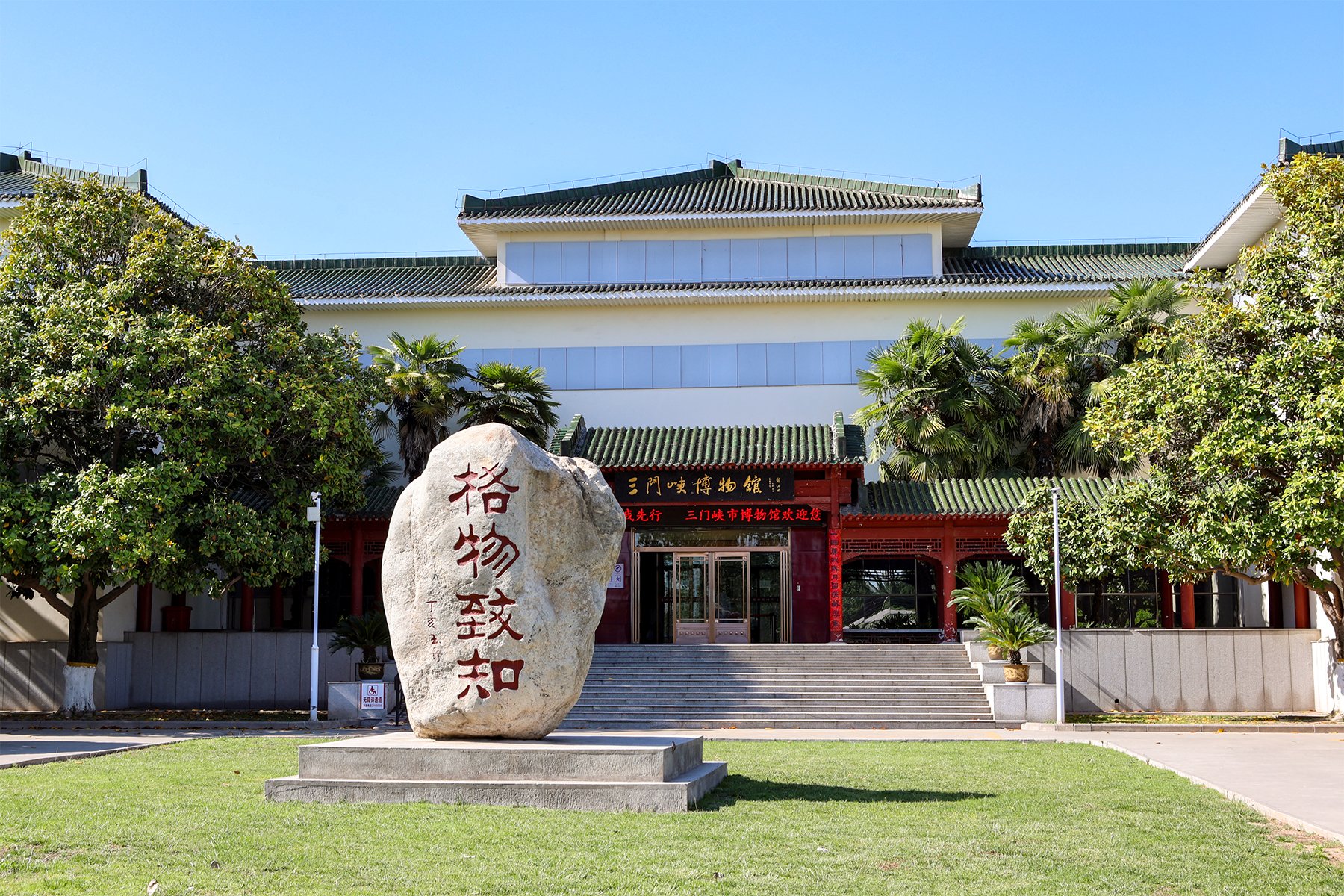
Sanmenxia sits at the far western end of Henan, where the Yellow River cuts through the Qinling-Taihang mountain system on its way east to the plains. The city's name — Three Gates Gorge — refers to the legend that the mythical flood-tamer Yu split the mountains into three channels here to control the river, and whether or not you believe that story, the landscape at this point really does feel like a place where the river makes a decisive transition. The philosopher Laozi is said to have composed the Dao De Jing at Hangu Pass, a mountain gateway just east of the city that marked the boundary between the Zhou heartland and the Qin state; the rebuilt pass (¥80 entry) is historically theatrical rather than original, but the geography that made it strategically vital is still very much present.
The Guo State Museum is one of Henan's most underrated archaeological stops. The Guo state flourished here during the Western Zhou and Spring and Autumn periods, and when its capital was excavated in the 1990s, archaeologists found royal tombs still containing chariots with horses — the actual vehicles and animals buried together over two and a half thousand years ago. The museum displays the burial pits essentially as found, with a glass walkway over the excavated chariots. It's a remarkable thing to stand above. The main museum collection covers Yangshao culture, which also has its origins in this region: in 1921, the Yangshao village southwest of Sanmenxia yielded the first excavated evidence of a Neolithic painted-pottery culture that turned out to extend across a vast swath of northern China.
The city's other great spectacle is ecological rather than historical. Swan Lake Wetland Park, on a stretch of the Yellow River just below the Sanmenxia Dam, hosts tens of thousands of migrating Siberian whooper swans between October and February. The birds arrive from Siberia and Inner Mongolia and congregate here in numbers that make the entire surface of some sections of the lake appear white. Access is free, and the swans are close enough to photograph without a telephoto lens.
Sanmenxia has no civilian airport; the nearest options are Luoyang (150 km east) or Xi'an (240 km west). High-speed rail runs through the city on the Zhengzhou–Xi'an line, making it convenient as a stop between those two larger destinations. The city itself is modern and unremarkable, but the Yellow River scenery and the Guo State Museum alone justify an overnight.