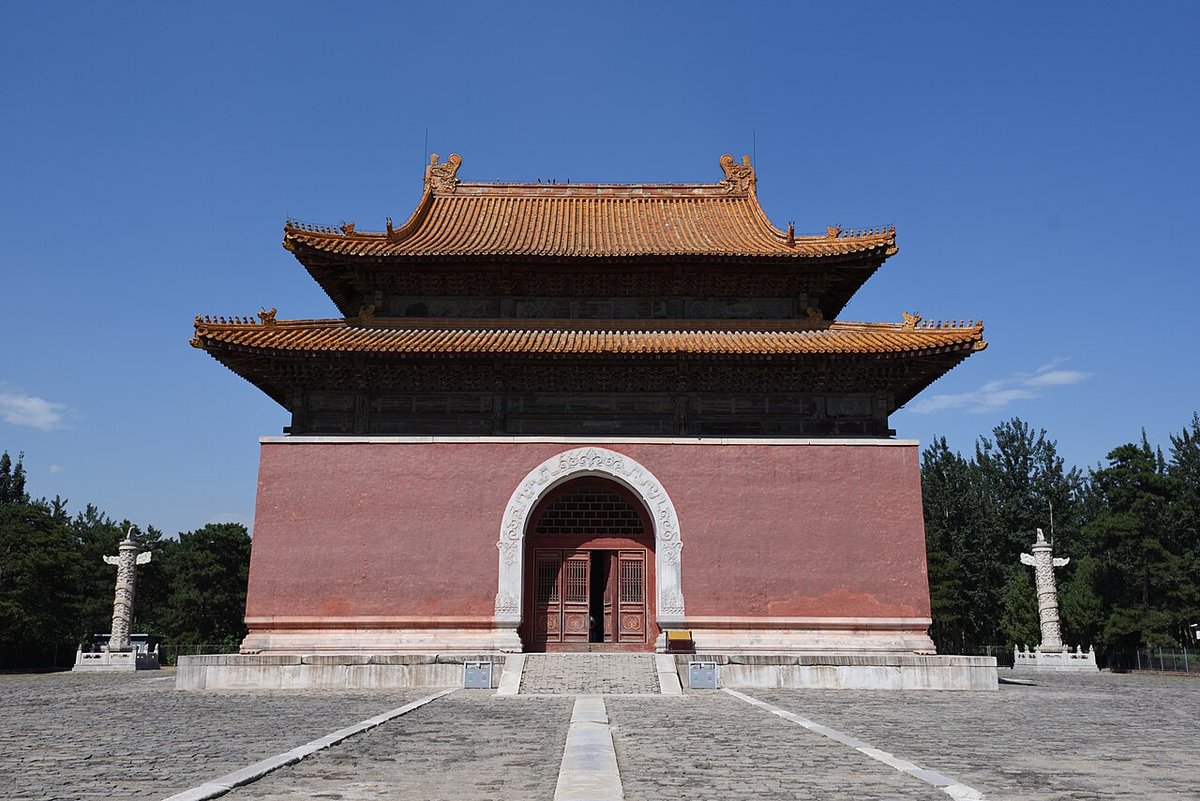
The Western Qing Tombs in Yi County, about 140 kilometres southwest of Beijing, hold four emperors: Yongzheng, Jiaqing, Daoguang, and Guangxu, along with 74 other royal family members. The complex exists because the Yongzheng Emperor chose not to be buried beside his father Kangxi at the Eastern Qing Tombs — the reasons remain a matter of scholarly speculation, with theories ranging from a guilty conscience about how he came to power to simple aesthetic preference. Whatever the cause, the break established a second imperial necropolis that his successors alternated between.
The western site is quieter and less visited than its eastern counterpart, and the setting in a forested mountain valley gives it a contemplative quality that the bigger crowds at the eastern tombs can undermine. The Yongzheng mausoleum, Tailing, is the oldest and most elaborately developed, with the standard sequence of processional way, ceremonial gates, and offering halls carried out on an imposing scale. The spirit way has some of the finest stone animal sculptures in either necropolis.
The Guangxu Emperor's tomb, Chongling, has a particular historical resonance. Guangxu died in 1908, the day before Empress Dowager Cixi, almost certainly by deliberate poisoning — forensic analysis in 2008 found arsenic levels in his hair consistent with a fatal dose. His tomb was only completed in 1915, after the Qing dynasty itself had collapsed, using funds provided by the early Republic. Walking through it, finished after the fall of everything it was meant to represent, is a strange experience.
The Western Qing Tombs are also a UNESCO World Heritage Site. Getting there requires either a tour or independent transport from Baoding, and the site is quiet enough on weekdays that you can have large sections of it almost entirely to yourself.