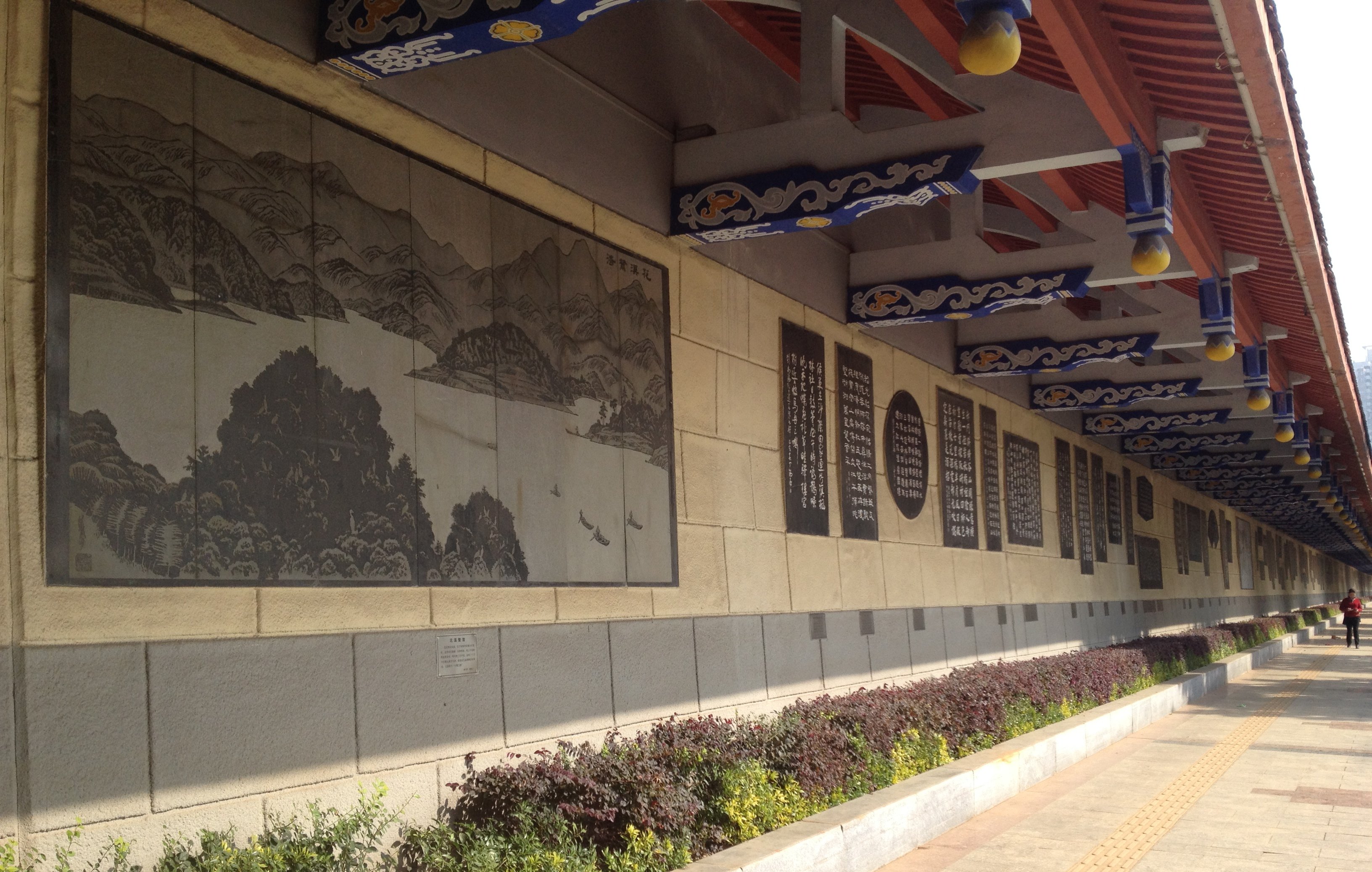
Changde sits on the Yuan River near where it empties into Dongting Lake in northern Hunan, and the river is the city's main attraction in the most literal sense: the Poem Wall runs for three kilometres along the Yuan's embankment, a flood barrier faced entirely with calligraphy and carved artwork that holds a Guinness record as the world's longest wall of engraved art. The scale is genuinely impressive, and evening illuminations make it worth lingering past dark. The adjoining riverside parks are where local residents gather for the slow rituals of Chinese urban leisure — dancing, kite-flying, tea at folding tables.
The city's other famous draw is Peach Flower Garden in Taoyuan County, about 40 kilometres south. The site takes its name from the prose-poem "Peach Blossom Spring" by Tao Yuanming (365-427 AD), which describes a fisherman who stumbles through a mountain tunnel into a hidden valley of perfect peace, sealed off from history and war. The garden built around this literary memory is expansive, best in April when the peach trees flower, and charges around ¥180 for three-day access. Like all Chinese tourist sites themed on ancient texts, it requires a tolerance for theatrical interpretation of the source material, but the landscape that inspired Tao Yuanming is still visible beneath the infrastructure.
Changde is also the city most directly associated with Ding Ling, one of the great Chinese writers of the 20th century, who spent her years of internal exile in the countryside around here after falling out with the Communist Party establishment. The connection is not heavily marketed, but literary travellers will find it resonant. The city fought one of the war's most brutal urban battles in November 1943, when a small Chinese garrison held the city street by street against overwhelming Japanese forces for sixteen days; the Battle of Changde Memorial covers this history clearly.
The city is on the Zhangjiajie-Changsha railway line, making it a practical stop between those two destinations. Changde Taohuayuan Airport has domestic connections to major Chinese cities. Liuye Lake, a reservoir on the city's edge, offers boat trips and cycling on its willow-lined shores. The food scene runs on standard Hunanese lines — spicy, substantial, and inexpensive.