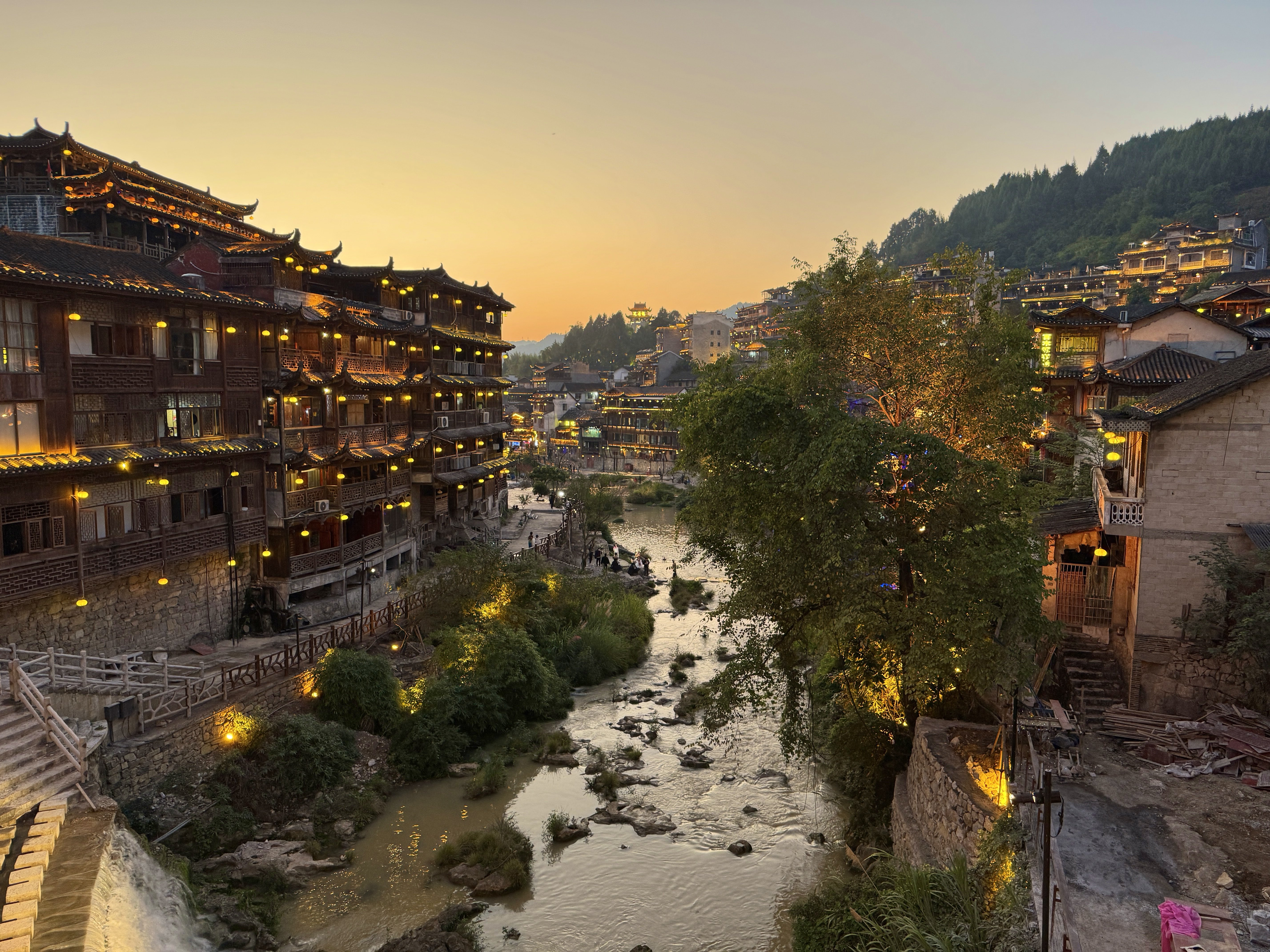
Furong — ancient name Wangcun, current official name Furong Ancient Town — sits on cliff faces above a waterfall that drops into the You River in Yongshun County, northwestern Hunan. The town was renamed after the 1986 film "Hibiscus Town" (Furong Zhen), directed by Xie Jin and starring Liu Xiaoqing and Jiang Wen, which used the setting as a backdrop for a story about ordinary lives destroyed and rebuilt across the upheavals of Maoist-era campaigns. The film is one of the most important Chinese works of the reform era and brought international attention to a town that had previously been known mainly to people who lived near it.
The waterfall is the defining physical fact of the place. A two-tiered fall drops more than sixty metres into a pool below the old commercial street, which was built on the hillside above and below the falls on stilted wooden structures typical of Tujia architecture. The ancient street itself — stone-paved, about 1,000 metres long, flanked by two- and three-storey timber buildings — climbs steeply from the river level to the plateau above, with the waterfall audible and partially visible throughout. At night, lit by lanterns, the street has a quality that goes some distance toward explaining why it appealed to a filmmaker. The film site, including the original tofu stall, is preserved near the bottom of the street.
The Tujia people are the original inhabitants of this landscape, and elements of Tujia material culture — brocade weaving, lacquerwork, carved wooden architecture — are visible in the workshops and stalls along the street, though the distinction between locally produced craft and tourist-market product requires attention to identify. The surrounding county contains additional Tujia villages without tourism infrastructure that reward exploration.
Furong is midway between Fenghuang and Zhangjiajie, making it a natural stop on a circuit of western Hunan. A high-speed railway connection opened in 2021 substantially improved access; it is also reachable by road from Laosicheng, 50 kilometres to the southeast.