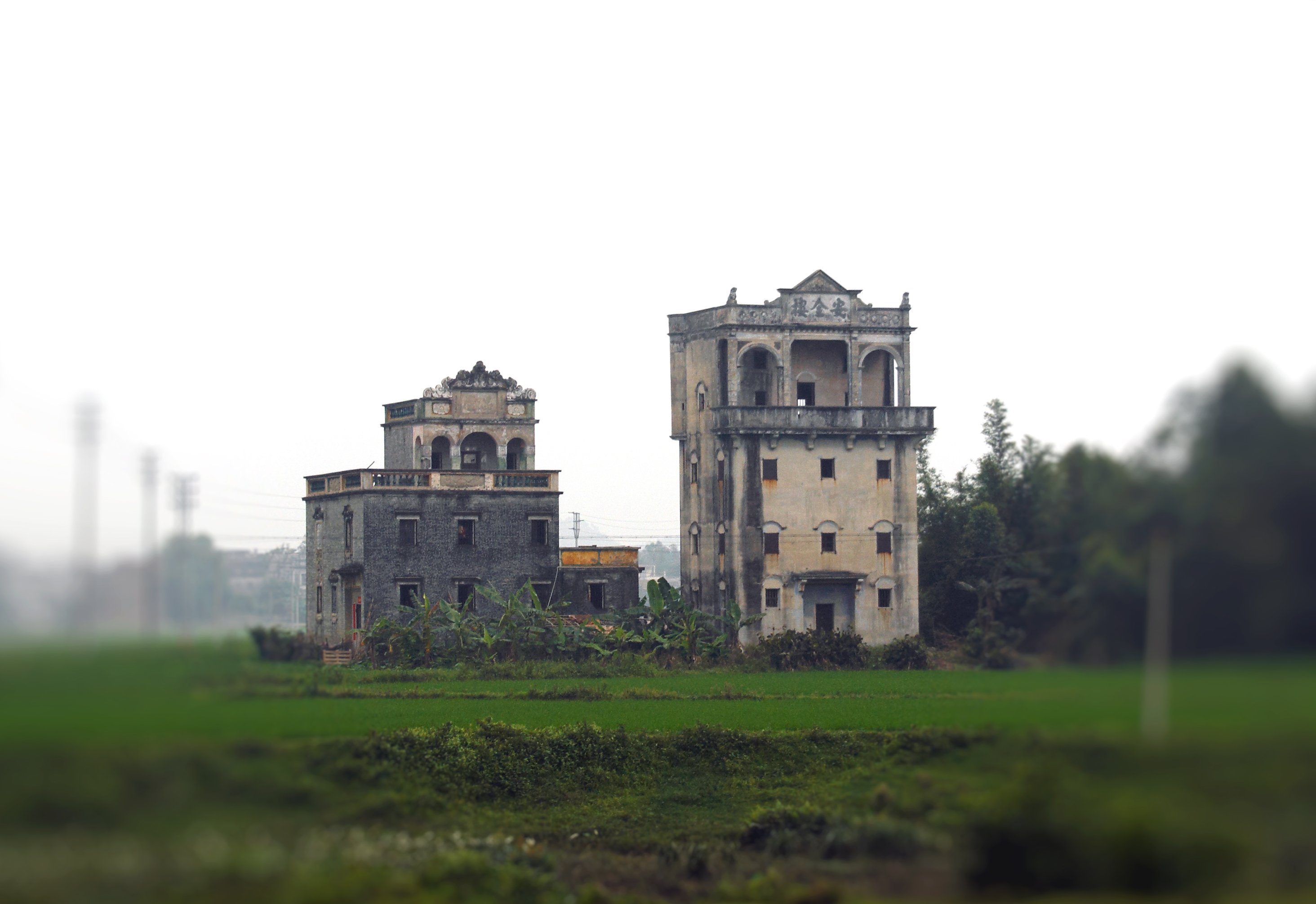
Kaiping is home to one of the strangest and most compelling landscapes in southern China: a countryside scattered with hundreds of fortified towers, called diaolou, built by returned emigrants in the early twentieth century. The towers are part defensive structure, part status symbol, and entirely the product of a particular historical moment — the years between 1900 and 1940 when Cantonese labourers who had built railways in North America and worked the goldfields of Australia came back with foreign money and foreign ideas. The result is an architecture like nothing else: five- and six-storey watchtowers in baroque, neoclassical, and Moorish styles, rising from rice paddies and lotus ponds, some of them abandoned for decades, their clocks stopped, their rooms still furnished. A UNESCO World Heritage designation in 2007 has formalized the obvious: this is extraordinary.
The four main designated villages — Zilicun, Liyuan, Majianglong, and Jinjiangli — each have their own character. Liyuan is the most manicured, its garden designed with obvious care and its buildings in the best repair. Majianglong is the most atmospheric, the towers emerging from dense bamboo thickets, the paths between them quiet enough that you can hear the birds. A joint ticket covers all four; individual entry is possible but the combination is worth it for the half-day or full day required to see them properly.
The market town of Chikan, a short distance away, adds an urban counterpart: old arcade shopfronts mixing Portuguese-influenced arched colonnades with Chinese signage, the ground floors still occupied by small businesses, the upper floors slowly decaying. The town has the pleasant, unpreserved quality of a place that hasn't quite figured out it's worth preserving yet. The film "Let the Bullets Fly," one of the highest-grossing Chinese films ever made, was shot partly here, which has brought some domestic tourism but hasn't noticeably changed the character of the streets.
Kaiping is accessible as a day trip from Guangzhou — about two hours by high-speed rail — though the scattered nature of the sites makes an overnight stay more relaxed. The local specialty is clay pot rice, unremarkable in Guangzhou but considerably better when eaten in the village where the tradition runs deepest.