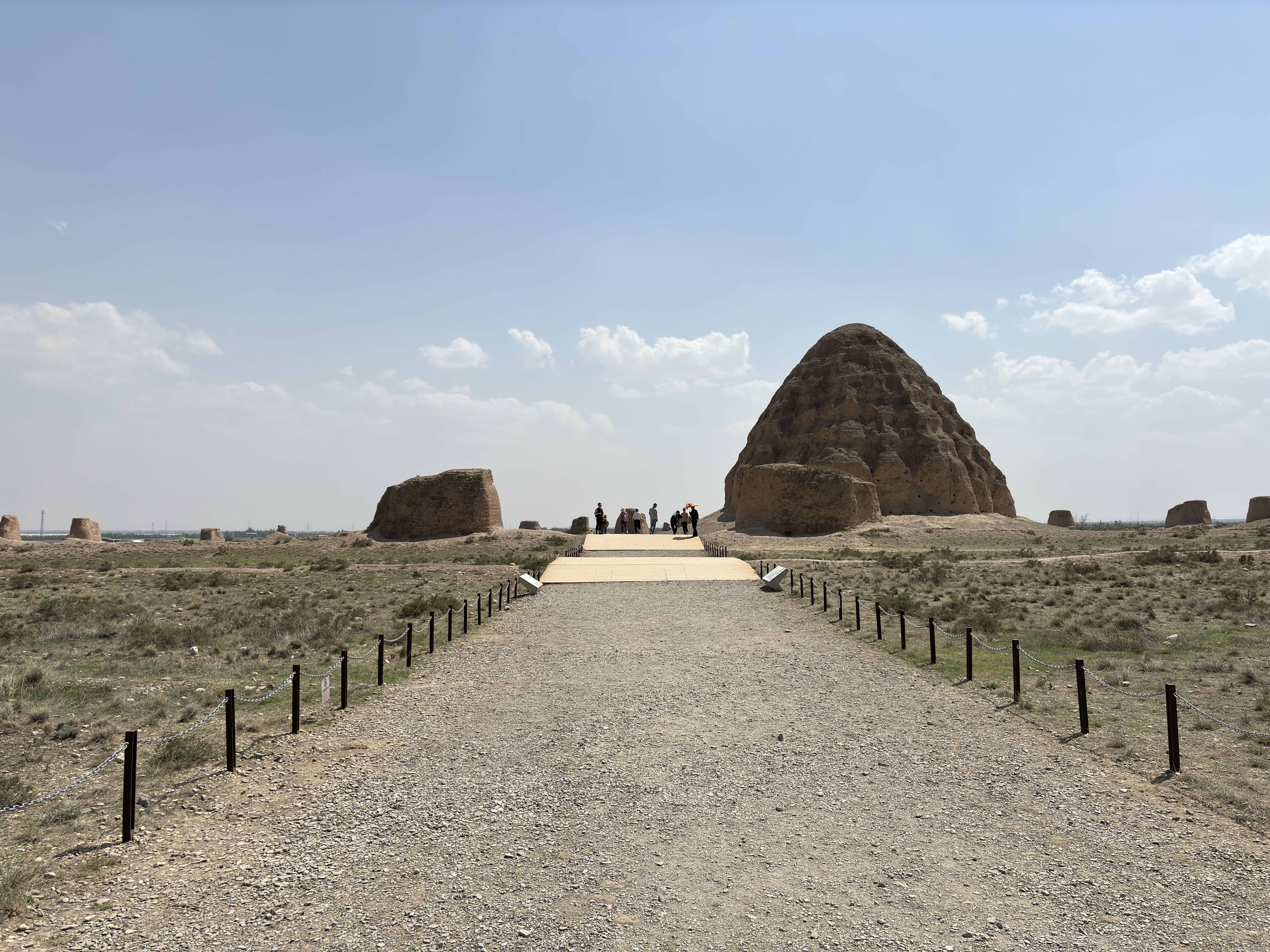
The Western Xia Mausoleum — known in Chinese as Xixia Wangling — is one of the strangest and most evocative sites in the northwest: an imperial cemetery of 193 tombs belonging to the Western Xia kingdom, a civilisation that flourished for about two centuries before being annihilated by the Mongols in 1227. The imperial tomb mounds stand at the foot of the Helan Mountains, about 25 kilometres west of Yinchuan, in a landscape of desert scrub and alkaline flats.
The Western Xia were a Tangut people who created a sophisticated state, their own writing system, their own Buddhist traditions, and an imperial burial culture that borrowed from Tang and Song China while remaining distinctly their own. The mausoleum complex covered an area of 50 square kilometres; the surviving earthen tomb mounds rise to heights of 20 or 30 metres, their eroded profiles giving the site the appearance of ruined towers seen from a distance. Nine of the tombs held emperors; the rest were for nobles and officials of the court.
The Mongols destroyed the tombs so thoroughly that knowledge of Western Xia was largely lost until archaeological excavation began in the 20th century. The on-site museum, modern and well laid out, presents the history of the kingdom through artefacts including glazed ceramics, Buddhist sculptures, and examples of the Tangut script. The museum alone is worth the visit even if the open-air landscape of tomb mounds risks seeming anticlimactic to those expecting a grander spectacle.
The entrance fee is 75 yuan plus 20 yuan for the shuttle bus across the site. Taxis from Yinchuan take about 40 minutes. The park is best visited in the morning, before the afternoon heat, combined if possible with the Helan Mountain rock carvings a few kilometres further up the range.