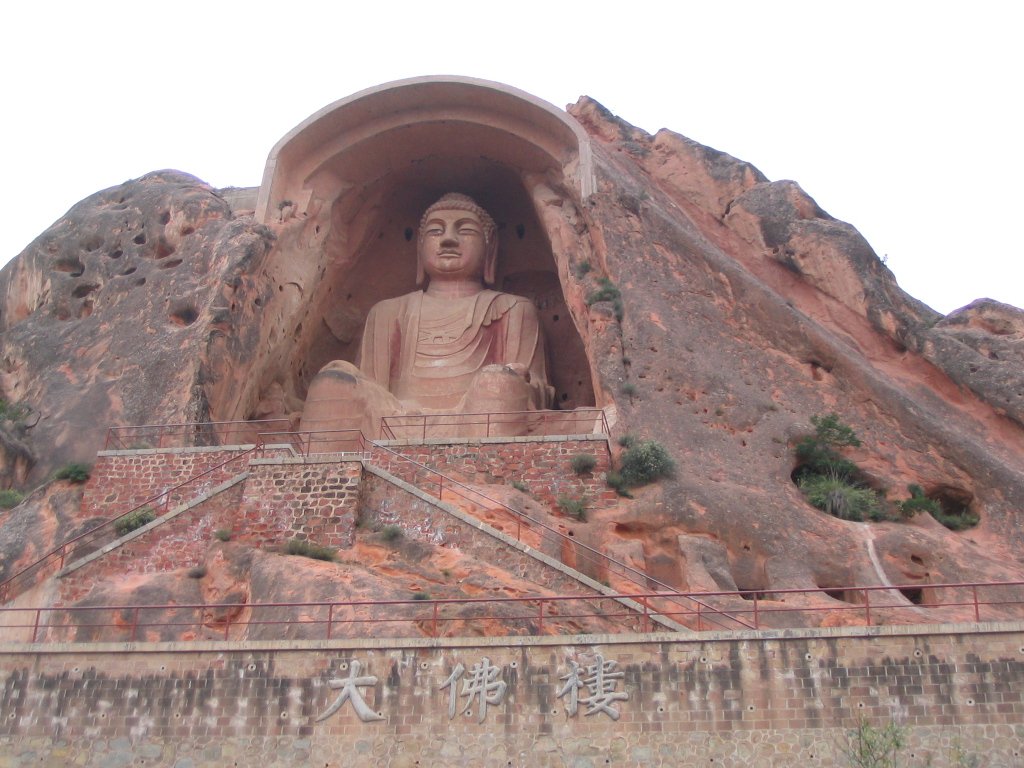
Southern Ningxia city on the Loess Plateau, near the Buddhist Xumi Mountain Grottoes.
Guyuan is the largest city in the southern half of Ningxia, set in the dry terraced hills of the Loess Plateau near the border with Gansu. It is less visited than Yinchuan or Zhongwei, but the surrounding area contains some of the most historically significant Buddhist art in the northwest: the Xumi Mountain Grottoes, carved into the sandstone flanks of Sumeru Shan about 55 kilometres to the northwest.
The Xumi grottoes comprise more than 130 chambers cut into the eastern face of the mountain, with Buddhist sculptures ranging from the Northern Wei period through the Tang dynasty — roughly the 5th to 10th centuries. The largest figure is a seated Buddha over 20 metres tall; the finest works are a set of Tang-era bodhisattva sculptures of considerable delicacy. The site is far less trafficked than the more famous cave complexes at Dunhuang or Longmen, which means you can often have entire grottoes to yourself.
Back in the city, the Guyuan Museum on Xicheng Road organises its collection chronologically from the Stone Age through the Silk Road period to the Qing dynasty, with particular strength in bronze vessels and Tang-period artefacts from local tombs. Admission is free. South of the city, Liupan Mountain Forest Park offers pine-covered hills that make a striking contrast to the bare loess terrain lower down.
Guyuan is accessible by train from Yinchuan in about six hours and from Xi'an in eight, though the most useful connections are by bus — services to Yinchuan run frequently from around 7am to 6pm and take about four hours. The city's own character is defined by its large Hui Muslim population; as throughout Ningxia, halal restaurants serving hand-pulled noodles and lamb dishes are the backbone of everyday eating.
Guide
Eating Out
Guyuan's food culture is defined by its Hui Muslim population. Hand-pulled noodles with lamb and a dark, vinegary broth are the staple — you will find a version of this dish in virtually every small restaurant in the city. Lamb kebabs grilled over charcoal are sold from street carts in the evenings. Pork is absent from the menu across most of the city.
The central market streets near the old town have the highest concentration of small Hui restaurants, with outdoor tables in summer. For a sit-down meal, look for places advertising beef and mutton hot pot, which is a regional speciality in cold weather. Guyuan is not a city for elaborate dining, but the basic food is honest, cheap, and filling.
Guide
Getting There
Guyuan has a small airport — Guyuan Liupanshan Airport — with connections to Xi'an and Yinchuan, though services are limited and flying here is rarely the most practical option. The train is more useful: Guyuan sits on the Baoji-Zhongwei railway, with services to Yinchuan taking about six hours and to Xi'an taking roughly eight. High-speed rail does not yet serve the city.
Buses are the most frequent option for regional travel. Coaches to Yinchuan run from the main long-distance bus station roughly every hour from early morning to late afternoon, taking about four hours. Services to Lanzhou, Xi'an, and Zhongwei are also available, making Guyuan a reasonable waypoint on a route through the northwest.
Guide
When to Go
Guyuan sits at around 1,700 metres elevation on the Loess Plateau, which gives it a climate considerably more temperate than the Yellow River plain further north. Summers are warm but not oppressive — July and August temperatures reach the mid-20s Celsius — and the higher altitude means evenings are cool even in peak summer.
Spring and autumn are the most comfortable seasons for visiting. April and May bring the first greenery to the hills. Autumn, from September through October, turns the forests on Liupan Mountain and the Xumi Mountain valleys into warm reds and yellows. Winter is cold, with temperatures regularly dropping below freezing overnight, and occasional snowfall makes the grotto site difficult to access.
The Hui festivals of Eid al-Fitr and Eid al-Adha bring the city to life with open-air celebrations and communal meals. Timing a visit around these occasions gives a vivid window into the community's life, though accommodation and transport should be booked well in advance.