Zhongwei
©
Zhongwei

Zhongwei

Ningxia city on the Yellow River, known for Shapotou's dunes at the Tengger Desert edge.

Zhongwei sits at one of the more dramatic junctions in Chinese geography — the point where the Tengger Desert, the Yellow River, and the terraced loess hills all converge within a few kilometres of each other. It is a small city that punches well above its size as a travel destination, largely because of Shapotou, the desert resort on the southern bank of the Yellow River where enormous sand dunes drop almost directly into the water.

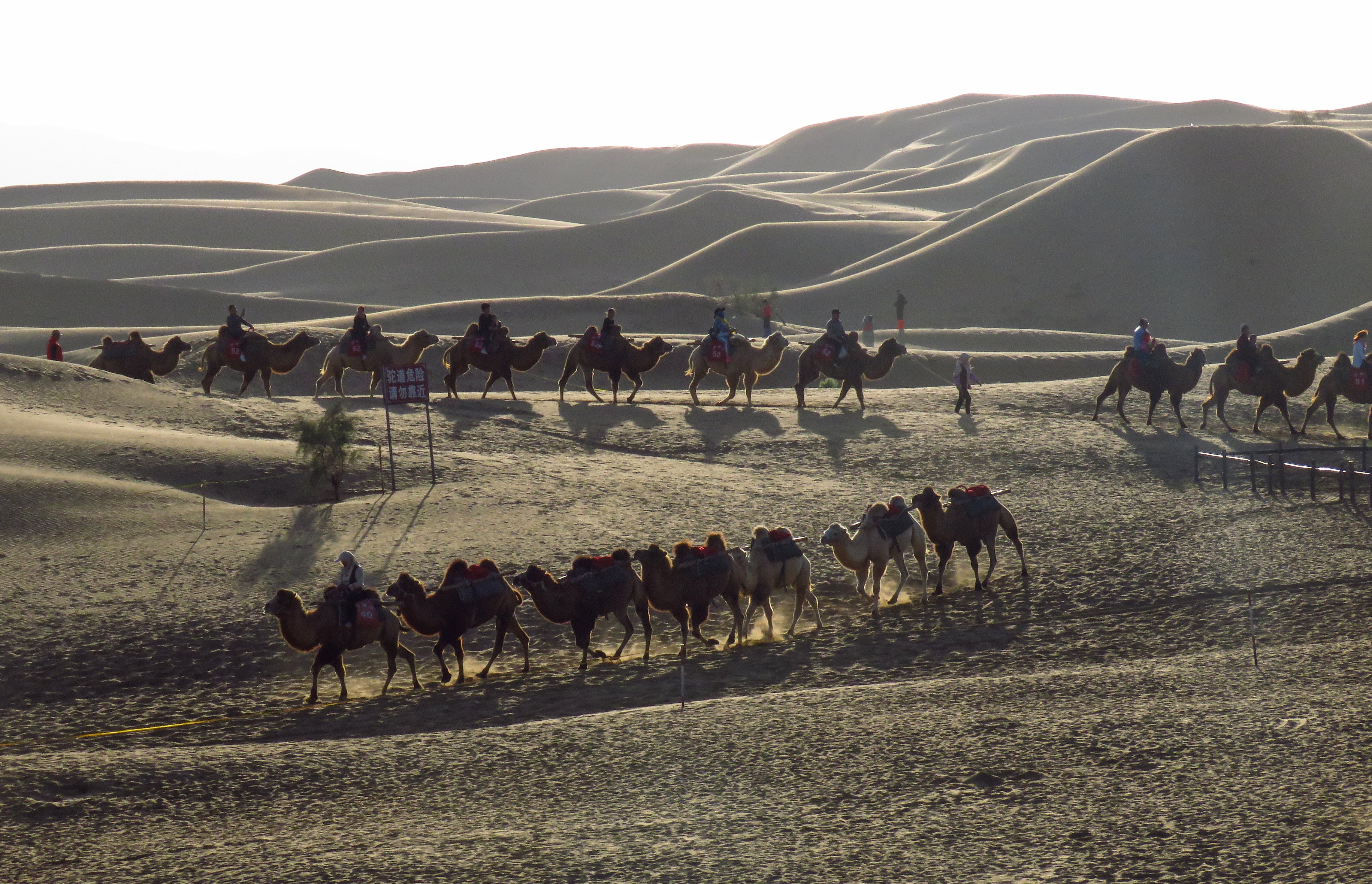
At Shapotou, the juxtaposition is genuinely striking: the river is wide and fast-moving, the desert behind it is vast and pale, and the oasis cultivation on the opposite bank is impossibly green. Activities there run the full gamut of Chinese tourist-resort excess — camel rides, sand skiing, hot air balloons, inflated sheepskin raft crossings, and Yellow River drifting. The entrance fee is steep and the crowds can be punishing in peak summer, but the landscape underneath the spectacle is real and impressive. Go early in the morning.

The town itself is worth a half-day for the Gaomiao Temple, an extraordinary multi-storey complex that compresses Buddhist, Taoist, and Confucian iconography into one densely layered building. Its most distinctive feature is a chamber modelled on a Chinese vision of the afterlife — a walk through the stages of hell illustrated in considerable sculptural detail. Film buffs may recognise the exterior as the shooting location for Pai Mei's compound in Kill Bill Vol. 2.

Zhongwei has its own small airport at Shapotou, 9 kilometres northwest of the centre, connecting to Yinchuan and several larger Chinese cities. The train station on North Street puts the city about three hours from Yinchuan and six from Lanzhou, and bus services cover both routes as well. As a Muslim city, pork is scarce; noodles — hand-pulled and served with lamb — are the staple, as they are throughout Ningxia.

Guide

Eating Out

Zhongwei is a Muslim city, which means hand-pulled noodles with lamb broth are the foundation of everyday eating and pork is essentially absent. The noodles here — lamian — are pulled to order, stretched and folded until they reach the right thickness, then dropped into boiling stock with slow-cooked lamb, chilli oil, and a scattering of green onion. A bowl costs five to ten yuan at a street stall and is better than most things you will eat in more expensive restaurants.

The central covered market off Gulou Street has the best concentration of small Hui restaurants and street food stalls. Look for stalls selling niurou (beef) versions of the same noodle dish, hand-made mantou steamed buns stuffed with lamb and onion, and sesame flatbreads baked against the inner wall of a clay tandoor. Zhongwei has no food streets set up for tourists — the eating is straightforwardly local.

Guide

Getting There

Zhongwei has a small airport at Shapotou, 9 kilometres northwest of the city centre, with connections to Yinchuan, Xi'an, Chengdu, and a handful of other Chinese cities. Services are limited; check schedules in advance.

The train station on North Street is the most practical arrival point for overland travellers. The Lanzhou-Yinchuan railway runs through Zhongwei, placing the city about three hours from Yinchuan and six from Lanzhou, with several trains daily in both directions. Connecting from the east, trains also run via Guyuan toward Xi'an, though these are slower. Buses from Yinchuan and Guyuan cover the same routes and are marginally cheaper but slower.

From the station, taxis to the city centre take five minutes. Shapotou is 15 kilometres further.

Guide

When to Go

Spring and autumn are the best seasons for Zhongwei. April and May bring warming temperatures and the desert flowering plants come briefly to life on the stabilised dune margins around Shapotou. September and October are golden and clear, with comfortable daytime temperatures and cold nights. The light at these times is excellent for photography.

Summer — June through August — is hot (often above 35°C at midday) and Shapotou becomes extremely crowded with domestic tourists, particularly during July, August, and the National Day week in early October. If you must come in summer, arrive at Shapotou before 8am.

Winter is cold, with temperatures dropping well below freezing at night, but the desert is empty and the light is clear. The Gaomiao Temple and the city itself are fine year-round; Shapotou in winter is a different experience from the summer resort — quieter, wilder, and surprisingly beautiful in clear morning light.