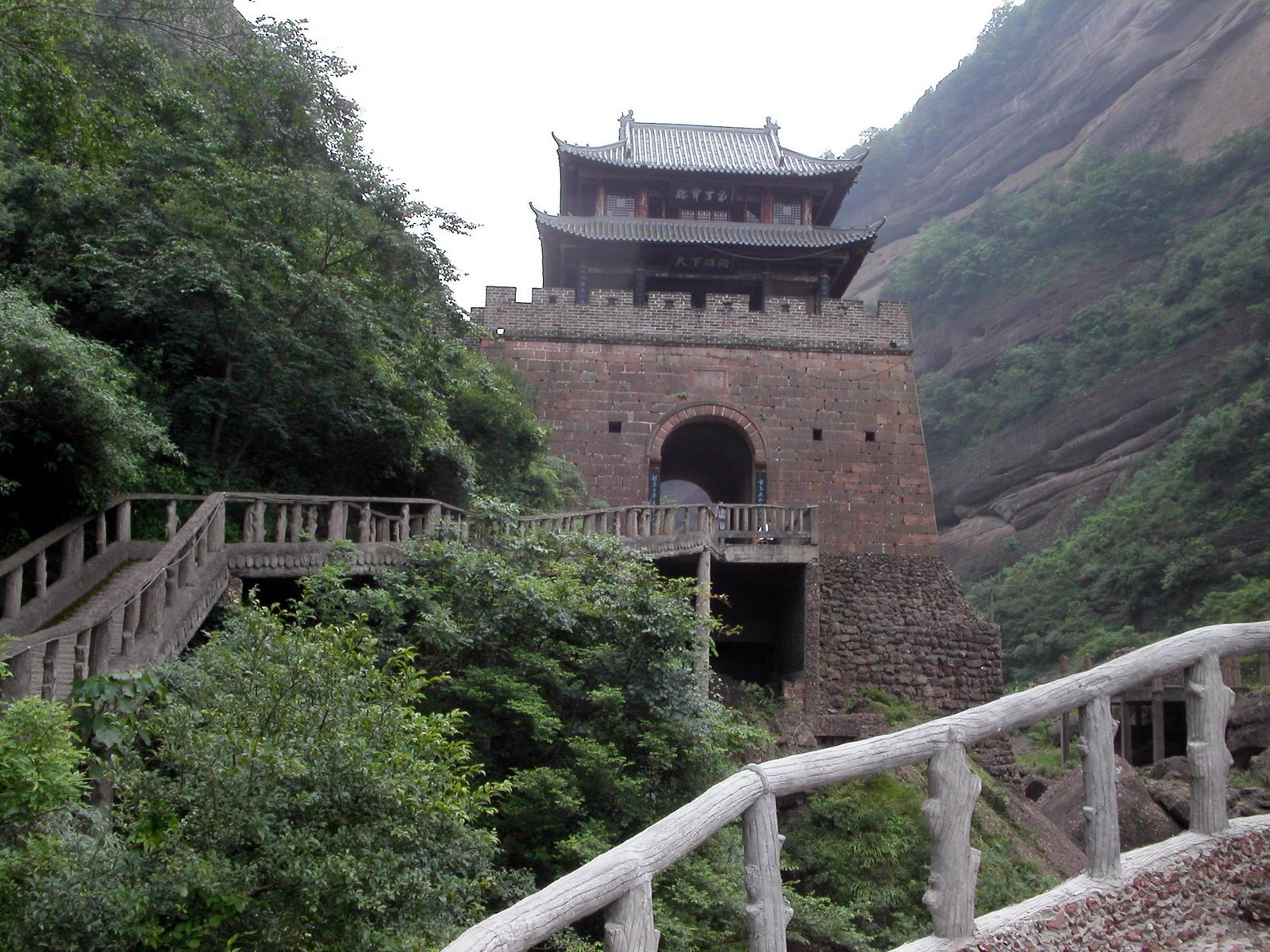
Jianmen Shudao National Park preserves a section of the ancient plank road that connected Sichuan to the north through the Qinling and Daba mountain ranges — one of the most strategically important routes in Chinese history and the subject of more classical poetry than perhaps any other piece of engineering. The road was built by carving notches into sheer cliff faces and suspending wooden planks from iron brackets above river gorges; sections of the reconstructed plank road still traverse the most dramatic passages of the Jialing River canyon.
The centrepiece of the park is Jianmen Pass, a narrow defile between two sheer limestone cliffs that controlled access between the Sichuan basin and the north for two thousand years. The Three Kingdoms period generals — Zhuge Liang and his successors — used and defended this pass repeatedly, and the site is inseparable from that history in Chinese cultural memory. The Thousand-Buddha Cliff, a wall of rock carvings from the Tang Dynasty, sits along the road between Mingyang and Guangyuan.
The park also contains the Li Bai Memorial Hall, dedicated to the Tang Dynasty poet who was born near this road and whose poem about the difficulty of the Sichuan road — "The road to Shu is harder than climbing to heaven" — is one of the most quoted lines in Chinese literature. Whether you find the memorial hall interesting depends considerably on how much classical Chinese poetry you have read, but the landscape that inspired the poem is worth the visit on its own terms.
Access is through the town of Jiange, which sits on the rail line between Chengdu and Xi'an and is therefore reachable from either direction. A tourist bus from Jiange station reaches the park in about thirty minutes. The park is significantly less visited than Jiuzhaigou or Huanglong and suits travellers with an interest in history and landscape rather than those seeking the colour-saturated scenery that defines northern Sichuan's more famous attractions.