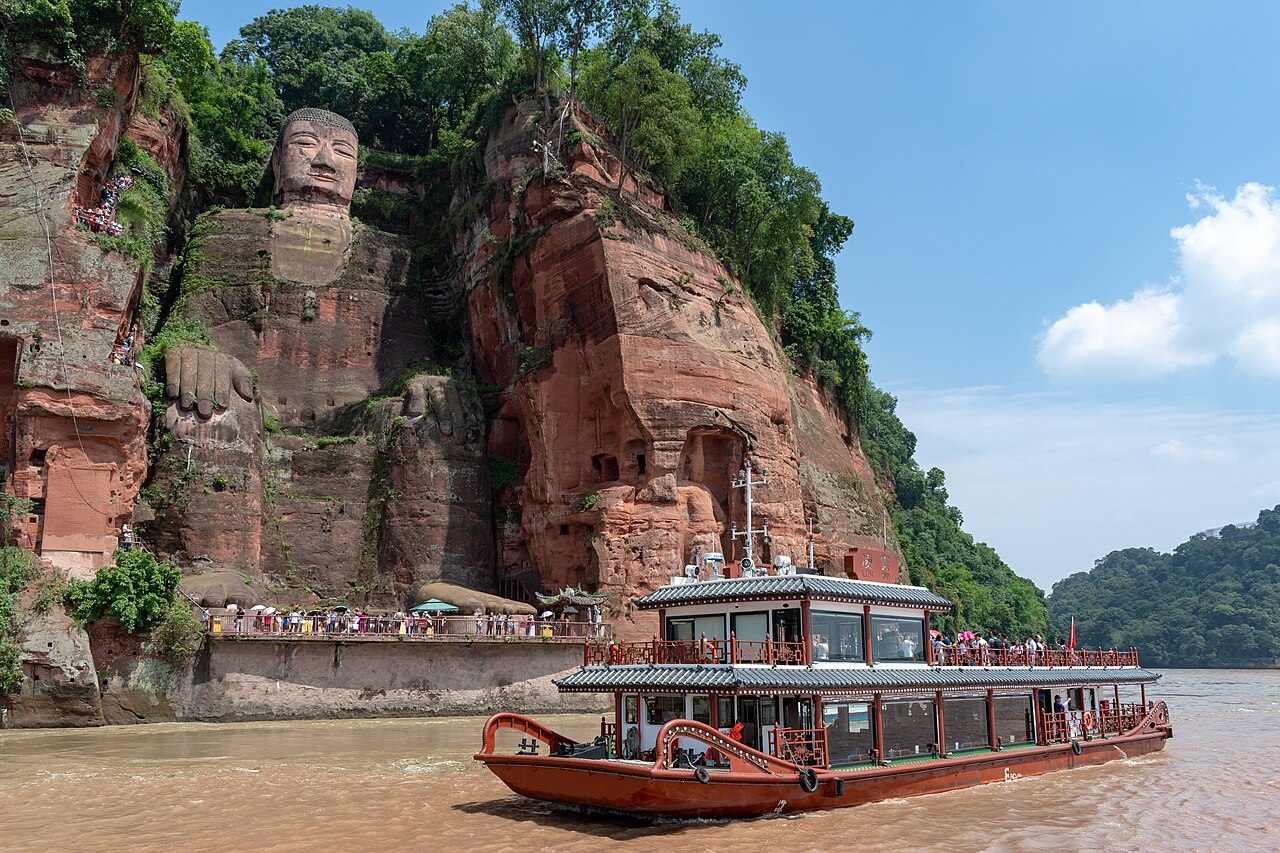
Leshan exists almost entirely in the shadow of one extraordinary thing: the Leshan Giant Buddha, a 71-metre Buddha carved into a cliff face where three rivers meet. It is the largest stone Buddha in the world, and it is genuinely astonishing — not in the way that photographs prepare you for, but in the way that standing at the statue's feet and realising his toenails are taller than you are can only be experienced in person.
The Giant Buddha (Dafo) was commissioned in 713 AD by a Tang Dynasty monk named Haitong, who believed the statue's presence would calm the treacherous currents at the confluence of the Minjiang, Qingyi, and Dadu rivers. Construction took 90 years. The drainage system carved into the rock, invisible to visitors below, has kept the statue intact through 13 centuries of floods and earthquakes. It was inscribed as a UNESCO World Heritage Site in 1996, jointly with the nearby Mount Emei.
The city itself is a pleasant, unhurried place — a welcome contrast to Chengdu, two hours north by bus. The riverside area below Lingyun Mountain has teahouses and restaurants where you can recover from the long staircase descent beside the Buddha's feet. Leshan's Sichuan food is straightforward and good — this is the heartland of mapo tofu and twice-cooked pork country.
You can approach the statue from two sides: walk down the cliffside staircase on Lingyun Mountain for the ground-level view, or take a river boat from the docks below for the full frontal perspective. Both are worth doing. Across the bridge, Wuyou Temple is usually included in the same ticket and adds another excellent half-day. The staircase queues can be very long during Chinese public holidays — if you have a choice, come on a weekday.