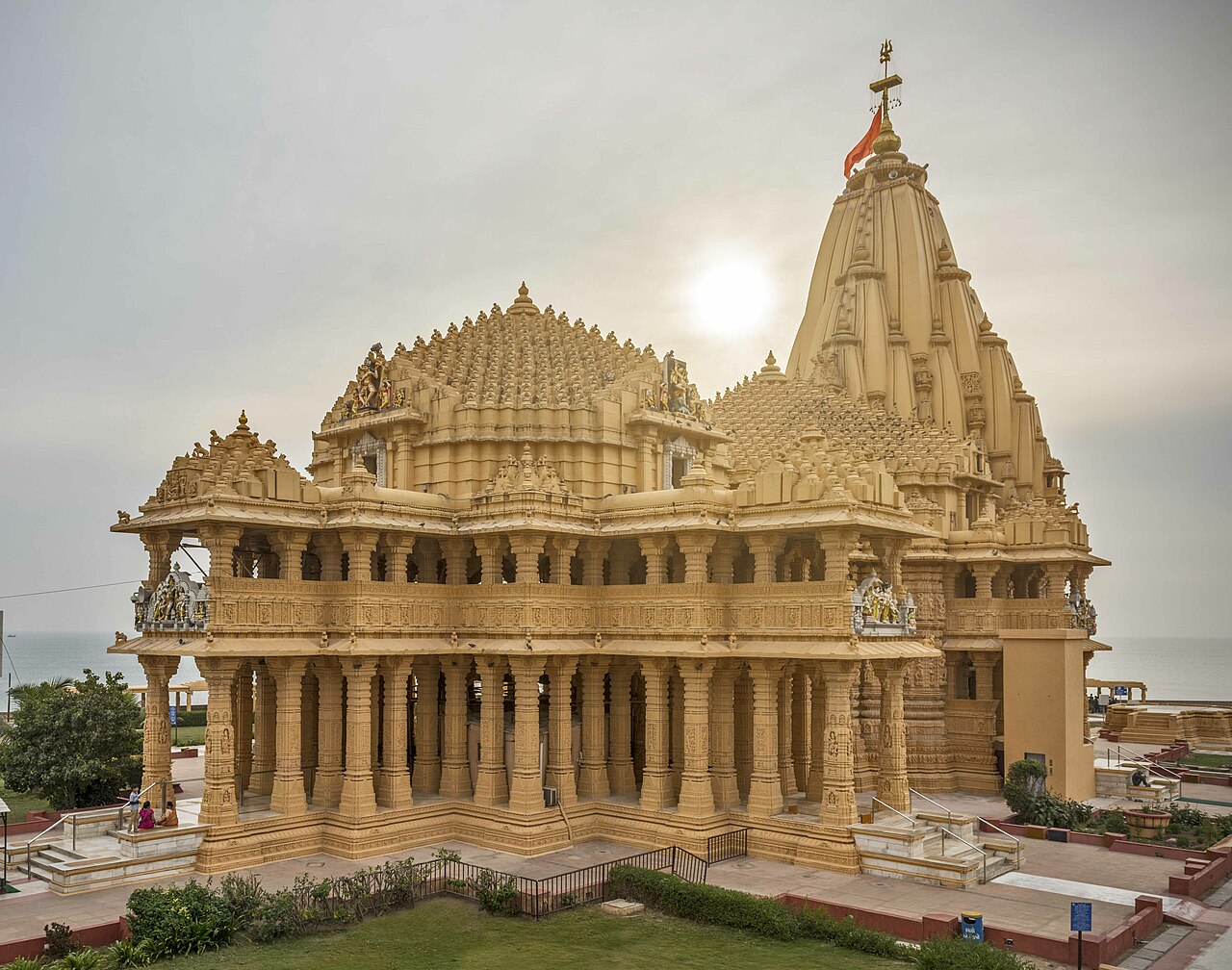
Arabian Sea pilgrimage town centred on Somnath Temple, one of Shiva's twelve jyotirlingas.
Somnath is one of India's most sacred pilgrimage sites, home to the Somnath Temple, one of the twelve jyotirlingas (shrines of Shiva). The present temple, rebuilt in 1951, stands dramatically on the Arabian Sea coast. The original temple was legendarily wealthy and was destroyed and rebuilt several times over the centuries — the story of each destruction and reconstruction is central to how the site is understood today. The Somnath Museum holds sculptural fragments from the medieval structures and puts the current building in context.
The area carries multiple layers of sacred significance: the nearby Bhalka Tirtha marks the spot where Krishna is said to have left his mortal body. The evening light-and-sound show at the temple tells the turbulent history against the backdrop of crashing waves.
The town is small and quiet outside pilgrimage season. The nearby harbour at Veraval, 7 km away, is where the fishing boats land their catch — a raw, working port that contrasts sharply with the refined pilgrimage atmosphere of Somnath itself.
Guide
Getting There
By Rail: The nearest railway station is at Veraval, 7 km away, with connections to Ahmedabad and other Gujarat cities. Local taxis and rickshaws are available from the station.
By Air: The nearest airport is at Keshod, 55 km away, with limited domestic connections.
By Road: Somnath is well connected by road via Veraval. Key distances: Junagadh 80 km, Porbandar 122 km, Bhavnagar 266 km, Ahmedabad 400 km, Mumbai 889 km. State transport buses run on most routes.
Guide
When to Go
Somnath is in coastal Gujarat and is generally hot. The most comfortable months are October to February, when temperatures are mild (20–28°C) and the sea breeze makes the coastal setting pleasant. This is also when pilgrimage traffic is highest, particularly around Mahashivaratri (February/March), when the temple hosts large gatherings.
March to May is hot and increasingly uncomfortable. The monsoon (June to September) brings heavy rain and the sea can be rough, but the town is quiet and the temple uncrowded. The surrounding landscape turns briefly green.
The Kartik Purnima fair, held on the full moon in November, attracts large numbers of pilgrims and is the most festive time to visit.